Melodic Dictation Practice: A Daily Plan to Play by Ear
You hear a melody once and know it matters.
Maybe it’s the hook from a song in your headphones. Maybe it’s a line you just sang into your phone before you forget it. Maybe you’re sitting at the piano or with your guitar, hunting for notes by trial and error and hoping your fingers land on something close. That moment is where a lot of musicians get stuck. They don’t lack passion. They lack a repeatable way to turn sound into action.
That’s where melodic dictation practice becomes useful. Not as an exam exercise. Not as a theory-class ritual. As a practical ear training skill that helps you play by ear, learn songs faster, improvise with more confidence, and stop relying on guesses.
A lot of public advice still treats melodic dictation like a school-only topic. It rarely answers the actual question self-taught musicians ask: how do you make this a daily, game-like habit instead of an occasional struggle tied to tests or worksheets, a gap noted in this discussion of melodic dictation outside formal study. The good news is that ear training isn’t reserved for people with perfect pitch. It’s trainable. You build it the same way you build timing, technique, and coordination. You practice small pieces often enough that your ear starts recognizing them automatically.
If you can give this skill 10 minutes a day, you can make real progress. You don’t need to hear full melodies instantly. You need a clear path from “I hear a blur” to “I can track the shape, find the notes, and play it back.”
Table of Contents
- Tired of Guessing? Turn What You Hear Into Music You Play
- The Building Blocks of Hearing Melodies
- Your First 10-Minute Melodic Dictation Workout
- A Daily Practice Plan to Hear Full Melodies
- How to Correct Your Most Common Dictation Errors
- The Real-World Payoff of a Trained Ear
Tired of Guessing? Turn What You Hear Into Music You Play
Most musicians who want to play by ear don’t want to become better guessers. They want to hear more clearly. That’s a big difference.
Guessing feels random. Ear training feels slow at first, then starts to click. You stop grabbing notes until one works. You begin to notice shape, direction, tension, release, and familiar patterns. That’s the primary point of melodic dictation practice. It teaches your ear to organize sound.
This skill isn’t talent-only
A lot of players assume they’re missing some inborn gift. They hear someone pick out a melody quickly and think, “I just don’t have that.” In reality, experienced musicians usually aren’t hearing magic. They’re hearing structure.
They notice things like:
- Which note feels like home
- Whether the line moves up, down, or repeats
- Whether the melody steps or jumps
- Which fragments sound familiar enough to sing back
That’s trainable. It also has very little to do with having perfect pitch. Perfect pitch gets talked about because it sounds impressive. But for most real musical situations, what matters more is learning to hear relationships between notes and respond on your instrument.
You don’t need to hear the name of every note instantly. You need to hear how one note connects to the next.
Why habit matters more than intensity
One long session can leave you tired and frustrated. A short daily session gives your ear a recurring signal: this matters, listen for this again tomorrow.
That’s why melodic dictation practice works best when it becomes a routine instead of a heroic effort. If you make it small enough to repeat, it starts feeling less like homework and more like a daily power-up. The result isn’t just better transcription. You start noticing melodies in songs more quickly, singing them more accurately, and finding them on your instrument with less delay.
The Building Blocks of Hearing Melodies
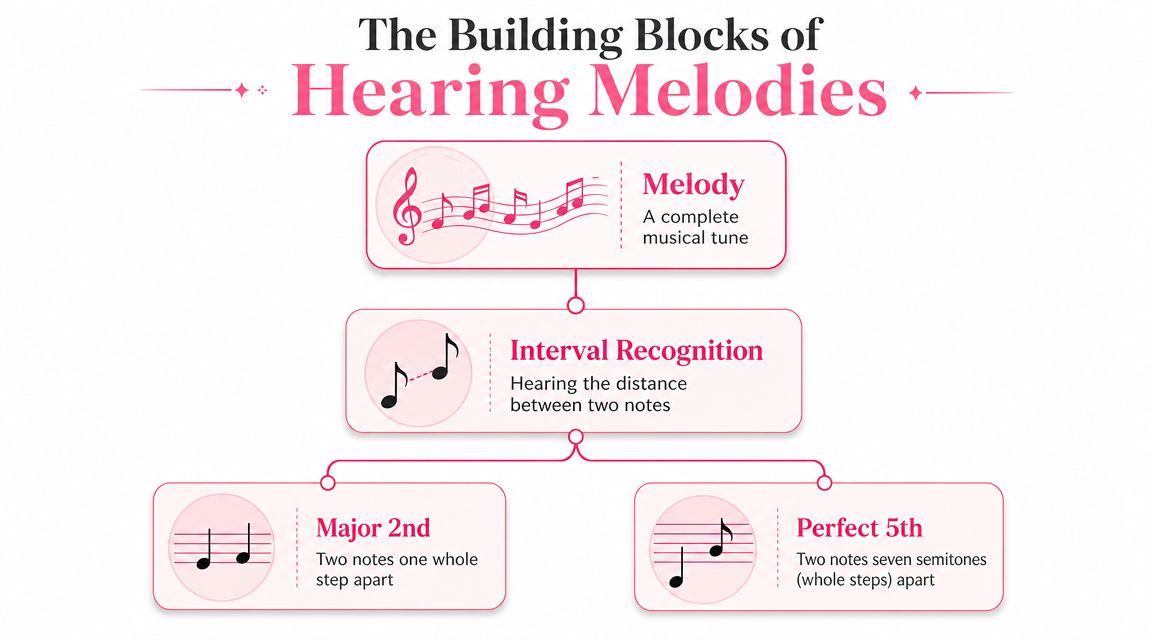
A melody can feel like one big moving object. To a trained ear, it’s made of smaller pieces.
The most important of those pieces is the interval. An interval is the distance from one note to the next. If your ear can recognize that movement, melodies stop sounding like random chains of notes and start sounding like connected events.
Why intervals come first
A controlled study found that interval identification explained 28.9% of the variance in melodic dictation scores even after controlling for musical-experience variables, which makes interval work a strong starting point for anyone building this skill through research on interval identification and melodic dictation.
That matters because beginners often try to jump straight into full phrases. Then they get overwhelmed and assume they’re bad at ear training. Usually, they just skipped the foundation.
If you want a practical place to start, spend time with interval ear training exercises and examples. Learn how a step feels different from a leap. Learn how a small rise feels different from a larger jump. Once those sounds become familiar, melodic dictation gets much less foggy.
What your ear is actually tracking
When you listen to a melody, your ear isn’t only asking, “What note was that?” It’s also asking:
| What you hear | What it tells you |
|---|---|
| A note repeats | The line may be stable or rhythmic rather than moving melodically |
| A small move upward | The melody may be stepping through the key |
| A bigger leap | The line may be outlining a chord or a strong accent |
| A return to an earlier note | There may be a pattern worth remembering |
This is why strong ear training looks less like blind guessing and more like pattern recognition.
Practical rule: If a full melody feels too hard, the melody isn’t the problem. The chunk you’re trying to hear is too large.
A good first win is hearing just two notes correctly. Then three. Then a short fragment you can sing back without panic. That’s how musicians build the ability to play by ear in practical settings.
Your First 10-Minute Melodic Dictation Workout
If you’re new to this, don’t start with full songs. Start with tiny melodies you can hold in your mind.
Research in music education has long shown that melody difficulty is shaped by factors like repetition, note direction, conjunct or disjunct motion, and degree of disjunctiveness, summarized in this work on melodic dictation difficulty and sequencing. That’s why beginner exercises start with repeated notes, simple contour, and small motion. Your ear needs stable ground before it can handle longer phrases.

A simple daily routine
Try this every day for 10 minutes.
-
Minute 1 to settle the key
Play a simple home note on your instrument. Sing it. Then sing up and back within the scale if you can. The goal isn’t theory accuracy. It’s getting your ear anchored. -
Minutes 2 to 4 for contour only
Listen to very short patterns of two or three notes. Don’t name notes yet. Just answer: did it go up, down, or stay the same? -
Minutes 5 to 7 for repeats and steps
Use easy fragments with repeated notes and small motion. Try to sing them back first. Then find them on your instrument. -
Minutes 8 to 10 for mini transcription
Write or record the pattern in a simple form. You can use note names, scale degrees, finger numbers, or even arrows at first. The point is to translate hearing into action.
If you want extra help turning this into actual transcription, this guide to how to transcribe music by ear gives a useful companion workflow.
What beginners usually get wrong
Many players think they need to identify every note immediately. That’s too much load at once.
Start with a smaller checklist:
- Hear the shape first. Is the line climbing, falling, or circling around one spot?
- Catch repeats next. Repeated notes are easier to confirm than moving ones.
- Notice jumps last. A leap stands out more once you already know the general contour.
Here’s a simple example.
If you hear three notes and the second sounds the same as the first, your first task isn’t “Which three notes were those?” Your first task is “I heard a repeat, then motion.” That single observation narrows the options and reduces panic.
Most early progress comes from hearing fewer things more clearly, not from trying to hear everything at once.
A beginner workout should feel almost too easy. That’s good. Easy enough gets repeated. Repeated enough becomes automatic.
A Daily Practice Plan to Hear Full Melodies
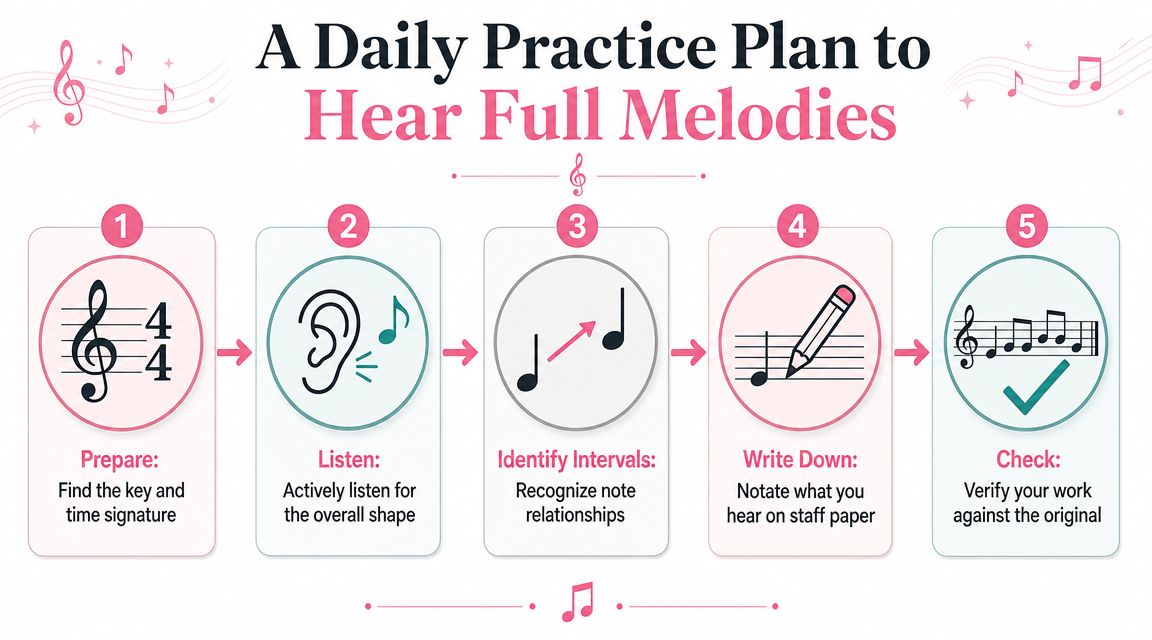
Once short fragments feel manageable, use the same repeatable process every time. Good melodic dictation practice isn’t about starting from zero on each attempt. It’s about using the same listening loop until your ear starts doing parts of it on its own.
A common teaching approach uses five steps: Prepare, Perceive, Process, Perform, and Proof, as described in this five-step melodic dictation method from an aural-skills course.
The five-part loop
Use this on every exercise, whether the melody is easy or difficult.
Prepare
Find the tonal center before chasing notes. Play or sing the home note. If you’re using an instrument, let your fingers rest there for a moment. This keeps your ear from drifting.
Perceive
On the first listen, don’t transcribe. Listen for the broad outline. Is the phrase smooth or jumpy? Does it sound balanced or surprising? Is there a repeated chunk?
Process
On the next listen, zoom in. Identify landmarks such as the highest note, the lowest note, obvious repeats, and any leap that stands out. Interval thinking proves beneficial here.
Perform
Now write it down or play it back. Keep it rough if needed. You’re building connection, not producing a perfect manuscript on the first pass.
Proof
Sing or play your answer and compare it to the original. That final check matters. It turns passive listening into active correction.
A quick demonstration can help you hear what this process looks like in action:

How to scale the same method
The method stays the same as you improve. Only the material changes.
Beginner level
Use short phrases in a clear key and simple meter. Limit yourself to stepwise motion and occasional repeats.
Good exercise ideas:
- Sing then find a three-note pattern on your instrument
- Write arrows first before writing note names
- Pause often so your ear doesn’t overload
Intermediate level
Move to longer phrases with a few leaps and less predictable rhythm. Start hearing little motifs instead of isolated notes.
At this stage, many musicians benefit from a tool that gives quick repetition and immediate correction. Trill: Ear Training Daily is one example of a daily ear training app built around short sessions, interval and note recognition, and structured practice that supports play-by-ear development.
Small feedback loops matter. If you hear it, test it, and correct it quickly, your ear learns faster than it does from occasional long sessions.
Advanced level
Work with phrases that change direction more often, contain larger leaps, or feel less familiar on first hearing. The challenge now isn’t just identifying notes. It’s staying calm while the melody gets denser.
Try practice tasks like these:
| Level | Focus | Sample task |
|---|---|---|
| Beginner | Contour and repeats | Transcribe a short phrase using arrows, then confirm on your instrument |
| Intermediate | Patterns and interval landmarks | Hear a phrase twice, identify one repeated fragment, then fill in the rest |
| Advanced | Full phrase control | Hear a longer melody, notate it, then sing it back to check internal hearing |
The main shift is mental. Don’t ask, “Can I transcribe this whole melody?” Ask, “What can I hear for sure on this listen?” That question keeps you moving.
How to Correct Your Most Common Dictation Errors
Everyone makes the same few mistakes at the start. That’s useful, because it means the fixes are also predictable.
Teachers working with GCSE and A-Level students often recommend giving 3 or 4 examples at a time rather than only one, because repeated low-stakes attempts improve confidence and accuracy, as described in this melodic dictation teaching advice for exam practice. That approach works just as well for self-taught players. You learn faster when each try feels like another rep, not a final verdict.
When the key center keeps slipping
You hear the first note, then everything floats away. By the end, nothing feels anchored.
Fix it by returning to the home note before and after each attempt. Hum it. Play it. Keep reminding your ear where “home” is so the melody has context.
When the rhythm is right but the notes are wrong
This usually happens when you latch onto timing before pitch relationships are stable. Your hand writes a shape, but your ear didn’t really confirm the distances.
Try this instead:
- Separate jobs. First listen for shape only. Second listen for rhythm. Third listen for note relationships.
- Sing before writing. If you can’t sing the fragment back, you probably don’t own it yet.
- Mark signposts. Find the highest note, lowest note, and any repeat before filling gaps.
When one interval keeps fooling you
A third may sound like a fourth to you. A step may blur into a small leap. That’s normal.
Use a short correction loop:
- Hear the troublesome interval alone.
- Sing it back several times.
- Compare it against a nearby interval that confuses you.
- Put it back into a tiny melodic fragment.
Mistakes in ear training are usually classification mistakes, not proof that your ear is weak.
If you work in small sets of examples, you give your brain multiple chances to notice the same pattern. That’s a much better teacher than frustration.
The Real-World Payoff of a Trained Ear
Melodic dictation practice matters because it changes what you can do away from the exercise.
When your ear gets stronger, songs stop feeling locked behind sheet music or tabs. You hear a vocal line and find it faster. You improvise with more intention because you can hear where your phrase wants to go. You write melodies with less trial and error because your inner hearing gets clearer. You also get better at noticing what other musicians are doing in real time, which makes rehearsal, jamming, and arranging much easier.
This is the bigger picture behind learning ear training so you can play by ear. You’re not doing melodic dictation practice to become good at an isolated worksheet skill. You’re training the part of musicianship that lets hearing lead your hands.
You also don’t need perfect pitch for that freedom. Relative hearing, steady daily work, and honest repetition take you a long way. If you stay with the process, there comes a point where melodies stop sounding like mysterious objects and start sounding playable.
That’s the moment many musicians have been chasing for years.
Your next step doesn’t need to be dramatic. Sit down today. Give your ear 10 focused minutes. Hear one short pattern. Sing it. Find it. Write a rough version. Repeat tomorrow.
If you want a structured way to make that daily habit stick, Trill: Ear Training Daily offers short ear training sessions designed to help musicians practice consistently, recognize intervals and notes, and build stronger play-by-ear skills over time.