Neapolitan 6th Chord: A Guide to Hearing and Using It
You’re probably here because you’ve heard this chord before, even if you didn’t know its name.
It shows up in emotional piano music, tense film cues, dark ballads, and those moments where the harmony suddenly turns deeper just before a release. You hear it and think, “What was that?” It feels like the floor shifts for a second, then the music lands somewhere powerful.
That sound is often the neapolitan 6th chord.
If music theory has ever felt like memorizing labels after the fact, this topic can feel intimidating. However, the objective isn’t to recite a definition. The goal is to hear the sound, recognize when it’s happening, and know how to use it when you play by ear, improvise, or write music.
Ear training makes that possible. It isn’t a gift some people are born with. It’s a trainable skill you build by listening on purpose, a little every day.
Table of Contents
- That Dramatic Chord You Hear in Emotional Music
- What Exactly Is a Neapolitan Sixth Chord
- How to Train Your Ear to Hear the Neapolitan Sound
- Why This Chord Sounds So Good Voice Leading Explained
- Using the Neapolitan Chord in Classical Pop and Jazz
- Your Next Step Toward True Musical Freedom
That Dramatic Chord You Hear in Emotional Music
A student once played a slow minor progression for me, stopped on one chord, and said, “That one sounds sad, but also expensive.” That’s a funny description, but musically, it’s not bad.
The neapolitan 6th chord often gives exactly that effect. It sounds darker than a normal pre-dominant chord, but also more vivid. It doesn’t just fill space. It leans forward and points hard toward what comes next.
If you’ve spent time learning how chords shape musical emotion, this is one of the clearest examples. One chord change can suddenly make the whole phrase feel more human, more fragile, or more dramatic.
Historically, this sound isn’t new. The neapolitan sixth chord emerged by the end of the 17th century, with uses by composers like Corelli and Purcell, and despite the name, its ties to the Neapolitan School are shallow because it also appeared outside Italy and spread widely through European music in the 18th and 19th centuries, as noted in the history of the Neapolitan chord.
A moment of intense, dark beauty right before a powerful release.
That’s the sound to keep in your head as you read.
This chord is often first encountered on paper. One sees symbols, inversions, and accidentals. Then one tries to spot it in a score. But if you want to play by ear, that order is backward. First hear the feeling. Then connect it to the shape. Then practice recognizing it in real music.
That’s where the aha moment happens. The neapolitan 6th chord stops being a theory term and starts becoming a sound you can catch in the wild.
What Exactly Is a Neapolitan Sixth Chord
The name sounds harder than the thing itself.
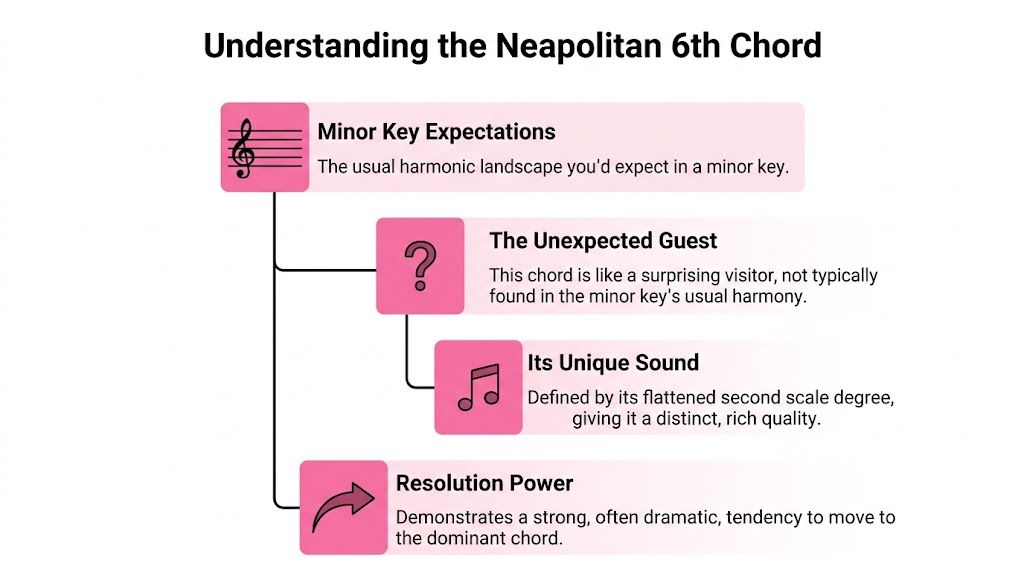
In plain language, a neapolitan 6th chord is a major chord built on a lowered second note of the scale, and it’s usually placed in first inversion. In minor keys, that creates a color that sounds immediately different from the usual harmony around it.
The simple build
Take C minor.
The second note of the scale is D. Lower it by a half step and you get D♭. Now build a major chord on D♭:
- D♭
- F
- A♭
That gives you the basic Neapolitan chord.
Now put it in first inversion, so F is in the bass instead of D♭. Now you have the usual form people mean when they say N6.
So in C minor:
Neapolitan 6th chord = D♭ major in first inversion = F A♭ D♭
Why first inversion? Because that bass note makes the chord move more smoothly toward the dominant chord. It feels less blocky and more directed.
One useful historical detail is that the chord appears in minor keys in about 85% of its occurrences in 18th-century music, partly because the diatonic VI chord in minor prepares it smoothly, according to Music Theory Academy’s explanation of the Neapolitan 6th.
A quick key table
Here’s the pattern in a few common minor keys:
| Minor Key | Neapolitan Chord (Root Position) | N6 Chord (First Inversion) |
|---|---|---|
| C minor | D♭ F A♭ | F A♭ D♭ |
| A minor | B♭ D F | D F B♭ |
| E minor | F C A | A C F |
| D minor | E♭ G B♭ | G B♭ E♭ |
| G minor | A♭ C E♭ | C E♭ A♭ |
You don’t need to memorize every key at once. Learn the pattern:
- Find scale degree 2.
- Lower it by a half step.
- Build a major triad.
- Put the third of that chord in the bass.
That’s it.
The confusion usually comes from the word sixth. Many learners think it means “add a sixth to the chord.” It doesn’t. Here, it refers to the inversion, not an added tone.
If you remember one idea, remember this: the neapolitan 6th chord is the sound of a major chord arriving from an unexpected place in a minor key, then pushing toward a strong resolution.
How to Train Your Ear to Hear the Neapolitan Sound
Most musicians don’t struggle because the chord is too advanced. They struggle because they’ve only seen it in notation and haven’t practiced hearing it enough in context.
A common problem on music theory forums is telling the Neapolitan 6th apart from other chromatic chords by ear, especially chords like V7/IV, as discussed in Open Music Theory’s treatment of ♭II6.
If you want better ear training for chords, don’t ask, “Can I name this chord from one isolated snapshot?” Start with a better question: What does this chord do?
The neapolitan 6th chord usually feels like a setup. It appears before a dominant harmony and makes that dominant hit harder. So your ear shouldn’t only listen for the chord itself. Your ear should listen for the move.
What to listen for first
Don’t start by trying to hear every note.
Start with these three clues:
-
A darker surprise in a minor key
The chord sounds outside the key, but not random. It has a rich, shadowed color. -
A pre-resolution feeling
It rarely sounds settled. It sounds like something important is about to happen. -
A half-step pull
The lowered second scale degree wants to fall to the leading tone. That motion is one of the most recognizable parts of the sound.
Practical rule: Hear the Neapolitan as a dramatic approach chord, not as a static chord to identify in isolation.
That one shift in thinking helps a lot.
Try this on piano in C minor. Play:
- C minor
- F A♭ D♭
- G major or G7
- C minor
Don’t analyze yet. Just listen. The second chord should sound like a sudden tightening. The third chord feels earned because of it.
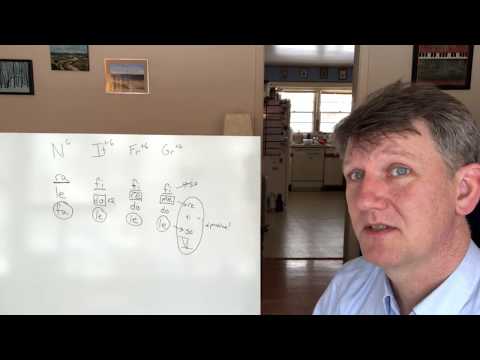
A short demonstration helps once you’ve tried it yourself:
A daily ear training routine
You don’t need long practice sessions. You need focused repetition.
Try this 10 minutes a day routine:
-
Minute 1 to 2. Sing scale degree 2 and lowered 2
In a minor key, sing the normal second note, then lower it. Feel how the lowered version already sounds more tense. -
Minute 3 to 4. Compare two progressions
Play i iv V i and then i N6 V i. The function is similar, but the neapolitan 6th chord has more color. -
Minute 5 to 6. Isolate the bass
Hear the bass note of N6 and then the bass of V. That bass motion helps your ear catch the chord earlier. -
Minute 7 to 8. Sing the upper pull
Sing the lowered second scale degree resolving down to the leading tone. Don’t worry if your intonation is rough at first. This is how pitch memory grows. -
Minute 9 to 10. Test yourself without looking
Record or loop short progressions and ask: “Was that iv or N6?” That’s real-world chord recognition.
If you’re working on perfect pitch, this still matters. Relative hearing is what lets you identify harmonic function inside real music. And if you want to play by ear, this matters even more, because songs don’t pause and label their chromatic chords for you.
The key is consistency. Short daily listening beats occasional marathon study every time.
Why This Chord Sounds So Good Voice Leading Explained
The neapolitan 6th chord works because the notes don’t just sit there. They move in a way your ear likes.
That smooth note-to-note movement is called voice leading. You don’t need advanced theory language to hear it. You just need to notice where each note wants to go.
If you’re still strengthening your hearing of note distance and motion, training with interval recognition and ear training makes this much easier. Good ears don’t just hear chords as blobs. They hear lines moving.
The motion matters more than the label
In C minor, the usual N6 is F A♭ D♭.
When it moves to G B D, several satisfying things happen at once:
| Note in N6 | Typical move | Effect |
|---|---|---|
| F | moves up to G | bass rises with purpose |
| A♭ | moves down to G or toward dominant harmony | upper tension relaxes |
| D♭ | moves down to B | strongest chromatic pull |
That last one matters most. The lowered second degree moving to the leading tone creates a tight, expressive squeeze. Your ear hears that and immediately expects resolution.
The neapolitan 6th chord sounds powerful because each note seems to know where it’s going.
This is why the chord often feels more emotional than a plain iv chord. It isn’t only “more chromatic.” It’s more directional.
How to hear the pull in real time
When students miss this chord, they often focus on the wrong moment. They listen to the chord attack, but not the release that follows.
Try this instead:
- Play N6 to V several times.
- Keep the top note loud enough to hear the half-step descent clearly.
- Then play iv to V and compare the feeling.
- Ask which one sounds more like a sudden dramatic inhale before the cadence.
The neapolitan 6th chord also has a strong subdominant role. It often substitutes for pre-dominant chords and leads naturally into the dominant through that characteristic voice leading. That’s why it feels both unusual and logical at the same time.
For your ear, that’s the important part. You’re not learning a museum fact. You’re learning a pattern of motion you can recognize in Beethoven, in film music, and in your own progressions.
Using the Neapolitan Chord in Classical Pop and Jazz
Some theory topics stay trapped in the classroom. This one doesn’t.
The neapolitan 6th chord belongs in classical harmony, but the sound itself is far too good to stay there. Once you start listening for it as a color before a dominant area, you’ll hear why musicians keep reaching for it in different styles.
In classical music
This chord became a staple of dramatic harmony after its early use in Baroque music. Later composers pushed its expressive power even further. By the 19th century, Chopin even used it in root position rather than only first inversion, expanding its dramatic range in Romantic writing, as described in the earlier historical source.
For players, the practical lesson is simple. If you want a cadence in a minor key to sound heavier, more tragic, or more cinematic, this chord does the job fast.
A pianist can try this in C minor:
- Left hand: F in the bass
- Right hand: A♭ D♭ F
- Then move to G or G7
- Resolve to C minor
A guitarist can think less in terms of Roman numerals and more in terms of shape and function. In a minor-key progression, insert a major chord built on the lowered second degree just before the dominant area. Listen for the emotional lift.
In pop and rock
Though many people think of it as a classical sound, analysis has pointed to Neapolitan usage in modern tracks such as Billie Eilish’s “Everything I Wanted,” and discussion around the chord also notes a spike in hyperpop interest, which shows its reach beyond older repertoire in this genre-focused video discussion.
That makes sense by ear. Pop producers and songwriters often want one harmonic moment that feels moodier than the rest of the progression without sounding random. The neapolitan move does that well.
If you write songs, try this test. Take a minor progression you already use and replace your usual pre-chorus pre-dominant chord with N6 before the dominant or dominant-like chord. Don’t ask whether it’s “allowed.” Ask whether it makes the next chord hit harder.
In jazz and songwriting
Jazz players may hear the chord less as a textbook classical object and more as a colorful approach sonority. In practice, it can feel related to altered dominant motion or to the kind of side-step harmony players already know by ear.
Here are three ways to experiment:
-
Minor cadence color
In a minor ii V i setting, try inserting the Neapolitan color before the dominant. -
Pedal point writing
Hold one bass note and shift upper voices into an N6 shape for extra tension. -
Melody first approach
Write a melody using the lowered second scale degree, then harmonize that moment with the chord beneath it.
If your ear likes the sound before your theory brain has named it, you’re already learning the right way.
That’s true for classical players, producers, singers, and guitarists who want to stop relying on tabs. The point isn’t to force the chord everywhere. The point is to recognize one more emotional option when your ear wants more than the default choices.
Your Next Step Toward True Musical Freedom
The neapolitan 6th chord matters because it teaches a bigger lesson.
Music becomes easier when you stop treating harmony as a pile of rules and start hearing it as motion, tension, and release. Once you can hear that dark pre-dominant color and the pull that follows, you’re not guessing anymore. You’re recognizing function in real time.
That changes a lot. You can transcribe faster. You can improvise with more intention. You can hear why one progression sounds ordinary and another sounds unforgettable.
And you don’t get there by reading one article and moving on. You get there with consistent, daily ear training. 10 minutes a day is enough to build real listening skill if you do it regularly.
If you want to play by ear, recognize chords faster, and build the kind of hearing people often mistake for natural talent, keep going. Learn the sound. Sing it. Compare it. Use it in songs. Then repeat tomorrow.
That’s how musical freedom works. Not through guessing. Through hearing.
If you want a simple daily system for building chord recognition, interval hearing, and the skills behind play by ear and perfect pitch, try Trill: Ear Training Daily. It’s built for short, focused practice that helps you stop guessing and start hearing music clearly.