Simple Duple Meter: Hear and Feel the 2/4 Beat
You’re probably already hearing simple duple meter, even if you don’t call it that.
It shows up when a rhythm makes you want to step left-right, left-right without thinking. It’s the beat behind a lot of marches, plenty of folk music, and any groove that feels direct, steady, and easy to lock into. If you’re learning ear training so you can play by ear, this matters more than it might seem.
Rhythm is one of the first things your ear grabs. Before you name chords, before you figure out the melody, you feel the pulse. When you can hear a two-beat pattern clearly, you stop guessing where the music lands. You start predicting it.
Table of Contents
- Introduction What Is Simple Duple Meter
- What Simple Duple Meter Actually Feels Like
- How to Count It and Not Get Lost
- Famous Songs That Use Simple Duple Meter
- Your Daily Ear Training Workout for Rhythm
- Conclusion From Counting to Musical Freedom
Introduction What Is Simple Duple Meter
Simple duple meter means there are two beats per measure, and each beat splits into two equal parts. It’s most commonly written as 2/4 time, where the quarter note gets one beat, as explained in this simple duple definition from Study.com.
That sounds theoretical, but the musical feeling is much easier than the words. You hear one stronger beat, then one lighter beat. Then it repeats. Strong-weak. Strong-weak.
If you clap it, it feels natural fast. Clap a little heavier on beat one, then lighter on beat two. You’re already doing the core thing your ear needs to notice.
Why this matters for ear training
When musicians struggle to play by ear, it’s often not because they lack talent. It’s because they haven’t trained themselves to notice patterns consistently. Meter is one of those patterns.
A clear two-beat pulse helps you place notes, feel phrases, and hear where chords change. If you’re working on aural training exercises for musicians, learning to hear simple duple meter gives you a reliable rhythmic frame before you even think about harmony.
Practical rule: Don’t treat meter like a math problem. Treat it like a physical sensation you can clap, walk, and sing.
The plain-English version
If 4/4 often feels like a bigger four-count and 3/4 feels like a waltz, simple duple meter feels like a compact two-step. That’s why it’s so useful for beginners. The pattern is short, repeatable, and easy to hear once you know what to listen for.
What Simple Duple Meter Actually Feels Like
Forget notation for a minute. The fastest way to understand simple duple meter is through your body.
Walk across the room and count your steps. ONE-two, ONE-two. Put a little weight on the first step each time. That’s the feel.
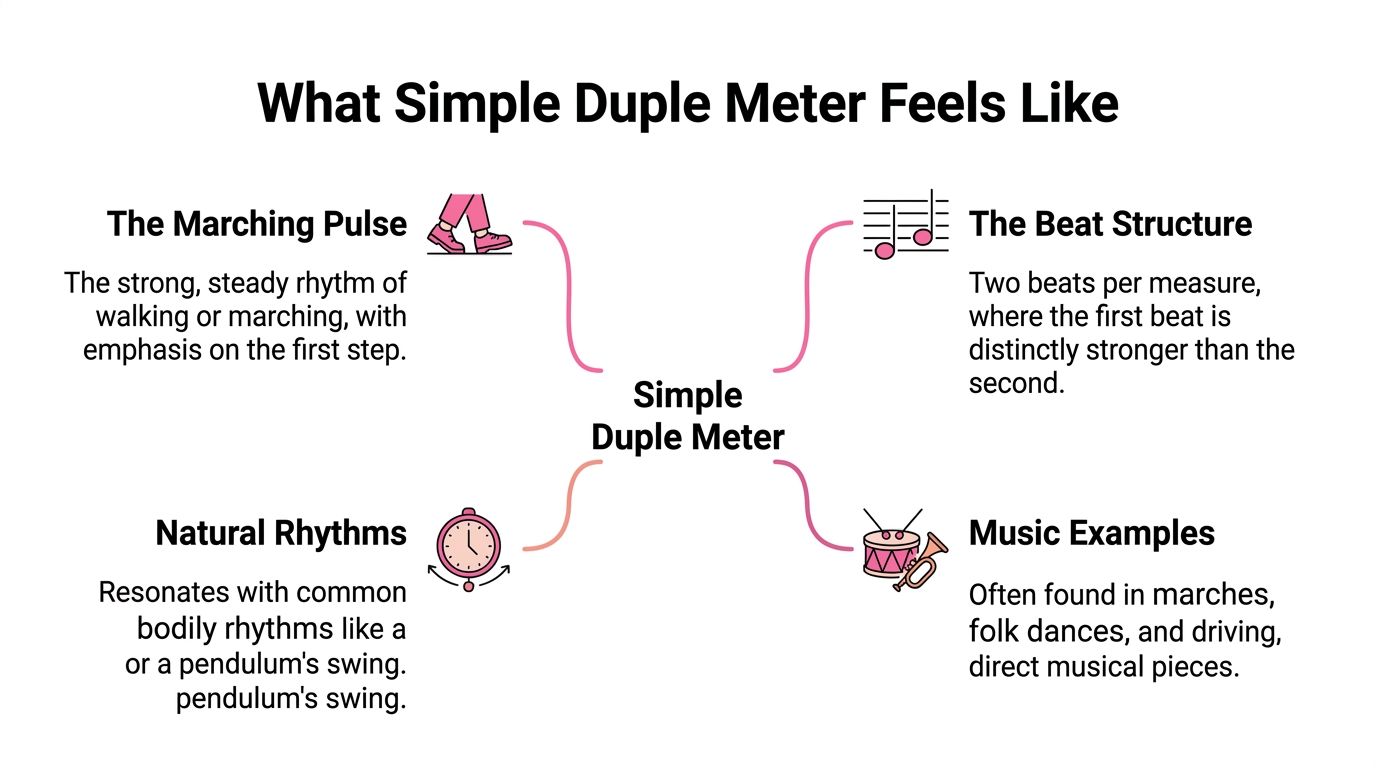
The strong-weak pattern
Simple duple meter doesn’t just give you two beats. It gives you a relationship between them.
Beat one feels settled, grounded, and slightly heavier. Beat two answers it. Not with the same force. With less weight. That contrast is what makes the meter audible.
If you’re trying to build perfect pitch or stronger rhythmic ear training, this matters because your ear learns accents before it learns labels. You don’t need to read the barline to feel where the bar starts.
If you can feel which beat wants to land harder, you’re already hearing meter.
Where people get confused
A lot of beginners hear “two beats” and think any repeated pulse counts as simple duple meter. That’s where things get messy.
Here’s a quick comparison:
| Feel | What it suggests | What your body usually does |
|---|---|---|
| ONE-two | Simple duple meter | March, step, clap evenly |
| ONE-two-three | Triple feel | Waltz, circular sway |
| ONE-a-la two-a-la | Compound duple feel | Bounce with a triplet lilt |
The confusion usually isn’t about the number on the page. It’s about the subdivision feel. Simple duple meter splits each beat into two. That creates a straighter, cleaner pulse.
Real-life ways to feel it
You can train this without an instrument.
- March to it: Walk and exaggerate the first step.
- Tap a table: Loud-soft, loud-soft.
- Say it out loud: “ONE-two, ONE-two.”
- Strum muted strings: Down-up, down-up while keeping the first beat stronger.
This is one of the most useful rhythm habits for anyone who wants to play by ear. Once your body recognizes the two-beat cycle, your ears stop floating around the groove.
How to Count It and Not Get Lost
Counting helps when your body feel isn’t stable yet. It gives your ear a simple map.
Start with the main pulse. Say ONE, two, ONE, two. Don’t rush to subdivisions yet. First make the difference between the two beats obvious.
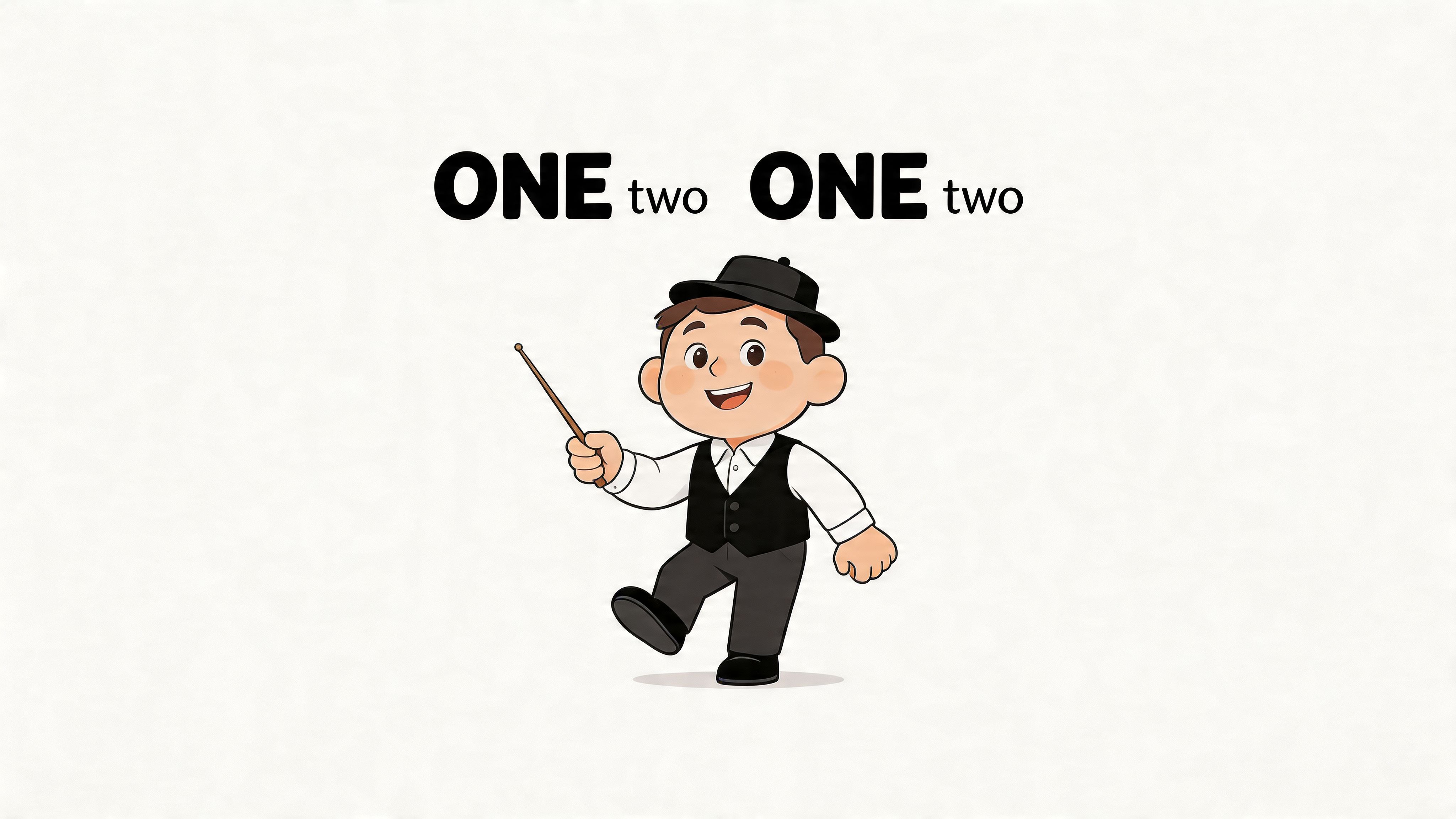
Add the space between the beats
Once the two main beats feel steady, split each beat in half. Count 1 & 2 &.
That little “and” is where your timing gets cleaner. It teaches you not just where the beat is, but what happens between beats. For ear training, that’s huge.
According to Open Music Theory’s explanation of simple meter and time signatures, recognizing simple duple meter through subdivision counting like “1 & 2 &” builds aural acuity for metric accents. The same source says trainees who reach 95% accuracy in clapping subdivisions at 100-140 BPM after 10 daily sessions correlate with 40% faster chord transcription in real-time playback.
A counting ladder that works
Try this in order:
-
Say the beats only
Count “ONE, two” while tapping your foot. -
Clap the beats
Keep beat one slightly stronger than beat two. -
Speak the subdivision
Count “1 & 2 &” evenly. -
Alternate voice and clap
Say the numbers, clap the “ands.” -
Transfer it to your instrument
Strum, pick, bow, or sing while keeping the count underneath.
If you want a steady click to practice with, use a musician’s metronome tool and keep the tempo comfortable enough that you can still feel the difference between the main beats and the subdivisions.
What usually knocks players off track
The beat isn’t usually lost because the rhythm is too hard. It’s lost because the listener stops hearing the smaller grid underneath the beat.
Common fix: If you drift, go back to saying “1 & 2 &” out loud. Quiet internal counting comes later.
That one habit helps with more than rhythm. It supports chord recognition too, because chords often change on predictable metric spots. When your timing is stable, harmonic changes become easier to hear.
Famous Songs That Use Simple Duple Meter
The best ear training isn’t abstract. It happens when you listen to real music and notice the pulse on purpose.
Start with a track or piece where the groove feels direct and compact. Don’t ask, “What is the time signature?” Ask, “Can I feel a repeating strong-weak cycle?”
The clearest classic example
John Philip Sousa’s “The Stars and Stripes Forever” is one of the clearest models of simple duple meter. It was composed in 1896 and later became the National March of the United States in 1987. The same verified source notes that over 70% of marches use 2/4, which tells you how closely this feel is tied to marching music.
Listen for the forward push. The rhythm doesn’t float. It steps.
How to listen instead of just naming songs
A song list only helps if you know what to do with it. Try this method:
- First pass: Tap only the main beat.
- Second pass: Make beat one slightly heavier.
- Third pass: Count underneath.
- Fourth pass: Notice where phrases begin. They often line up with that stronger first beat.
This is what turns theory into playing-by-ear skill. You’re teaching your brain to connect pulse, phrasing, and musical memory.
Songs can suggest the feel even when arrangement blurs it
In modern music, drums, bass, and vocal phrasing can make the pulse feel more layered. That can confuse beginners. A part may loop in a way that feels like a short two-beat cell even when other parts stretch across a larger phrase.
That’s why I like using obvious march examples first, then moving into groove-based songs later. Your ear needs a clean model before it can handle mixed signals.
A quick listening reset helps:
Don’t chase every instrument. Follow the pulse that makes your body want to step.
Here’s a performance to listen through with that in mind:

A short listening checklist
| Listen for | What it tells you |
|---|---|
| A repeating two-step pulse | You may be hearing simple duple meter |
| A clear strong first beat | The bar likely starts there |
| Even subdivision | The feel is probably simple, not compound |
| March-like drive | Strong clue toward 2/4 |
Once you can hear this in one piece, start hunting for it elsewhere. That’s how ear training grows. Not through memorizing rules, but through repeated recognition.
Your Daily Ear Training Workout for Rhythm
You don’t need a long practice block for this. You need a short routine you’ll repeat.
A lot of students get stuck on one specific problem. They can count when they see the notes, but they can’t reliably hear whether something feels like 2/4 or 6/8. That’s normal. According to Music Theory Academy’s discussion of simple and compound meter, 60-70% of novices misidentify simple duple and compound duple by ear without specific training.
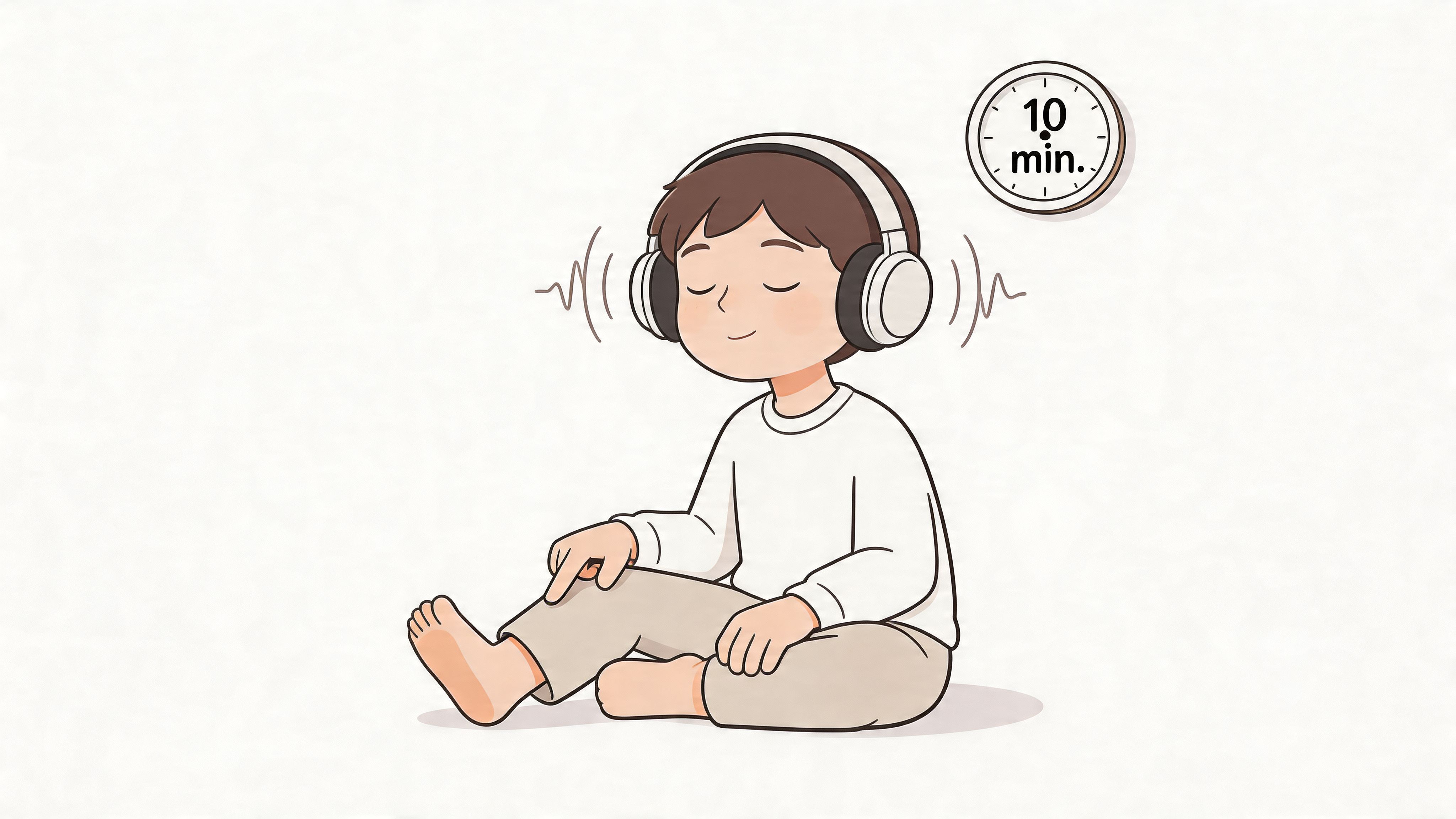
A 10-minute routine
Here’s a practical workout.
-
Minute 1 to 2
Clap a steady ONE-two pulse with no music. -
Minute 3 to 4
Count 1 & 2 & while keeping the clap steady. -
Minute 5 to 6
Listen to a march and tap only beat one. -
Minute 7 to 8
Switch to a piece with a lilting compound feel and compare the subdivision. -
Minute 9 to 10
Return to simple duple meter and say out loud why it feels different.
This works because comparison sharpens the ear. You’re not just learning one thing. You’re learning to separate two similar things.
A simple drill for the accent
Use this pattern:
- Round one: CLAP-rest, CLAP-rest
- Round two: CLAP-clap, CLAP-clap
- Round three: Clap the pulse, say “1 & 2 &”
- Round four: Keep clapping while singing one note over the top
That last step matters. Once you add a note or short melody, meter stops being an isolated exercise and starts becoming actual musicianship.
Listening cue: Simple duple meter feels straight and grounded. Compound duple feels more rolling and lilting.
Keep the habit easy to repeat
Don’t make rhythm practice so complicated that you avoid it. Keep one tool open, one exercise in mind, and one goal for the day.
If you want help building consistency, this article on why musicians should practice with a metronome is a good companion to the routine above. The point isn’t robotic timing. The point is training your ear to hear pulse clearly enough that you can use it in real music.
That’s where improvisation, chord recognition, and confident playing start to open up.
Conclusion From Counting to Musical Freedom
Simple duple meter seems small, but it enables a big part of musical freedom.
When you can hear a steady two-beat pattern and feel the strong-weak motion without overthinking it, you’re no longer reacting late to the music. You’re inside it. You can place phrases better, hear chord changes more clearly, and stay grounded when you play by ear.
That matters because simple duple meter isn’t rare. This overview of meter in Western notation notes that simple duple comprises 25-30% of meters found in canonical works. It’s a pattern your ears should know well.
Keep the practice plain. Clap it. Count it. Walk it. Hear it in recordings. Repeat it daily until your body recognizes it before your brain tries to explain it.
That’s how ear training works. Not as talent, but as repetition that turns sound into instinct.
If you want a daily system for building ear training, chord recognition, rhythm awareness, and the skills you need to play by ear, try Trill: Ear Training Daily. It’s built for short, focused practice so you can stop guessing and start hearing music more clearly.