Compound Duple Meter: An Ear Training Guide
You hear a song that seems to rock forward instead of march forward. It isn’t stiff. It isn’t square. It has that rolling, swaying feel that makes you want to move with it.
A lot of musicians get stuck right there.
They can tell the rhythm feels different, but they can’t name it, count it, or play it back by ear. So they guess. They count wrong. They put accents in the wrong place. And the whole groove slips away.
That’s where compound duple meter matters.
If you want stronger ear training, better rhythm recognition, and more confidence to play by ear, this is one of those concepts that changes how you listen. Not because it gives you more vocabulary on paper, but because it teaches your ear to hear pulse correctly. That skill is trainable. It isn’t reserved for people with “natural rhythm” or perfect pitch.
Table of Contents
- Why Some Songs Have That Irresistible Swing
- What Is Compound Duple Meter Really
- How to Hear Compound Duple Meter in Music
- Seeing the Rhythm on the Page
- Daily Drills to Master Compound Duple Meter
- From Theory to Musical Freedom
Why Some Songs Have That Irresistible Swing
Some songs feel like walking on flat pavement. Others feel like riding a gentle wave.
You’ve probably heard both without knowing why one feels steadier and the other feels more lilting. A sea shanty, a folk ballad, a hymn, or a slow pop song can all have that rounded motion. The rhythm seems to lean and roll instead of landing in even chunks.
That feel often comes from compound duple meter.
The important thing isn’t the label. The important thing is what your ear learns to notice. When you can hear that sway clearly, you stop forcing songs into the wrong rhythmic box. You clap more accurately. You enter at the right moment. You improvise with better phrasing because your ideas sit inside the groove instead of fighting it.
Some rhythm problems aren’t counting problems. They’re listening problems.
A lot of beginners assume rhythm is something you either “have” or you don’t. That’s not how it works. Your ear can learn to hear large beats, small subdivisions, and accent patterns the same way it learns intervals or chord quality. With daily repetition, those patterns stop feeling abstract and start feeling obvious.
That matters if you want to play by ear.
When you listen to a song and quickly recognize the rhythmic frame, everything else gets easier. You can predict where phrases will land. You can match accompaniment patterns more naturally. You can sing or play along without constantly correcting yourself.
Here’s the musical payoff:
- Better groove: You place accents where the music wants them.
- Cleaner imitation: You can copy what you hear with less hesitation.
- Stronger improvisation: Your phrases breathe with the pulse.
- More freedom: You rely less on notation and more on hearing.
Many musicians spend years trying to read rhythm better when what they really need is to feel rhythm better. Compound duple meter is a perfect place to start because the difference is so physical. Once your ear locks into it, you won’t just understand it. You’ll recognize it in real music almost immediately.
What Is Compound Duple Meter Really
The fastest way to understand compound duple meter is to stop staring at the time signature and start listening for the beat.
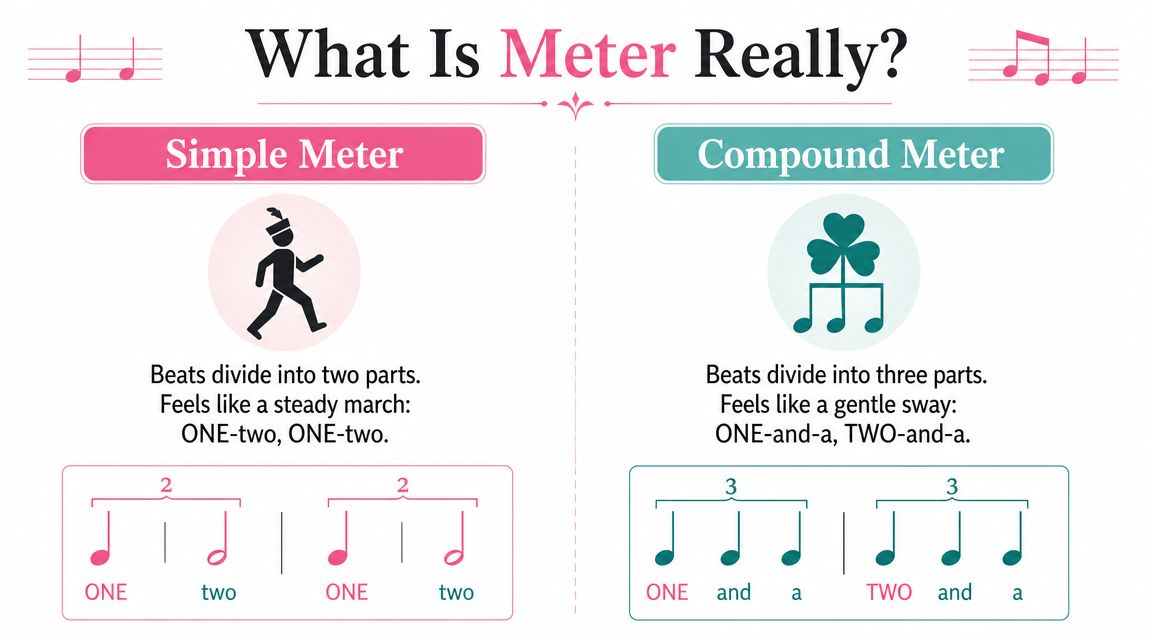
The feel comes before the math
In a simple meter, each beat splits into two parts. Think of a march. The pulse feels even and direct. You might count it like “ONE-and, TWO-and.”
In a compound meter, each beat splits into three parts. The pulse feels rounder. You might count it like “ONE-and-a, TWO-and-a.”
That’s the whole doorway into this topic.
Compound duple meter means there are two main beats in each bar, and each beat divides into three equal parts. That combination matters more than the name. “Duple” tells you there are two big beats. “Compound” tells you each of those beats breaks into three smaller parts.
If simple duple feels like left-right, left-right, compound duple feels more like sway-sway, with each sway containing three tiny steps.
Practical rule: If the pulse wants to break into threes instead of twos, your ear is probably hearing compound meter.
A common point of confusion is the idea that more written notes must mean more beats. That’s why many students look at 6/8 and think, “six beats.” But that’s not how this meter is usually felt.
How 68 actually works
One of the core explanations in music theory is that compound duple meter groups the bar into two main beats, with each beat subdividing into three equal parts. In standard notation, the most common example is 6/8, which is understood as two dotted-quarter-note beats per measure, and each dotted quarter equals three eighth notes, as explained in Open Music Theory’s guide to compound meters and time signatures.
So when you see 6/8, don’t hear six separate footsteps. Hear two larger pulses, each made of three smaller eighth notes.
A quick comparison helps:
| Aspect | Simple Duple (e.g., 2/4) | Compound Duple (e.g., 6/8) |
|---|---|---|
| Main beat count | Two | Two |
| Beat subdivision | Divides into two | Divides into three |
| Common spoken feel | ONE-and, TWO-and | ONE-and-a, TWO-and-a |
| Overall character | Straight, square, march-like | Rolling, lilting, swaying |
If you’ve already worked on simple duple meter, this is the key contrast to keep in your ear. The number of main beats can stay the same while the subdivision changes completely. That one change alters the groove, the accent pattern, and the way your body wants to move.
Here’s a useful shortcut for listening. Don’t ask, “How many notes are written?” Ask, “How many big pulses do I feel before the pattern repeats?”
If the answer feels like two, and each pulse naturally breaks into three, you’re hearing compound duple meter.
How to Hear Compound Duple Meter in Music
The ear-training version of this topic starts with your body, not your theory notebook.
Tap along to the music and look for the big pulse first. Don’t chase every little note. Find the larger rocking motion under the surface.

Use the wonderful and coffee test
A practical identification rule is this: in compound meter, the top number of the time signature is a multiple of three, such as 6, 9, or 12, and for compound duple, 6/8 is the common example. A useful ear test is to try whether a “coffee” style two-part split or a “wonderful” style three-part split fits more naturally, as described in Music Theory Academy’s explanation of simple and compound meter.
That gives you a listening exercise you can use today.
Try this:
-
Tap the larger beat Put on a song with a lilting feel. Tap slowly until your tapping matches the strongest repeating pulse.
-
Say “won-der-ful” Fit the word across one beat. If it sits naturally, you’re likely hearing a three-part subdivision.
-
Try “coff-ee” Now force a two-part split onto the same pulse. If it feels cramped or wrong, that’s a clue you’re not in a simple meter.
-
Listen for accents In compound duple, the first part of each three-note group feels stronger, then the next two are lighter.
This matters for ear training because it teaches you to hear subdivision, not just tempo. That’s a huge leap for anyone trying to play by ear. You’re no longer guessing where notes belong. You’re hearing the rhythmic grid underneath them.
For more listening drills like this, a focused set of ear training exercises can help you practice identifying pulse and subdivision deliberately instead of hoping you absorb it passively.
Songs you can test right away
A few well-known examples often taught or recognized in this feel include:
- “Hallelujah”
- “We Are The Champions”
- “Greensleeves”
Don’t worry about proving the meter on paper first. Use them as listening labs.
Play a section and ask:
- Where are the two large pulses?
- Does “ONE-and-a, TWO-and-a” fit smoothly?
- Do the phrases lean into that swaying motion?
Watch and listen with a counting mindset here:

When your ear hears the subdivision correctly, your hands usually fix their rhythm on their own.
If you sing, this helps you phrase lyrics more naturally. If you play guitar or piano, it helps you place accompaniment patterns where they belong. If you improvise, it stops your ideas from sounding rhythmically stiff.
Compound duple meter is one of those rhythm skills that pays off immediately because you start hearing shape, not just counting beats.
Seeing the Rhythm on the Page
Once you can hear the sway, notation becomes much easier to decode. The page stops looking like math and starts looking like a map of the pulse you already know.
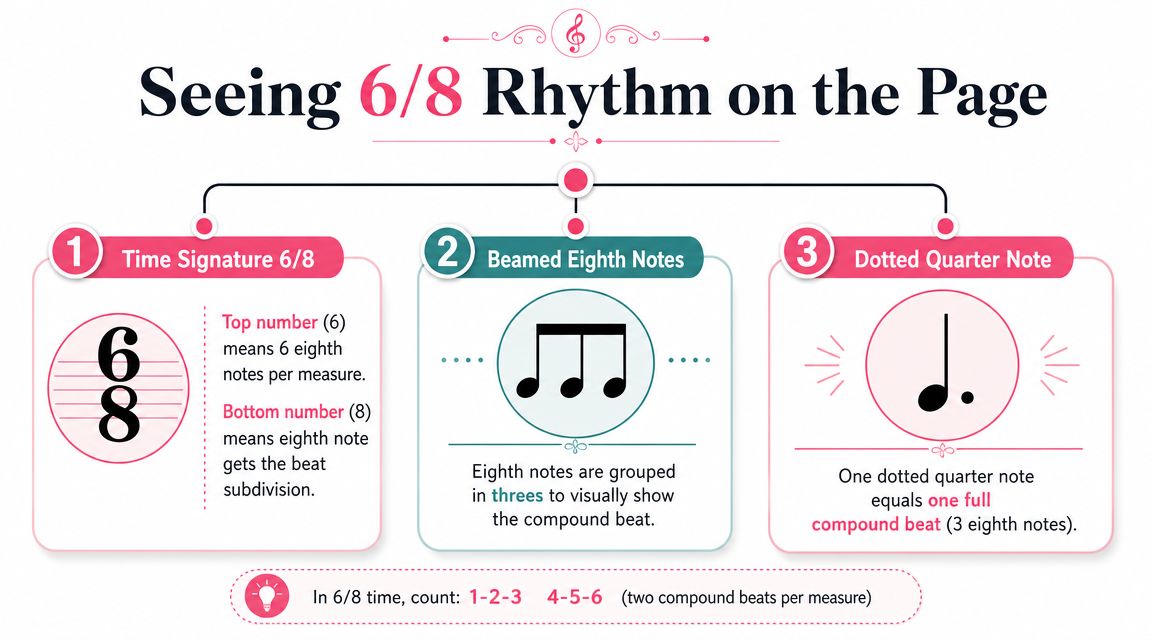
What your eyes should notice first
When you see 6/8, the first visual clue is usually the grouping of the eighth notes. They’re commonly beamed in groups of three. That beam pattern is trying to show you the beat structure at a glance.
Instead of reading six isolated notes, train yourself to see:
- First group of three eighth notes
- Second group of three eighth notes
Those two groups match the two big pulses your ear should already be feeling.
A helpful symbol here is the dotted quarter note. In compound duple meter, that note value represents one full beat. So if you’re counting the pulse, you’re often counting dotted-quarter beats even though the page may show eighth-note motion inside them.
If you read drum charts or rhythmic patterns often, studying how notation groups time can sharpen your rhythmic eye. This overview of how to read drum notations is useful because drum notation makes beat grouping especially obvious.
Sheet music works best when your eyes confirm what your ear already suspects.
Conduct the big beats, not the tiny notes
A lot of students conduct 6/8 incorrectly because they try to mark every subdivision. That usually makes the rhythm feel tense.
For compound duple, conduct the two large beats. A standard two-beat pattern traces the bar in two motions rather than six little jabs. The exact shape matters less than the principle: your hand should reflect the big pulse.
Try this simple routine:
- Beat one: Move down and slightly outward.
- Beat two: Move up and inward.
- Keep subdivisions internal: Feel the three-part split inside each motion instead of showing every eighth note.
A powerful connection exists between reading and ear training. If the notes are grouped in threes but your hand insists on six equal beats, you’ll misread the music’s character. If your ear already hears two broad beats, the notation starts to make sense quickly.
Many rhythm-reading problems come from looking too closely at the small notes and missing the larger pattern. In compound duple meter, the larger pattern is the whole point.
Daily Drills to Master Compound Duple Meter
Rhythm gets better through repetition. Not vague repetition. Focused repetition.
If you spend 10 minutes a day on the feel of compound duple meter, your ear starts recognizing it faster, your counting gets steadier, and your playing feels less forced.
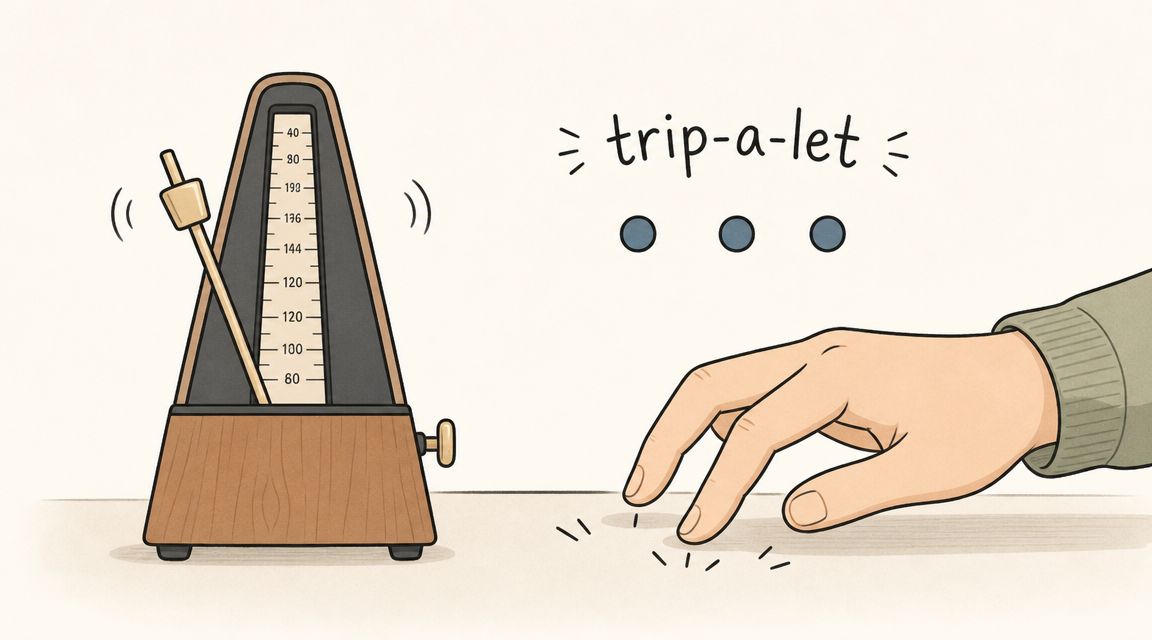
A short practice routine that works
Here’s a simple daily set of drills you can rotate.
-
Metronome pulse drill
Set a metronome to the two main beats, not the tiny subdivisions. On each click, say “ONE-and-a, TWO-and-a” across the bar. Then clap only the first syllable of each beat. Then clap all three parts evenly.
This teaches your body the difference between pulse and subdivision.
-
Word-subdivision drill
Alternate between saying “won-der-ful” and “coff-ee” over the same pulse. One will fit naturally. The other will feel awkward.
That contrast trains your ear to sort rhythms by feel, which is exactly what you need when you’re trying to play by ear in real time.
-
Listening journal
Pick one song a day and ask one question only: does it divide into twos or threes?
Don’t overcomplicate it. Write down your guess, tap it out, and check again later. Over time, you’ll notice your first guess becomes more accurate because you’re listening for the right thing.
-
Instrument groove drill
On your instrument, play a simple scale or even one repeated note in a 6/8 feel. Accent the start of each main beat. Keep the notes light, and listen for whether the phrase rocks forward naturally.
If you rush the third subdivision, stop and speak the rhythm before playing it again.
Listening cue: If your phrase sounds stiff, you may be thinking in six equal notes instead of two large beats.
For musicians who want a structured daily routine, Trill: Ear Training Daily offers short practice sessions focused on hearing musical patterns, including skills that support playing by ear, chord recognition, and pitch awareness. Used alongside metronome work and active listening, it can fit into a consistent ear-training habit.
How this helps you play by ear
These drills do more than teach one time signature.
They train a deeper habit: hearing how music is organized before you touch your instrument. That habit improves rhythmic imitation, accompaniment, improvisation, and transcription. It also helps singers enter phrases more confidently because they aren’t guessing where the beat lives.
A lot of players chase faster fingers before they build better ears. For rhythm, that order should usually be reversed. First hear the pulse. Then move.
Do that daily, even briefly, and compound duple meter starts feeling normal instead of tricky.
From Theory to Musical Freedom
When you can hear compound duple meter clearly, music opens up in a practical way.
You stop mistaking six small notes for six main beats. You stop placing accents randomly. You stop fighting the groove. Instead, you hear the larger pulse, feel the three-part subdivision inside it, and respond more naturally as a player or singer.
That kind of listening is the foundation of musical freedom.
It helps when you’re learning songs by ear because you can identify the rhythmic frame sooner. It helps in improvisation because your phrases land with the groove instead of floating outside it. It helps in ensemble playing because your internal pulse matches what the group feels.
Most of all, it reminds you that ear training isn’t a talent test. It’s practice.
You don’t need to be born with perfect timing or perfect pitch to improve. You need repetition, attention, and a habit of listening for the right details. A few minutes a day adds up. Your ear gets sharper. Your rhythm gets steadier. Your playing gets freer.
Compound duple meter may look like a theory term, but in real music it’s a feeling you can learn to recognize, trust, and use.
If you want a simple daily system for building that kind of listening, Trill: Ear Training Daily helps musicians practice ear training in short sessions focused on hearing intervals, chords, notes, and scales so they can stop guessing and start to play by ear with more confidence.