A Guide to Atonal Ear Training with the Twelve Tone Matrix
You’re probably here because the twelve tone matrix looks harder than it sounds. You may have seen a grid full of note names, labels like P, I, R, and RI, and the feeling that this belongs in a theory exam more than at an instrument.
That reaction makes sense. Many musicians can follow the mechanics on paper, then still feel stuck when they try to hear what any of it means. This auditory disconnect is the fundamental barrier. Music only becomes useful when your ear can recognize it and your hands can turn it into sound.
The good news is that this isn’t a talent issue. It’s an ear training issue. If you can train yourself to hear intervals, chord color, and melodic contour, you can also train yourself to hear the relationships inside atonal music. You don’t need perfect pitch to start. You need repetition, attention, and a method you can return to for 10 minutes a day.
Table of Contents
- What If Music Had No Key
- Building Your First Twelve-Tone Matrix
- From Grid to Music Reading the Rows
- How to Hear Atonal Music Not Guess It
- Your Ten Minute Daily Atonal Workout
- Using the Matrix for Creative Freedom
- A Tool Not a Rule
What If Music Had No Key
Most of the music people grow up with gives the ear a home. A note feels settled. A chord feels final. Even when the harmony gets colorful, your ear still senses direction.
Now remove that home base.
No major key. No minor key. No familiar cadence pointing toward arrival. You can still have shape, contrast, drama, and memory, but you can’t rely on tonal gravity to organize the piece. That musical problem is part of what led composers toward twelve-tone writing.
For beginners, confusion often arises at this point. They hear “atonal” and assume it means random. It doesn’t. It means the music uses a different way of organizing pitch.
Practical rule: If tonal music trains you to hear destinations, atonal music trains you to hear relationships.
That change in listening matters. In tonal music, your ear often asks, “What key am I in?” In twelve-tone music, a better question is, “What pattern just returned, and how did it change?”
A twelve-tone approach begins with a row that uses all the pitch classes before any returns. From there, the composer can transform that row in consistent ways. The matrix helps track those possibilities. But the matrix itself isn’t the music. It’s the map.
That distinction matters because many explanations stop at the grid. They teach the mechanics, then leave you with no idea how to turn that grid into something singable, playable, or memorable. If you’ve felt that gap, you’re not behind. You’ve just noticed the core challenge sooner than most.
Why your ear still matters
You don’t become musical by memorizing labels like P-0 or RI-7. You become musical by hearing when a line keeps its identity, even when it moves, flips, or reverses. That’s the same listening instinct behind play by ear skills in any style.
Think of it this way:
- In pop music, you might hear a chord progression repeat in a new key.
- In jazz, you might hear a motif answered with a variation.
- In twelve-tone music, you might hear a row return backward or inverted.
The listening habit is the same. Your ear tracks identity through change.
That’s why the twelve tone matrix can be valuable even if you never plan to write strict serial music. It can sharpen melodic awareness, contour recognition, and pattern memory. Those are core ear training skills, not niche academic tricks.
Building Your First Twelve-Tone Matrix
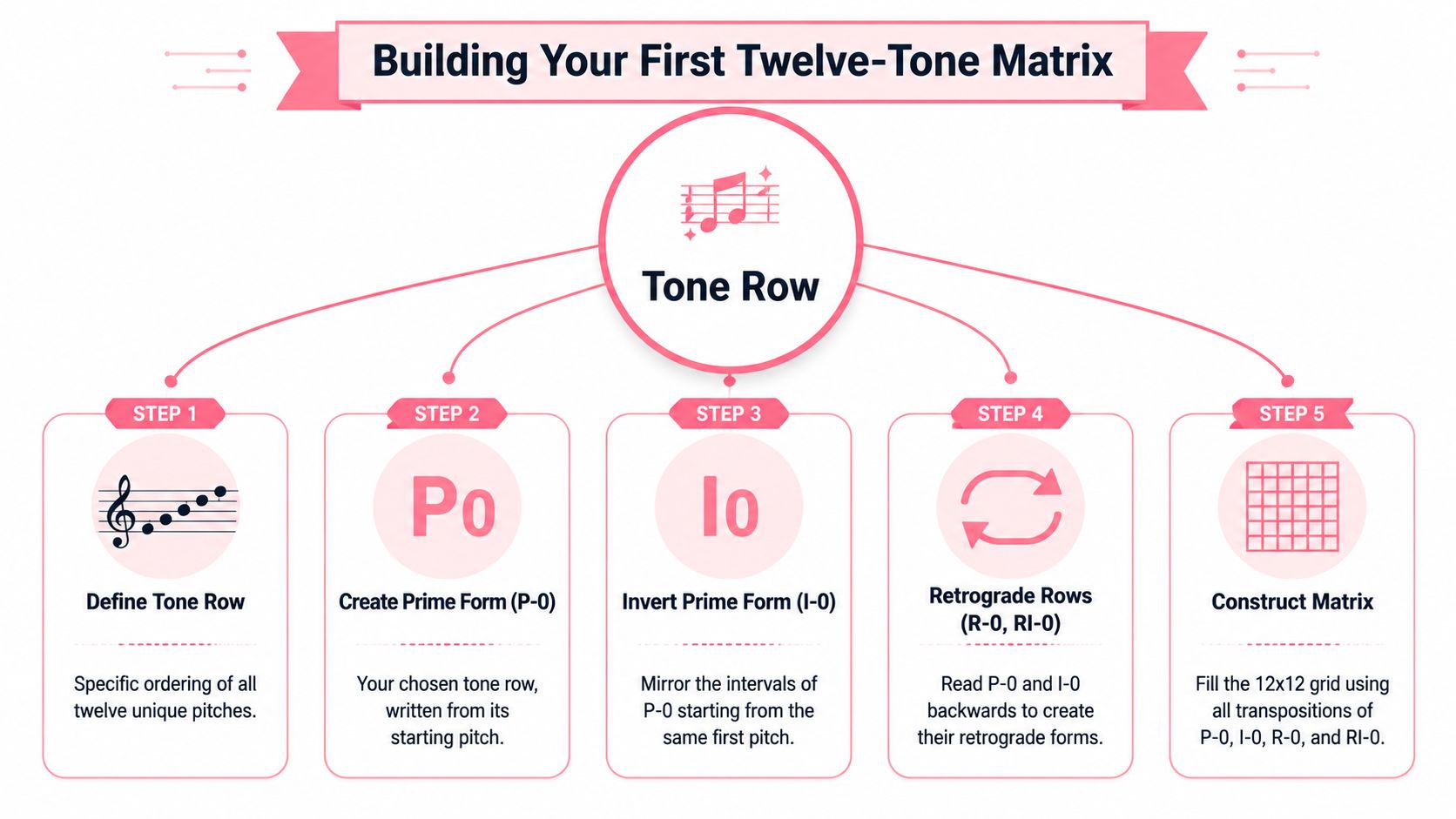
A matrix looks intimidating until you treat it like a note puzzle. You begin with one ordered set of all twelve pitch classes. That ordered set is the row.
Why the row comes first
Your first step is simple. Write down all twelve pitch classes with no repeats until you’ve used them all.
You can use letter names if that feels more natural at the piano. You can also use pitch-class numbers if you like clean visual logic. Either way, the point is the same. This row is your source material.
Some players find it easier to build rows after reviewing how all twelve notes relate on the keyboard. If that helps, a quick refresher on the chromatic scale on piano makes the layout much easier to visualize.
A common misunderstanding appears right here. People assume the row has to sound good on its own before anything else can work. Sometimes it will. Sometimes it won’t. A row can suggest strong shapes, but it doesn’t automatically create expressive music.
That’s one reason beginner explanations often fall short. As the University of Puget Sound overview of twelve-tone composition makes clear, twelve-tone composition uses all 12 pitch classes and usually avoids tonal reference points, yet the matrix is only a bookkeeping tool for transformations, not a method that guarantees coherence or listener perceptibility.
The row gives you material. It doesn’t make choices about rhythm, texture, pacing, or expression.
Later, that becomes freeing.
Here’s a visual walkthrough before the written steps:

A simple way to build the grid
Once you have the row, the logic unfolds in a repeatable order.
-
Write your prime row across the top
This is often called P-0 if you’re starting from your original form. -
Find the inversion starting pitch series
Inversion means you mirror each interval direction. If the prime row goes up by a certain distance, the inversion goes down by that same distance, and vice versa. -
Write the inverted form down the first column
Now your top row and left column give the framework for the whole matrix. -
Fill each remaining row by preserving interval order
Each row becomes a transposition of the prime form. -
Read backward when you want retrogrades
You don’t need to calculate brand new rows for these. The matrix already contains them.
A quick reference table helps:
| Form | What it means | How to hear it |
|---|---|---|
| P | Prime | Original pitch order |
| I | Inversion | Same interval sizes, flipped direction |
| R | Retrograde | Original order backward |
| RI | Retrograde inversion | Inverted form backward |
If you’re new to inversion, don’t rush. Most errors happen because people try to think too far ahead. Work one interval at a time. If the first move in the row rises, the inversion falls by the same amount.
Another important point often gets lost. The matrix is usually presented as a 12-by-12 reference containing 48 transformations across P, I, R, and RI, but many explanations stop at the mechanics and don’t show how this helps with actual hearing or composing. That gap is one reason so many musicians can fill in a grid and still feel musically disconnected.
From Grid to Music Reading the Rows
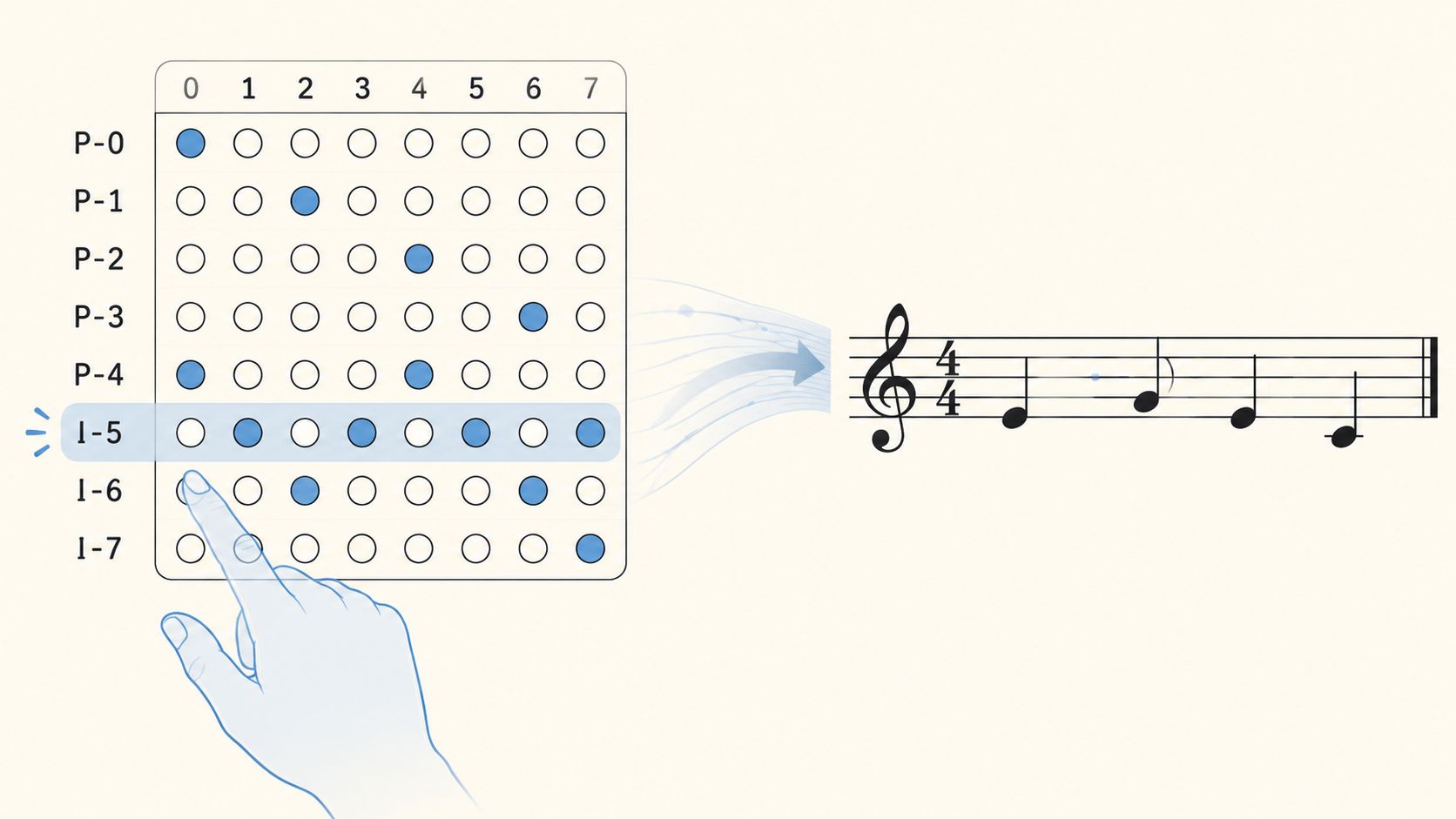
Once the matrix is finished, it can still look like a spreadsheet pretending to be music. The shift happens when you stop asking, “What does this box mean?” and start asking, “What line can I play from here?”
What the labels mean in practice
If you choose P, you read a row from left to right. If you choose R, you read that same row from right to left. If you choose I, you read a column from top to bottom. If you choose RI, you read that inverted column backward.
That sounds technical, but the musical use is direct:
- A melody can come from one row form.
- A bass line can come from another.
- Two instruments can share related forms for contrast.
- A phrase can return in retrograde to create recognition without tonal repetition.
Suppose you pick one row and play its first few notes as a short melody. You’re still free to decide almost everything the listener experiences.
A row is only pitch order
The matrix tells you pitch sequence. It does not tell you rhythm, articulation, octave placement, tempo, dynamics, or instrumentation.
That’s where the musical life enters.
A dry row played in equal notes can sound flat. The same row with shaped rhythm, register contrast, and phrasing can sound vivid and intentional.
Here’s a practical comparison:
| The matrix decides | You decide |
|---|---|
| Pitch order | Rhythm |
| Transformation choice | Octave |
| Related row forms | Dynamics |
| Structural consistency | Instrument or voice |
| Recurring pitch pattern | Texture |
This is the point where many players relax. They realize the system hasn’t removed creativity. It has only organized one layer of it.
Try this on piano. Pick one row form and play it slowly in the middle register. Then play the same pitches again, but this time:
- leave space after every third note
- jump a few notes up an octave
- accent one repeated contour
- turn the last notes into a question, not a conclusion
Nothing about the pitch order changed. But the phrase changed completely.
That’s why the twelve tone matrix works best when your ear and hands stay involved. Read the row, yes. But then phrase it like music.
How to Hear Atonal Music Not Guess It
Many musicians say atonal music sounds impossible to follow. Usually they’re trying to hear it with tonal expectations. They’re listening for a key center, a familiar chord pull, or a melodic destination that the music never promised to provide.
A better approach is to train your ear to notice relationships instead of tonal gravity.
Stop listening for a key center
When you hear tonal music, your ear often sorts notes by function. One note feels like home. Another wants to resolve. Another creates tension.
In twelve-tone music, that strategy can leave you frustrated. You keep waiting for a center that doesn’t arrive. So stop measuring the music against a missing key and start noticing contour, interval character, spacing, and recurrence.

A useful support for this kind of hearing is movable, chromatic listening language. These chromatic solfege hand signs can help you connect altered pitches to physical gesture, which makes abstract pitch movement easier to remember.
One underserved question in this topic is how to use the matrix for actual hearing or composing, not just paper analysis. Mainstream explanations often present it as a 12-by-12 reference with all 48 transformations, yet they rarely show how those forms affect voicing, counterpoint, or listening for recurring pitch-class relationships in an aural setting, as discussed in this video on hearing and composing with the twelve-tone matrix.
Train your ear to catch transformations
If you want to play by ear in atonal settings, don’t start by naming every note at full speed. Start by hearing identity through change.
Use exercises like these:
-
Backward recognition
Play a short row fragment, then play it backward. Ask yourself whether you can hear that it’s the same idea reversed, not a new melody. -
Contour flipping
Take a three or four note shape and invert it. If the original rises then falls, the inversion falls then rises. Sing both slowly. -
Register masking
Play the same row form in different octaves. Your ear learns to recognize pattern beyond register. -
Rhythm swap
Keep the pitch order fixed, but change the rhythm. This trains you not to confuse surface rhythm with pitch identity.
Your ear doesn’t need to catch every note instantly. It needs to notice what stays the same when the surface changes.
This is advanced ear training, but it’s still trainable. The same way some musicians develop strong interval recognition without perfect pitch, you can develop strong atonal pattern recognition through repetition.
A short listening journal helps. After each session, write one sentence:
- Did the line feel jagged or smooth?
- Did the inversion still sound related?
- Could you hear the retrograde as the same object turned around?
Those observations matter. They prove you’re not guessing. You’re learning to hear structure.
Your Ten Minute Daily Atonal Workout
Long theory sessions usually don’t build strong listening. Short, focused repetition does. If you want the twelve tone matrix to become musical instead of abstract, use it daily in a small routine.
A structured habit matters more than occasional intensity. If you want a model for consistent ear work, Ear Training Daily is built around short, repeatable sessions rather than rare marathon practice.
A routine you can actually keep
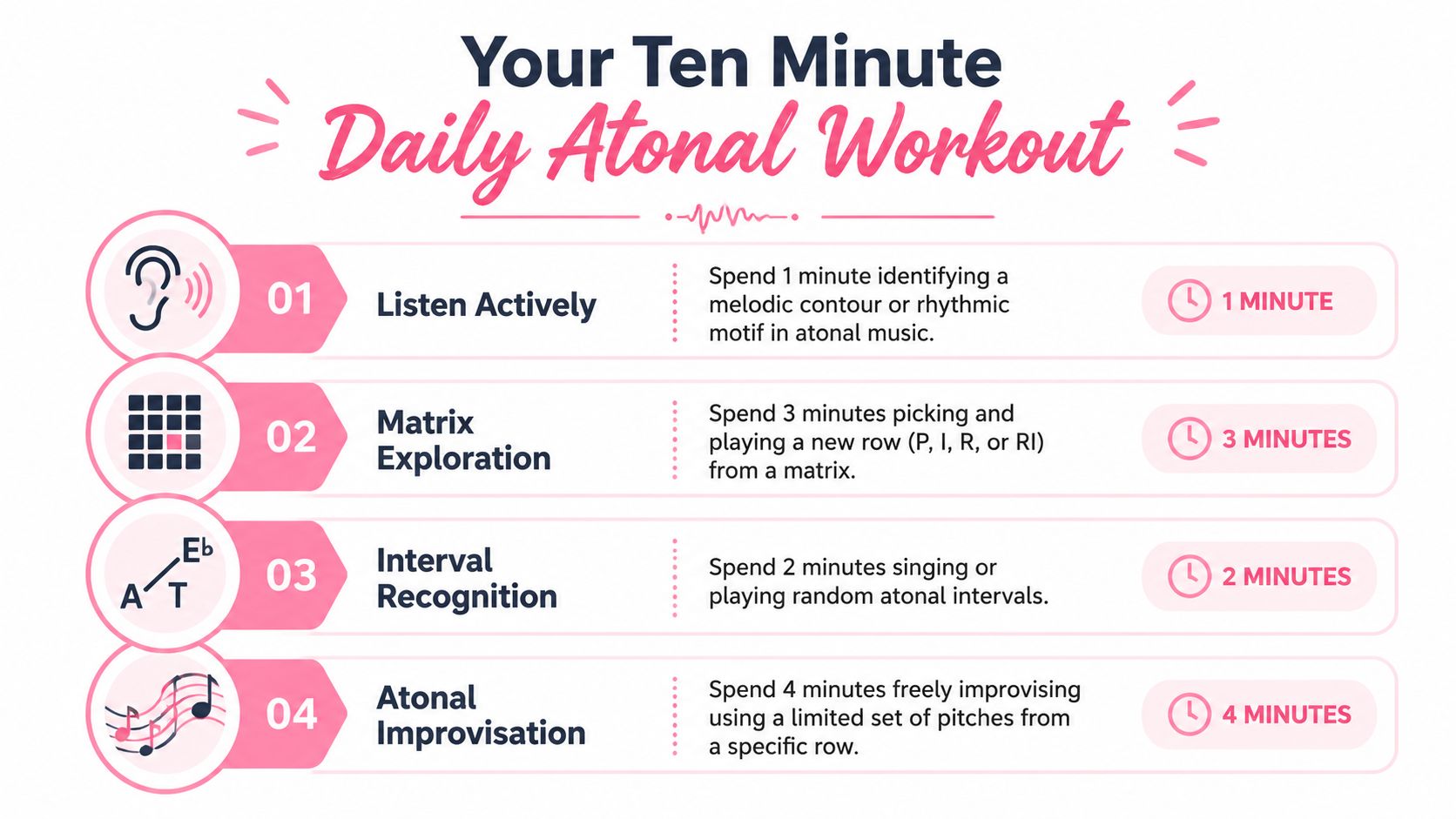
Here’s a practical 10 minute a day workout.
-
Minute 1, hear the row
Play one row form slowly. Don’t analyze. Just listen for shape. Is it angular, clustered, spacious, tense, singable? -
Minutes 2 to 4, sing fragments
Take the first three or four notes and sing them back. Then sing them in retrograde. Accuracy matters more than speed. -
Minutes 5 to 6, isolate intervals
Pull out two-note jumps from the row. Hear each leap clearly before moving on. Here, atonal music starts becoming less blurry. -
Minutes 7 to 8, compare forms
Play a prime form, then its inversion. Ask what stayed recognizable. The answer might be contour energy, interval size, or phrase weight. -
Minutes 9 to 10, make a tiny phrase
Use any short segment from the row and turn it into a musical idea. Add rhythm, rests, accents, or octave shifts.
What to notice each day
Keep the questions small. Small questions build reliable ears.
- Did one interval keep grabbing your attention?
- Could you sing the opening without touching the instrument again?
- Did the retrograde feel familiar or completely hidden?
- Did a certain register make the row easier to hear?
A compact checklist can help:
| Time | Task | What to listen for |
|---|---|---|
| 1 minute | Play the row | Overall contour |
| 3 minutes | Sing a fragment | Pitch memory |
| 2 minutes | Hear isolated intervals | Leap quality |
| 2 minutes | Compare forms | Identity through change |
| 2 minutes | Improvise briefly | Musical control |
Daily consistency beats occasional overload. Your ear is a muscle, and muscles respond to repeated use.
This kind of work supports more than atonal listening. It sharpens melodic memory, interval recognition, and phrase control. Those same abilities help with improvisation, transcription, chord recognition, and freer playing in every style.
Using the Matrix for Creative Freedom
Some musicians hear “twelve-tone” and think “restriction.” They picture rules squeezing the life out of music.
The opposite can happen.
Constraint can unlock invention
When you remove your usual tonal habits, you stop reaching for the same safe sounds. That can be uncomfortable at first, but it can also be refreshing. The row gives you material that doesn’t lean on your favorite scale licks or familiar chord shapes.
That kind of limit can force better listening.
If you improvise on piano, try using only the first few notes of one row form for a minute. Then keep the same notes but change the rhythm completely. Then move them to a different register. Then split them between two hands. You’ll notice that the creativity isn’t gone. It has moved away from tonal reflexes and into rhythm, touch, spacing, and motif work.
Ways to use it when you improvise
Different musicians can use the matrix in different ways:
- Pianists might assign one row form to the right hand and a related form to the left.
- Guitarists can treat a row fragment like a picking pattern source instead of a scale box.
- Singers can use short row cells to train accurate leaps and flexible phrase memory.
- Composers and producers can build a melodic identity first, then shape texture around it.
A row can also become a creative prompt rather than a law. Use six notes from it. Stretch one rhythm. Repeat a contour. Layer two forms. The matrix gives order, but your ear decides what feels alive.
That’s why this topic belongs in practical ear training, not only in analysis. It gives you a disciplined way to hear fresh material and respond to it musically.
A Tool Not a Rule
The twelve tone matrix works best when you stop treating it like a test and start treating it like a listening device. It organizes pitch relationships. It does not replace musical judgment.
That’s the healthy way to hold it. Use it to build rows. Use it to track transformations. Use it to sharpen pattern recognition. Then return to the part that matters most. Can you hear what’s happening, sing part of it back, and shape it into real music?
If you keep showing up for a few focused minutes a day, your ear will change. You’ll stop hearing atonal music as a blur of unrelated notes. You’ll start hearing contour, recurrence, contrast, and structure. That’s the same deep shift musicians chase when they want to play by ear with more confidence.
You don’t need perfect pitch for that. You need trained attention.
And trained attention grows through daily work.
If you want a simple way to make that daily work stick, Trill: Ear Training Daily gives you short, focused ear training sessions designed to help you stop guessing and start hearing. It’s built for musicians who want real listening skills they can use in playing, improvisation, chord recognition, and learning music by ear.