What Is a Harmonic Minor? Unlock Its Unique Sound
You sit at your instrument, find a minor key, and something still feels missing. The notes sound sad or dark, but they don’t have that dramatic pull you hear in classical music, film cues, metal riffs, or certain jazz lines. You want that one sound that feels tense, elegant, and a little dangerous.
That’s usually the moment you run into the question, what is a harmonic minor?
Most students first meet it as a formula. Raise the 7th. Memorize the notes. Move on. But that approach leaves out the most useful part. The harmonic minor scale matters because of how it sounds and how that sound helps you play by ear, recognize chords faster, and improvise with more intention.
If your goal is ear training, not just passing a theory quiz, this scale is worth learning thoroughly.
Table of Contents
- The Secret Sound Behind Dramatic Music
- Hearing the Harmonic Minor Formula
- Choosing Your Minor Scale Flavor
- Why the Harmonic Minor Creates Such Strong Chords
- Train Your Ear to Recognize the Harmonic Minor
- From Theory to Musical Freedom
The Secret Sound Behind Dramatic Music
You’ve probably heard it before even if you didn’t know its name.
A melody climbs in a minor key, and right before it lands home, one note suddenly sharpens the tension. The line feels darker, but also more focused. It doesn’t just wander back to the home note. It leans into it.
That’s the sound many players are reacting to when they discover harmonic minor.
For beginners, the confusion usually starts here. They think, “Minor is minor, right?” Not quite. Different minor scales create different emotional colors. Harmonic minor has a very specific flavor. It often feels dramatic, eerie, old-world, or theatrical. On the instrument, it can feel like a familiar path with one unexpected turn near the end.
Practical rule: If a minor-key line sounds like it suddenly gains a stronger urge to resolve, your ear may be catching harmonic minor.
This matters for more than music theory vocabulary. If you’re trying to build ear training skills, this is one of those sounds you want to stop guessing at. Once you can recognize it, a lot of things get easier. You start hearing why certain chord changes feel stronger. You begin to predict where a melody wants to go. Improvisation becomes less random.
A good ear doesn’t come from talent alone. It comes from repeated contact with clear sounds and patterns. Harmonic minor is one of the best examples because its character is so distinctive. When you learn to hear it, you aren’t just learning a scale. You’re learning tension, release, and musical direction.
And that’s the true payoff. You hear a sound, recognize it, and respond musically. That’s the foundation of learning to play by ear.
Hearing the Harmonic Minor Formula
The harmonic minor scale is easier to understand once you stop thinking of it as a pile of note names and start hearing it as one familiar sound with one altered note.
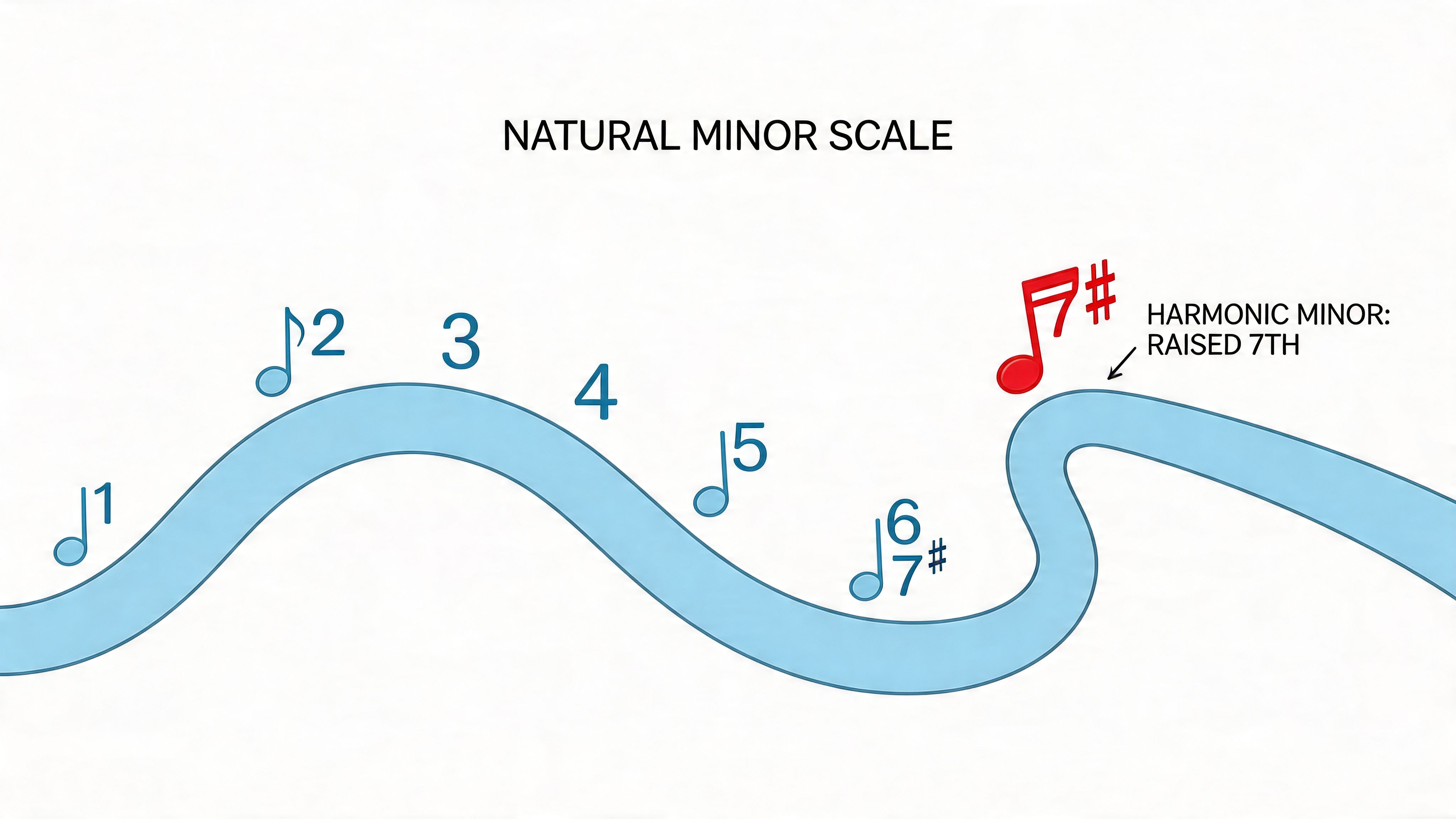
One note changes the whole mood
The key fact is simple. The harmonic minor scale is constructed by raising the seventh degree of the natural minor scale by one semitone. In A harmonic minor, the notes are A-B-C-D-E-F-G#-A, and that raised 7th, G#, sits just one semitone below A, which creates a strong leading tone toward the tonic, as described in the harmonic minor scale reference.
If you already know A natural minor, compare the two:
- A natural minor: A-B-C-D-E-F-G-A
- A harmonic minor: A-B-C-D-E-F-G#-A
That single change does a lot of work.
Think of natural minor as walking up a staircase where the final step to home is a little too far away to feel urgent. Harmonic minor shortens that last distance. Suddenly the final note doesn’t just arrive. It pulls.
The interval pattern is whole, half, whole, whole, half, augmented second, half. Written as scale degrees, it’s 1, 2, ♭3, 4, 5, ♭6, 7, 8. If you want to map that out visually on piano or guitar, a scale finder tool for musicians can make the shape easier to see.
How to hear the big jump
Most students don’t struggle with the raised 7th itself. They struggle with the sound between ♭6 and 7.
In A harmonic minor, that’s F to G#. That span is an augmented second, which covers three semitones. That jump is the signature color of the scale. It’s a big reason the sound feels dramatic and unusual.
Don’t try to memorize the name first. Listen for the leap that sounds slightly wider than you expect in a minor scale.
Here are three ways to lock that sound into your ear:
-
Play natural minor, then harmonic minor
Keep everything the same except the 7th. Your ear will notice the new tension right away. -
Sing the top of the scale slowly
Sing 5, ♭6, 7, 1. In A, that’s E-F-G#-A. The unusual stretch happens in the middle, and the release happens at the end. -
Pause before the tonic
Play up to the raised 7th and stop. Let your ear feel how unfinished it sounds. Then resolve to the tonic.
That last move is where ear training turns into instinct. You’re no longer asking, “What’s the rule?” You’re hearing, “This note needs to go home.”
Choosing Your Minor Scale Flavor
One reason students get tangled up with minor scales is that all three often get introduced too quickly. Natural minor, harmonic minor, melodic minor. Three labels, three formulas, one confused musician.
A better way to hear them is to treat them like different flavors of minor.
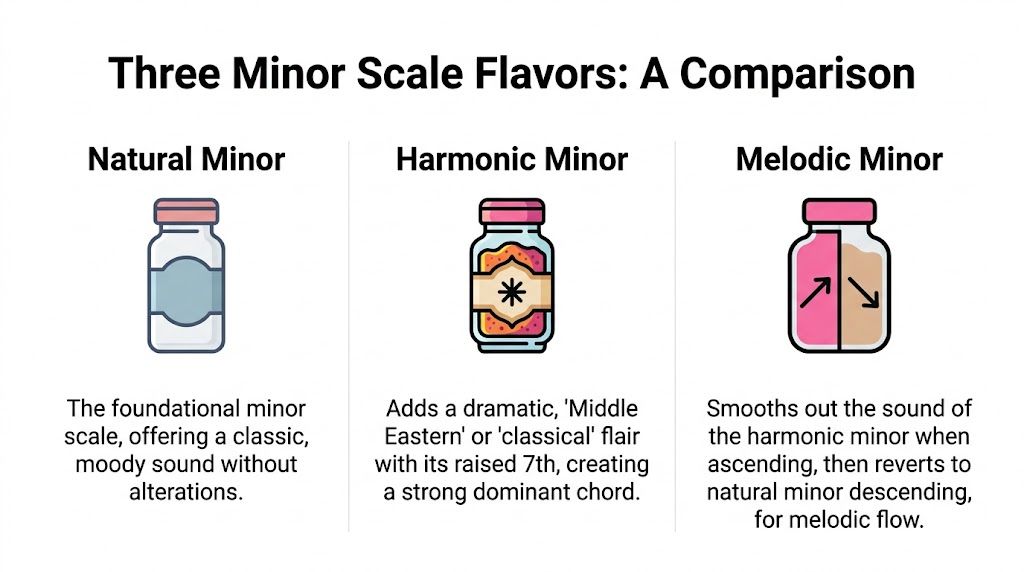
Three sounds, three jobs
Natural minor is the plain base flavor. It sounds moody, stable, and familiar. If you’re writing a simple minor melody or learning basic ear training, this is often the first minor sound you internalize.
Harmonic minor adds a sharper spice. It keeps the darker quality of minor but introduces that raised 7th, which makes the scale feel more directed and intense. This is the one that often sounds dramatic, old-world, or harmonically charged.
Melodic minor usually feels smoother going upward because it avoids the awkward melodic gap that harmonic minor creates. Students often experience it as the more “singable” version when ascending.
The trick is not just knowing the formulas. The trick is hearing each one as a different emotional tool.
If natural minor feels like a calm shadow, harmonic minor feels like the shadow suddenly turning its head.
Here’s a side-by-side view:
Minor Scale Comparison
| Scale | Interval Formula | Sound Characteristic |
|---|---|---|
| Natural Minor | 1, 2, ♭3, 4, 5, ♭6, ♭7 | Dark, familiar, grounded |
| Harmonic Minor | 1, 2, ♭3, 4, 5, ♭6, 7 | Dramatic, tense, strongly resolving |
| Melodic Minor | Ascending form raises 6 and 7 | Smoother, more melodic, less jagged |
This comparison matters in real playing situations.
If you’re improvising and want a line that sounds dark but not too tense, natural minor may fit better. If the harmony underneath needs a strong pull back home, harmonic minor often gives you that sound. If you’re shaping a melody that should rise smoothly, melodic minor may feel more natural under the fingers and voice.
A useful ear exercise is to keep the same tonic and switch between the three. Don’t analyze first. Just listen and describe what changes.
- Ask about direction: Which scale sounds like it wants to resolve harder?
- Ask about smoothness: Which one feels easiest to sing upward?
- Ask about color: Which one sounds more mysterious or theatrical?
With the harmonic minor, play by ear skills start to become practical. Instead of hearing “some kind of minor,” you start hearing a more precise color. That makes it easier to choose notes while improvising, match melodies on your instrument, and identify harmony without guessing.
Why the Harmonic Minor Creates Such Strong Chords
The harmonic minor scale didn’t become important just because of its melody. Its real power shows up in harmony.
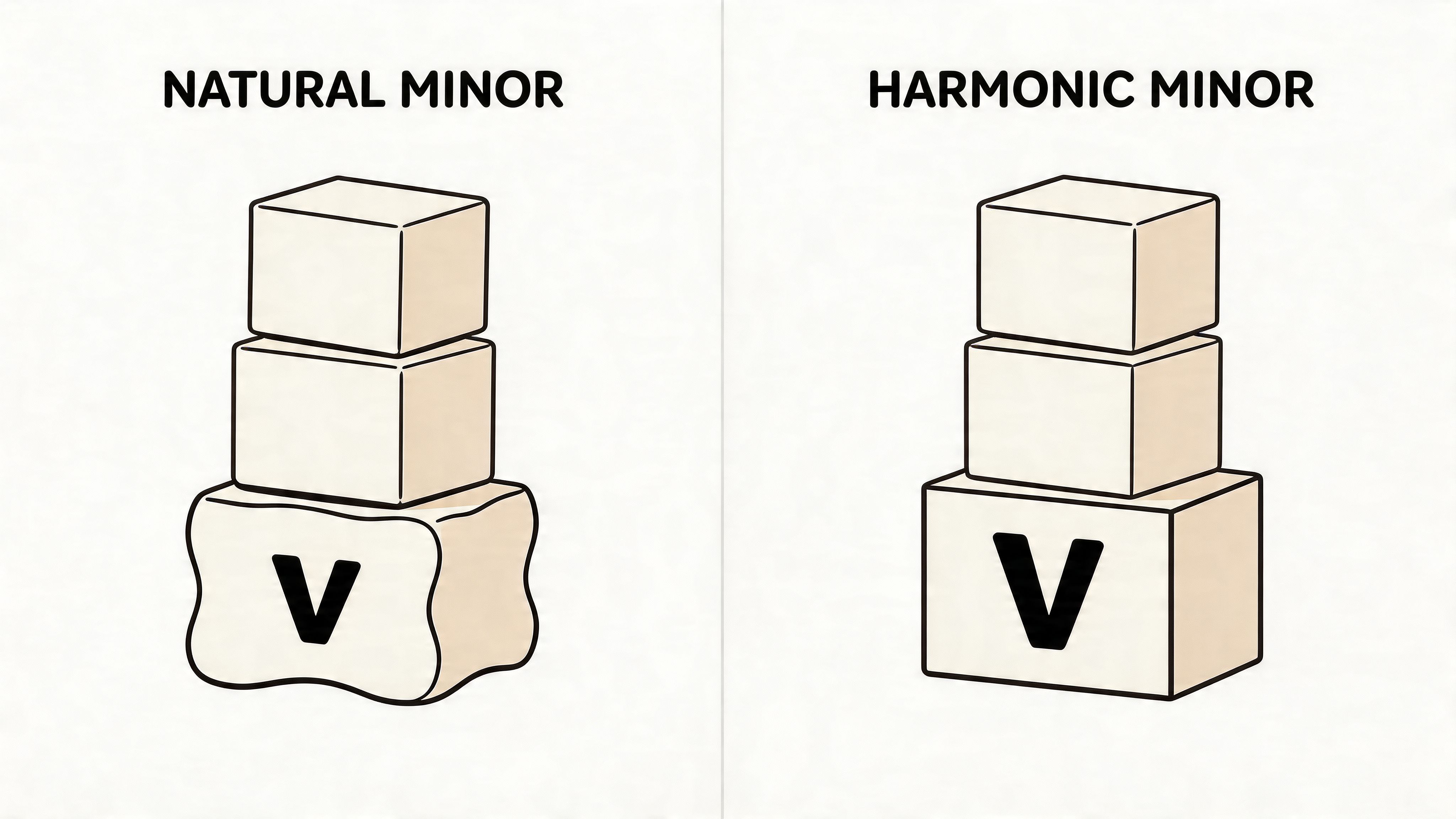
The problem it solves
In natural minor, the dominant chord doesn’t push back to the tonic very strongly. It can sound softer, less urgent, less final. Raising the 7th changes that.
That one note allows the scale to produce a V7 dominant chord in a minor key. In A minor, that chord is E-G#-B-D. The G# is the important note. It acts as a leading tone that wants to resolve upward to A. Historically, this use was codified by 1722 in Jean-Philippe Rameau’s Traité de l’harmonie, helping minor keys gain a strong dominant function like major keys, as noted in this discussion of harmonic minor and functional harmony.
If you’re learning chords, this is worth hearing at the keyboard or guitar right away:
- Natural minor dominant: softer pull
- Harmonic minor dominant: stronger pull back to home
That difference trains your ear to recognize harmonic function, not just note collections. It also helps when studying common chord structures in music theory.
What your ear should notice in real music
When you hear a minor-key progression and the dominant chord suddenly sounds bright, tense, and eager to resolve, that’s often your clue.
The sensation is physical for many players. The V7 chord feels stretched. The tonic minor chord feels like release.
Hear the chord before you name it. If it sounds like it can’t wait to return home, listen for harmonic minor in the background.
There’s also a practical reason to care. If you can hear that dominant pull, you stop hunting blindly for the next chord in a progression. You start anticipating it.
This short lesson can help you connect that sound to the keyboard and your ear:

For improvisers, this opens a lot of doors. You can target the raised 7th for tension. You can outline the V7 chord to make your lines sound connected to the harmony. You can hear when a minor key is asking for more than the plain natural minor sound.
That is one of the big shifts in musicianship. Theory stops being a worksheet and starts becoming a listening skill.
Train Your Ear to Recognize the Harmonic Minor
If you want to really understand harmonic minor, don’t start by writing it out in twelve keys. Start by hearing it every day.

A simple daily routine
You don’t need perfect pitch to learn this sound. You need repetition, attention, and a short practice loop you can stick to. 10 minutes a day is enough if you stay focused.
Try this routine:
-
Listen before you play
Pick one key, such as A harmonic minor. Play it up and down several times. Don’t rush. Let your ear absorb the color before your fingers take over. -
Sing the altered note
Sing the scale and exaggerate the raised 7th. If you’re in A harmonic minor, really feel how G# leans into A. -
Isolate the signature motion
Practice just ♭6, 7, 1. That small fragment contains most of the sound your ear needs to recognize. -
Compare it with natural minor
Alternate between the two scales in the same key. The contrast is what teaches your ear fastest. -
Test yourself with audio prompts
Use an ear training app for daily practice or your instrument with your eyes closed. Hear first, answer second.
How this helps you play by ear
This kind of work pays off in very practical ways.
- Improvisation gets clearer: You stop throwing random minor notes over a progression and start aiming for the notes that create or release tension.
- Chord recognition improves: You begin to hear when a minor key uses a strong dominant sound instead of a weaker one.
- Melody learning gets faster: When a song uses that raised 7th, your ear recognizes the color instead of treating it like a surprise accident.
- Pitch confidence grows: Singing the scale helps connect inner hearing to your voice and instrument, which is the main path toward stronger relative pitch and, for some players, better note memory often associated with perfect pitch training.
A lot of students think ear training means endless guessing. It doesn’t. Good ear training means hearing the same important sound enough times that it becomes familiar. Harmonic minor is perfect for that because its sound is distinctive.
Your ear is trainable. The more often you identify a sound on purpose, the less often you have to guess.
Stay with one key until it feels obvious. Then move to another. Consistency beats intensity here.
From Theory to Musical Freedom
The harmonic minor scale is more than a theory term. It’s a sound with a specific emotional effect and a specific job in harmony.
Once your ear recognizes that raised 7th and the tension it creates, music starts making more sense from the inside. You hear why a melody sounds dramatic. You hear why one dominant chord in a minor key feels stronger than another. You begin to improvise with intention instead of trial and error.
That’s why learning what is a harmonic minor matters so much for musicians who want real freedom. Not because you’ll be able to recite the formula, but because you’ll hear the sound and know what to do with it.
If you want to play by ear, recognize chords faster, and build stronger musical instincts, this is exactly the kind of sound you should train daily. Small sessions add up. A few focused minutes every day can turn an abstract idea into a sound you recognize instantly.
And once you can hear it, you can use it.
If you want a simple daily system for ear training, Trill: Ear Training Daily helps you practice the skills that matter in real music: recognizing scales, chords, intervals, and pitch through short sessions designed to help you play by ear with more confidence. It’s built for musicians who want to stop guessing and start hearing.