What Is Rubato in Music? Master Expressive Timing
Rubato is the expressive act of slightly speeding up and slowing down within a phrase so the music can breathe. The term tempo rubato appears in the first half of the 18th century, and the practice itself goes back as far as the 14th century.
You’ve probably heard it already, even if you didn’t know the name. A singer lingers on one word just long enough to make it ache. A pianist leans into the top of a phrase, then eases back as it lands. Nothing feels broken. It feels human.
That’s why rubato matters so much for ear training. If you want to play by ear, improvise, or recognize what gives a performance emotion, you need to hear more than notes and chords. You need to hear time moving. Rubato is one of the clearest examples of that musical “give and take.”
Table of Contents
- That In-Between Feeling in Music You Could Never Name
- The Art of Stolen Time
- Two Flavors of Rubato You Can Learn to Hear
- Hearing Rubato in Your Favorite Music
- How to Train Your Ear for Musical Feeling
- From Knowing to Hearing Musical Freedom
That In-Between Feeling in Music You Could Never Name
A lot of musicians run into the same frustration. You can tell when one performance sounds stiff and another sounds alive, but you can’t quite explain why. The notes may be identical. The chords may be the same. Yet one version feels like it’s breathing.
That mystery often lives in timing.
When a great performer shapes a phrase, they don’t always place every note with machine-like sameness. They may press forward for a moment, then hold back just a little. Your ear hears that motion as emotion. You feel longing, urgency, relief, tenderness, or suspense.
It’s a listening skill before it’s a theory term
If you’ve searched what is rubato in music, you might expect a dry definition. But rubato makes more sense when you hear it than when you memorize it.
Think of speech. When people speak naturally, they don’t deliver every word with identical spacing. They pause, lean, rush, soften, and stretch. Music works the same way. Rubato is part of what makes a phrase sound spoken instead of printed.
Rubato is one of those things your ear can learn to notice long before you can describe it in formal language.
That’s good news if you’re working on ear training. You don’t need perfect pitch to hear rubato. You don’t need advanced theory either. You need focused listening and a habit of asking, “Did that phrase stay perfectly even, or did it breathe?”
Where beginners get confused
Many players assume expressive timing means losing the beat. That’s usually the first misunderstanding.
Another common mistake is treating rubato like random sloppiness. It isn’t random when it’s done well. It feels flexible, but it also feels intentional. That’s why skilled listeners can hear the difference between a performer making an expressive choice and a performer drifting.
A strong musical ear helps you stop guessing. That matters whether you’re learning songs by ear, singing with better phrasing, or trying to improvise with more freedom.
Here’s the payoff:
- Better listening: You start hearing why a phrase moves you.
- Better phrasing: Your playing becomes less mechanical.
- Better ensemble awareness: You notice whether a solo line floats over the beat or whether the whole group moves together.
- Better musical freedom: You stop treating rhythm as a grid and start hearing it as expression.
The Art of Stolen Time
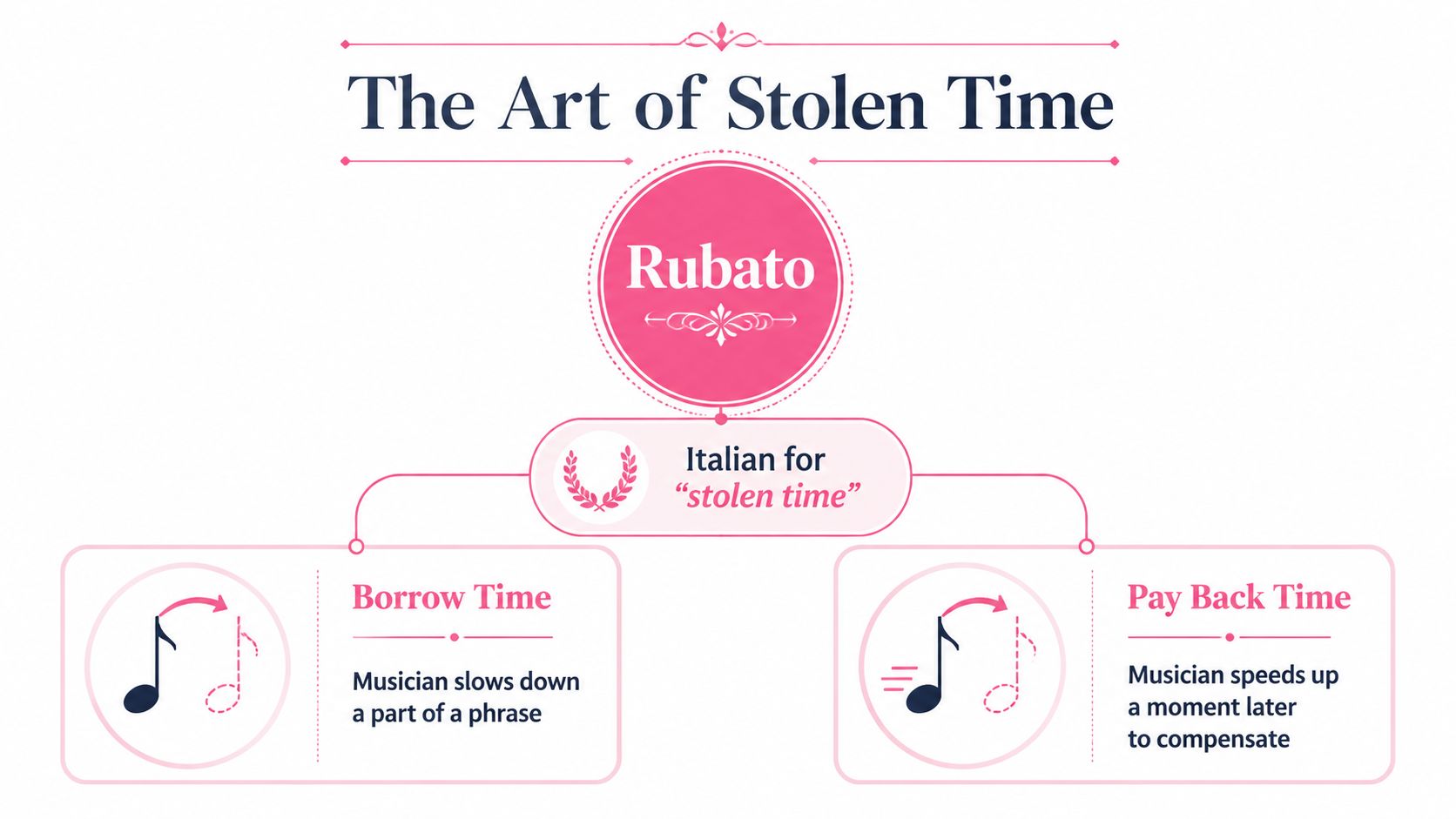
The Italian word rubato suggests stolen time, and that image helps. A performer “borrows” a little time from one part of a phrase and gives it back in another. One moment stretches. Another compresses.
That’s why rubato isn’t just “playing out of time.” Standard reference descriptions define it as an intentional redistribution of time where one part of a phrase is stretched and another is compressed, while an underlying balance is still felt, as explained in this reference on tempo rubato.
What rubato is not
Rubato is not the same as getting slower.
It’s also not the same as a steady acceleration. If the whole piece gradually speeds up, that’s a different kind of tempo change. Rubato is more local and more expressive. It happens inside the phrase.
A useful way to hear it is this:
| Sound | What your ear notices |
|---|---|
| Even playing | Every note lands with similar spacing |
| Simple slowing down | The pulse broadly relaxes |
| Rubato | The phrase pulls against time, then settles back |
How it feels in real music
A singer might delay one emotional word, then move through the next few syllables a bit faster. A pianist might linger at the top of a melodic rise, then reconnect with the beat as the line resolves.
You don’t need to count every fraction of a beat to hear this. Instead, listen for tension and release.
Practical rule: If the phrase feels elastic but not lost, you’re probably hearing rubato.
This is a big ear training lesson. Good musicians don’t only hear pitch. They hear shape in time. If your goal is to play by ear, that matters as much as chord recognition. You want to hear not just what note arrived, but how it arrived.
A simple analogy
Think of someone walking a dog on a leash. The person keeps moving at a steady pace, but the dog runs slightly ahead, then circles back. There’s freedom, but there’s still connection.
Rubato often works like that. The phrase moves away from the pulse and returns. Your ear hears both the freedom and the anchor.
That balance is why rubato can sound expressive without sounding chaotic.
Two Flavors of Rubato You Can Learn to Hear
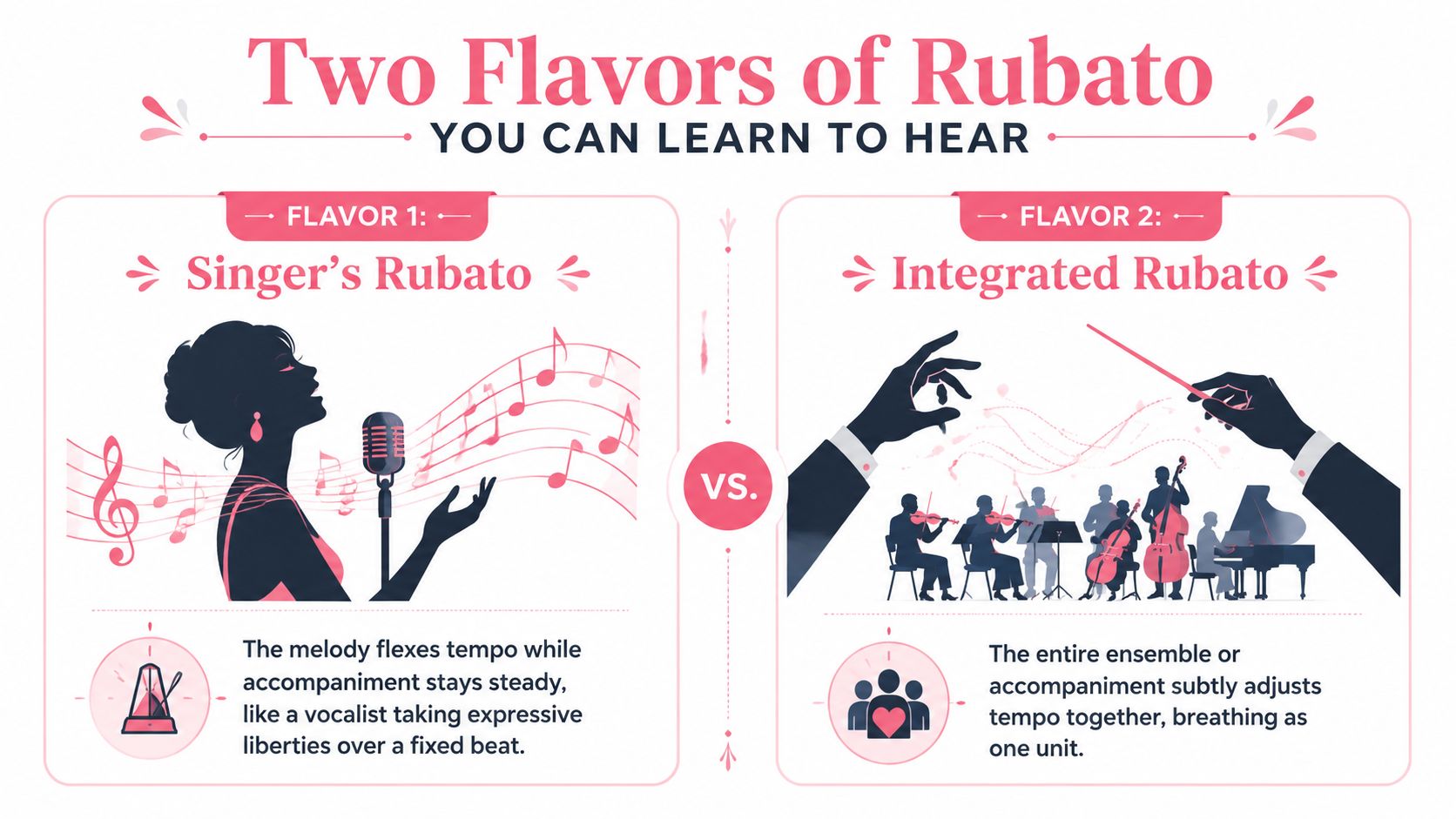
Rubato isn’t one single sound. Your ear can learn to identify at least two broad historical flavors, and they feel very different when you listen for them carefully.
Richard Hudson’s historical survey notes that the expression tempo rubato appears in the first half of the 18th century, while the practice is older. He distinguishes an earlier rubato, where the melody has freedom over a strict accompaniment, from a later rubato that became predominant in the second half of the 19th century and affects the whole musical texture, as described in this Oxford Music history discussion of rubato.
Flavor one, the melody floats
In the older style, the accompaniment stays steady while the melody bends time more freely.
This is the kind of rubato many teachers describe with the image of one hand staying firm while the other sings. Your ear may hear the bass or accompaniment acting like a clock, while the top line leans, delays, or rushes slightly for expression.
That creates a beautiful tension. One layer is grounded. The other is flexible.
Flavor two, the whole texture breathes
In the later style, the whole musical surface moves together. If the melody eases back, the accompaniment eases back too. If the phrase presses forward, everything joins the motion.
This can feel more like a shared breath than a tug-of-war. Instead of hearing one line drift against a steady backdrop, you hear the entire performance swell and relax as one body.
Some performances feel like a soloist bending around the beat. Others feel like the whole room inhaled and exhaled together.
How to tell them apart
This is a great exercise for ear training, especially if you want more confidence in phrasing and musical analysis by ear.
Ask yourself:
- Where is the steady pulse? If the backing feels firm while the melody moves, you may be hearing the older style.
- Who changes together? If multiple parts slow or push at once, you may be hearing the later style.
- What feels more obvious? Melody-against-pulse often sounds more exposed. Whole-texture rubato often sounds more blended.
You don’t have to label every example perfectly. The point is to train attention. The more clearly you can hear these two flavors, the easier it becomes to understand expressive timing in the music you already love.
Hearing Rubato in Your Favorite Music
You don’t need to stay in a theory book to hear rubato. You can hear it in piano music, vocal performances, and ensemble playing if you listen for motion inside the phrase.
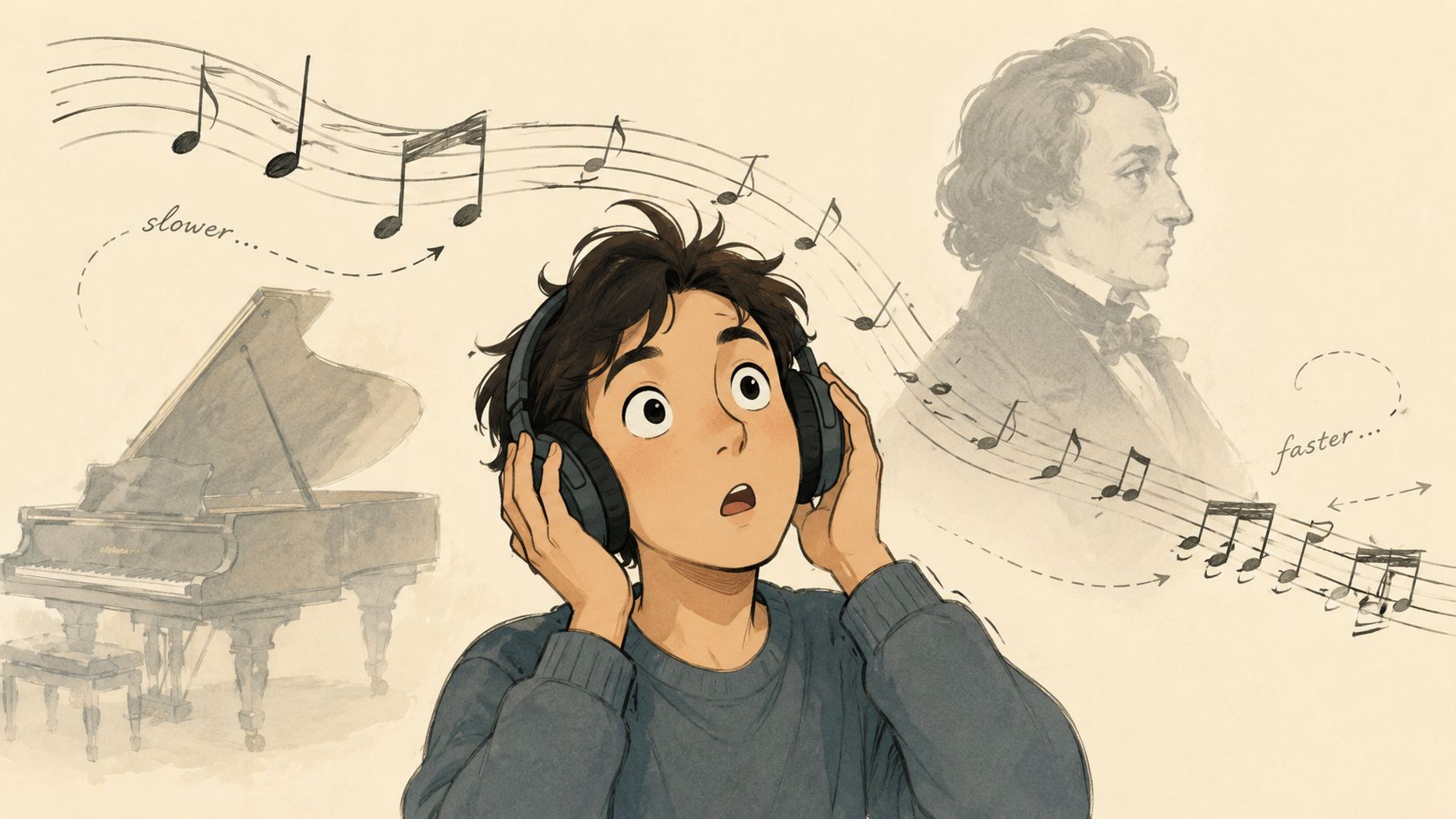
A strong place to start is expressive piano repertoire, especially performances where the melody seems to sing rather than tick forward. Then compare that with a vocalist who delays a word for emotional weight, or a small ensemble that subtly stretches a cadence together. If you’re building this skill from the ground up, these ear training ideas for musicians help sharpen the kind of listening rubato requires.
Listen for the phrase, not the bar line
Beginners often listen too vertically. They hear beat one, beat two, beat three, beat four. That’s useful, but rubato asks for another layer of listening.
Follow one musical line from the start of the phrase to the end. Notice where it reaches, where it hesitates, and where it settles.
Here are three listening targets:
- A solo piano line: Does the melody seem to stretch at the top of a phrase?
- A singer: Do certain words arrive a touch late, then get balanced by quicker motion after?
- A group performance: Does one player bend time alone, or does everyone move together?
A simple home exercise
Pick a recording you already enjoy. Don’t start with something you think you “should” admire. Start with music you want to replay.
Then do this:
- Clap a steady beat while listening.
- Focus on one instrument or voice instead of the whole mix.
- Notice any drift against your clap that still sounds intentional.
- Mark the emotional moment where the phrase stretches or compresses.
If you can feel a phrase lean away from the beat and still make musical sense, your ear is already starting to hear rubato.
This kind of listening helps with more than rhythm. It helps with phrasing, transcription, accompaniment, and improvisation. When you hear how performers shape time, you start understanding why some lines sound conversational and others sound flat.
That’s one of the hidden links between rubato and learning to play by ear. You’re not just identifying notes. You’re hearing how a musician uses time itself as expression.
How to Train Your Ear for Musical Feeling
Rubato becomes real when you stop treating it like vocabulary and start practicing it with your ears and body. In this context, ear training pays off. Not because you memorize a definition, but because you learn to hear control inside flexibility.

The good news is that this skill is trainable. It isn’t reserved for people with “natural feel.” Like chord recognition, interval work, or perfect pitch training, it improves when you practice consistently. Even 10 minutes a day can make your listening more precise and your phrasing more confident.
Start with a metronome, then bend around it
A metronome isn’t only for rigid timing. It can also teach expressive timing.
Set it slow. Sing or play a very simple scale or short melody. Stay exactly with the click first. Then repeat the phrase, but let one note sit slightly behind the click and the next one move slightly ahead, while still arriving back in place by the end.
That exercise teaches two things at once:
- Pulse awareness: You keep the beat alive internally.
- Expressive control: You learn how far you can stretch before the phrase loses shape.
This is much better than vague “play with feeling” advice. You’re training your ear to hear the difference between expressive flexibility and drifting.
Three exercises that work
If you want structure, use a short routine like this and repeat it daily. These kinds of ear training exercises for daily practice fit well into a consistent habit.
- Echo the phrase: Play a simple line evenly. Then play it again with a tiny delay on one note and a tiny recovery later. Record both versions and compare.
- Sing against the click: Let the metronome stay steady while your voice lightly leans around it. This is especially helpful for singers who want more expressive phrasing without losing time.
- Tap and trace: Tap a steady beat with one hand while conducting the melodic shape with the other. This separates pulse from phrase, which is exactly what your ear needs to understand rubato.
Listening test: If your flexible version still sounds anchored, you’re on the right track. If it sounds lost, make the movement smaller.
Here’s a helpful demonstration to study after you try the exercises yourself.

What to listen for in your own playing
When you record yourself, don’t ask only, “Was that accurate?” Ask better questions.
| Question | What it reveals |
|---|---|
| Did the phrase breathe? | Whether your timing had shape |
| Did I still feel the pulse? | Whether the rubato stayed controlled |
| Did the emotion become clearer? | Whether the timing choice actually served the music |
Many musicians grow fast, stopping abstract theory and starting to hear cause and effect. A tiny delay can make a note feel tender. A slight push can make a line sound eager. Those are practical, playable skills.
If metronome work has always felt dry, this is a good reset. Use it as a frame, not a cage.
From Knowing to Hearing Musical Freedom
Rubato starts as a definition, but it becomes useful when your ear begins to catch it in real time. Then it stops being a music-history word and turns into something you can recognize, copy, and use.
That shift matters if your goal is to play by ear. Real musical freedom isn’t only about finding the right notes or naming the right chords. It’s also about hearing how a phrase lives in time. That’s part of what makes improvisation sound expressive instead of mechanical.
The real takeaway
You don’t need to be born with special timing instincts. You can train them.
Daily listening, a steady beat, short recording checks, and focused repetition build this skill the same way other ear training does. If you want another practical angle on steady pulse, this guide on why musicians should practice with a metronome connects directly to hearing rubato with more control.
Rubato is musical freedom with responsibility. The phrase bends, but your ear still knows where home is.
That’s the heart of the answer to what is rubato in music. It’s expressive timing you can learn to hear. And once you hear it, you’ll start noticing it everywhere.
If you want to build that kind of listening every day, Trill: Ear Training Daily gives you a practical system for ear training, chord recognition, interval work, and learning to play by ear in short sessions. It’s built for musicians who want real progress through consistent daily practice, including the kind of sharper listening that helps you hear phrasing, timing, and musical feeling with much more clarity.