What Is Tone Quality? a Musician's Guide to Hearing Color
You hear two sounds playing the same note. One feels warm and round. The other feels bright and cutting. You know they’re different right away, even if you can’t explain why.
That difference is tone quality.
If you’ve ever tried to play by ear, copy a singer, recognize instruments in a mix, or understand why one version of a note feels “right” and another feels thin or harsh, you’re already dealing with tone quality. The good news is that this isn’t some mysterious gift. It’s a listening skill, and like any ear training skill, you can build it with focused practice.
Table of Contents
- Why Can a Saxophone and a Piano Sound So Different?
- Tone Quality Is Your Musical Superpower
- What Creates a Sound’s Unique Fingerprint
- Hearing in Color with Instruments and Voices
- How to Train Your Ear for Tone Quality
- Start Your Daily Listening Practice Today
Why Can a Saxophone and a Piano Sound So Different?
A saxophone and a piano can play the same pitch at the same loudness, and they still won’t sound the same. That’s the question many players bump into before they ever ask, “What is tone quality?”
The simple answer is this. Tone quality is the color or character of a sound. In music, people often call it timbre. It’s what helps you tell one instrument from another, one singer from another, and one version of your own playing from another.
Merriam-Webster describes tone quality as the way listeners distinguish sounds that have the same pitch and loudness through their spectral and temporal characteristics, which is a more precise version of what musicians often mean when they say “sound color” (Merriam-Webster’s definition of tone quality).
A simple way to hear it
Think about middle C.
A piano plays it with a certain attack. You hear the hammer strike, the note bloom, then fade. A saxophone plays that same note with a different start, a different texture, and a different shape as it continues. The pitch may match. The volume may match. But the sound has a different personality.
That personality is tone quality.
Practical rule: If two sounds share the same note but still feel different, you’re hearing tone quality.
This matters more than many beginners realize. When you’re learning songs by ear, you’re not only hearing notes. You’re hearing who is playing them and how they sound. That’s why a strong ear doesn’t just identify pitch. It recognizes tone, texture, and sound identity too.
Why musicians get confused
Many people use tone quality to mean “good tone.” That can muddy the waters.
Sometimes “good tone” means beautiful, controlled, expressive, or stylistically appropriate. But tone quality itself isn’t automatically good or bad. It’s the trait that makes one sound distinct from another. Once you hear that clearly, ear training gets easier because you stop guessing and start noticing.
If you want a stronger sense of pitch alongside tone, it helps to understand how notes are organized across instruments. This guide to instrument tuning frequencies can sharpen that connection between hearing pitch and hearing sound color.
Tone Quality Is Your Musical Superpower
Most musicians think ear training means intervals, chords, and maybe perfect pitch. Those matter. But hearing tone quality is one of the skills that makes all the others more useful in real music.
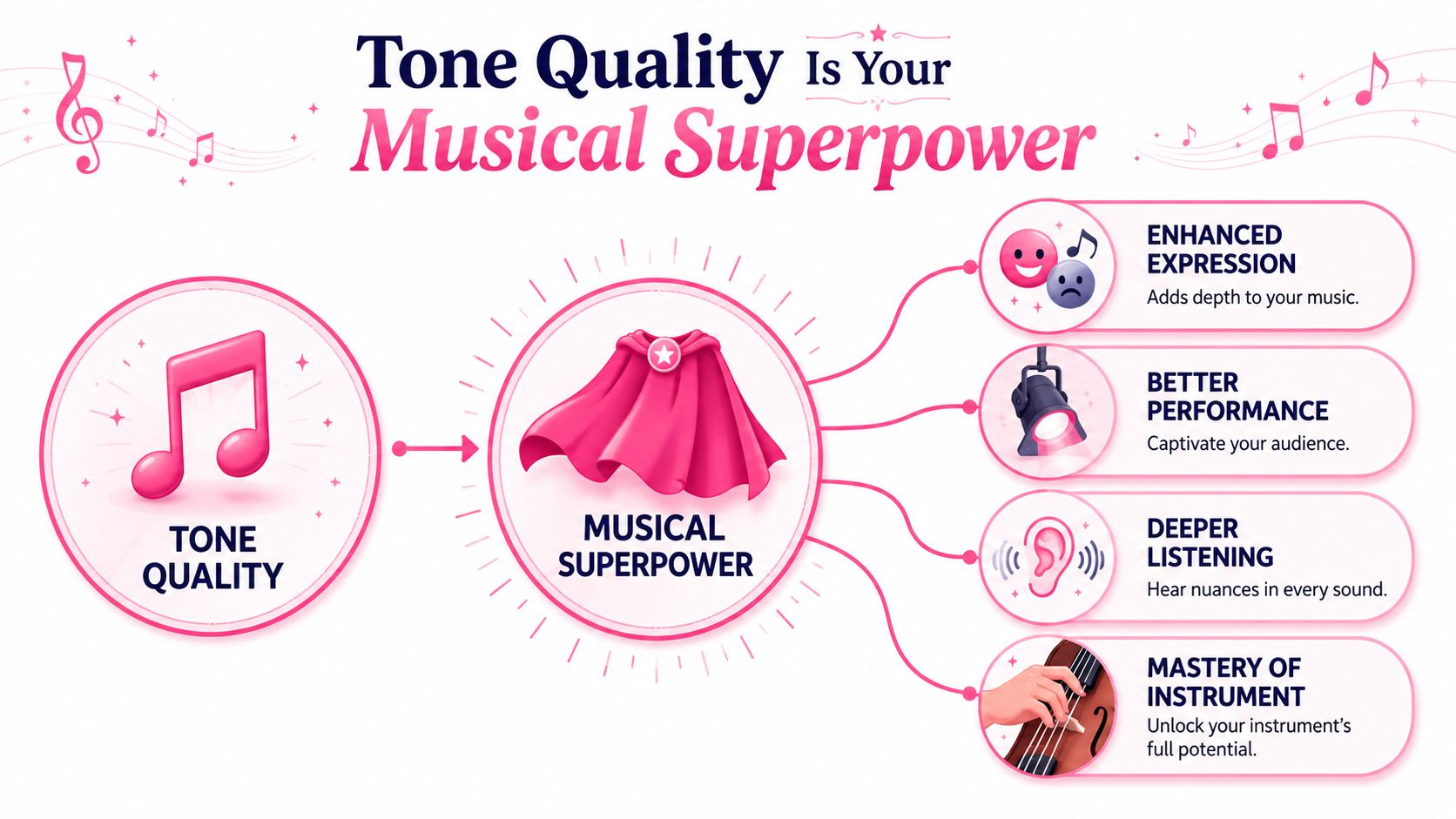
When you hear tone quality well, you stop listening to music like a blur. You start hearing layers. You notice which sound carries the melody, which instrument thickens the harmony, and which voice cuts through the texture.
What this changes in real playing
- Learning songs by ear gets easier. You can separate instruments in a mix more clearly, which helps you find chords, bass movement, and melodic lines.
- Improvisation gets more musical. You don’t just choose notes. You react to the color of the sound around you.
- Ensemble playing gets tighter. You hear when your sound blends well and when it sticks out in the wrong way.
- Your own tone improves. Once your ear notices differences in brightness, warmth, breathiness, or focus, your playing becomes more intentional.
- Chord recognition becomes less abstract. You begin hearing how different tones stack and interact, not just naming chord labels from theory.
It helps you hear music, not guess at it
A lot of players stay stuck because they try to identify music with logic alone. They think, “Maybe that chord is major. Maybe that interval is a fifth.” That approach can work sometimes, but it’s slow.
Tone awareness gives you another clue. You begin to hear that the keyboard pad is soft and wide, the guitar is crisp and percussive, and the vocal sits forward in the mix. That makes your ear training more practical because actual music is never just naked pitches.
The more clearly you hear sound color, the less often you need to rely on trial and error.
This is especially useful if you want to play by ear
If your goal is musical freedom, tone quality matters. It helps you identify what’s happening faster. It helps you copy phrasing more accurately. It helps you match style, not just notes.
That’s a big difference.
A player with strong theory can still sound mechanical. A player with a trained ear can hear the shape, weight, and color of a sound, then respond musically. That’s the kind of skill that supports improvisation, transcription, chord recognition, and eventually even the kind of listening people associate with perfect pitch.
What Creates a Sound’s Unique Fingerprint
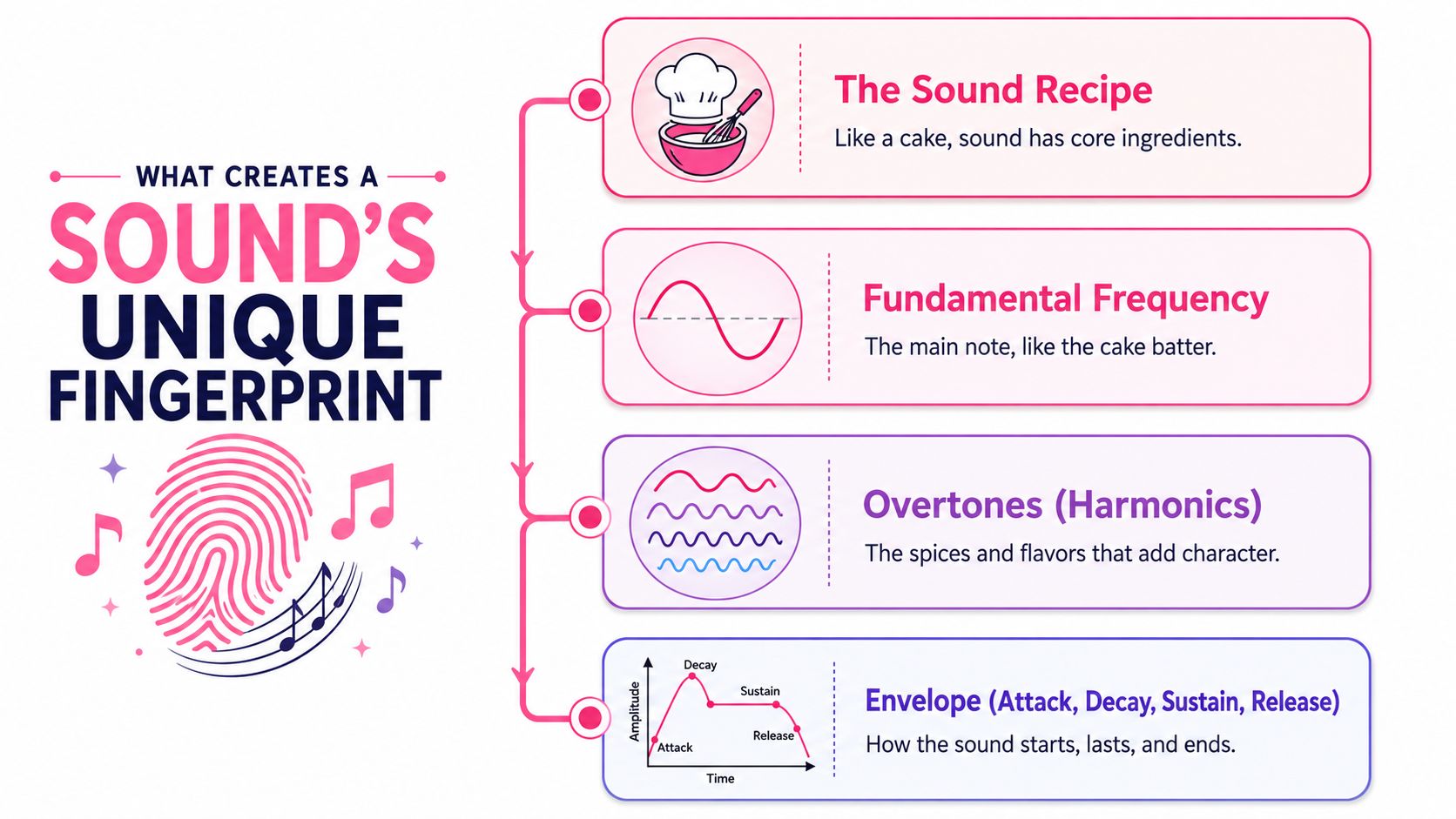
The clearest answer to “what is tone quality” is that it’s the result of several parts of a sound working together. For musical sound, tone quality, often called timbre, is determined by the combination of the fundamental frequency, harmonics or overtones, waveform shape, resonance, and the medium of propagation. That’s why two instruments can play the same note at the same loudness yet still sound different because their harmonic content and resonance profiles differ (reference on timbre and sound components).
Think of sound like a recipe
A note is like a cake.
The fundamental frequency is the base ingredient. It tells you the main pitch you hear. If the note is A, that’s your core flavor.
The overtones or harmonics are everything added on top. They’re like sugar, spice, vanilla, and texture. You may not name each one while listening, but together they shape the final result.
Then there’s waveform shape and resonance. These affect how the sound vibrates and where it seems to “live.” A guitar body resonates differently from a clarinet tube. A human voice resonates through the body in a different way from either one.
Why some sounds feel bright and others feel warm
Musicians often use descriptive words like bright, dark, warm, airy, nasal, focused, or buzzy.
Those words aren’t random. They usually point to differences in the balance of overtones and resonance. A brighter sound tends to make higher parts of the sound more noticeable. A darker sound tends to feel heavier or softer on top. A warm sound often feels full and rounded.
You don’t need a physics degree to hear this.
Try this simple comparison:
| Sound | What you might notice |
|---|---|
| Flute | Smooth, pure, airy |
| Trumpet | Bright, bold, brassy |
| Nylon-string guitar | Warm, mellow, soft-edged |
| Steel-string acoustic | Crisp, ringing, shimmering |
Those aren’t hard rules. They’re listening handles. They give your ear something to latch onto.
Why this matters for real musicians
If you only focus on pitch, you miss a big part of musical listening.
A singer can hit the right note with a breathy tone or a resonant tone. A guitarist can play the same chord with a soft touch or a sharp attack. A pianist can shape the exact same note so it feels gentle, punchy, dry, or singing.
When your ear notices tone quality, music stops sounding flat. It starts sounding three-dimensional.
That’s why ear training should include more than note drills. If you want to play by ear, improvise with confidence, or build the kind of listening some people connect with perfect pitch, you need to hear the full sound, not just the note name.
Hearing in Color with Instruments and Voices
Once you start listening for tone quality, everyday sounds become easier to sort. You stop hearing “an instrument” and start hearing its character.
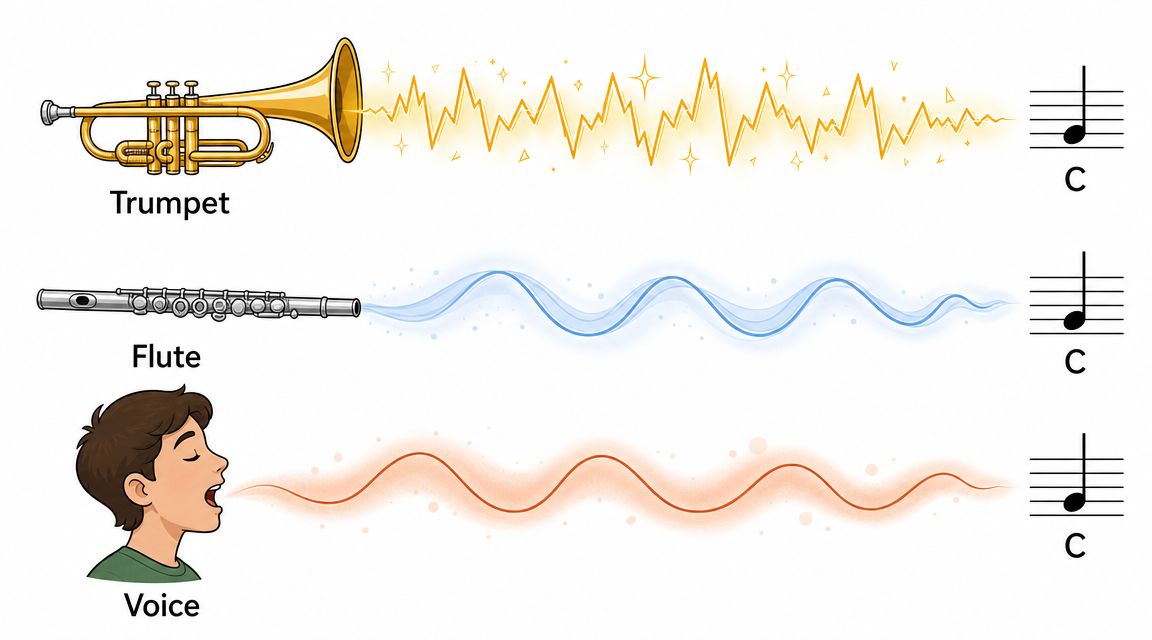
A flute often feels light and airy. A trumpet can feel bright and direct. A cello might sound rich and deep, while a violin on the same pitch range can feel more focused or cutting. Even inside one instrument family, tone shifts fast. A nylon-string guitar and a steel-string acoustic don’t just differ in volume. They speak with different colors.
Voices are even more obvious once you know what to hear.
One singer might sound breathy, where air seems to ride along with the note. Another sounds resonant, where the tone feels fuller and more centered. Another may sound sharp-edged or nasal, not necessarily in a bad way, but in a way that gives the voice identity.
If you work on singing, these listening habits pair well with focused vocal training tones because they help you connect what you feel in your voice to what you hear.
Words that help you hear better
A small sound vocabulary goes a long way. Try using words like these while listening:
- Bright when a sound feels clear, shiny, or cutting
- Dark when it feels covered, weighty, or muted
- Warm when it feels rounded and full
- Thin when it feels narrow or lacking body
- Breathy when extra air is part of the sound
- Focused when the tone feels centered and steady
These words won’t replace your ear. They train it. The moment you can describe a tone, you’re closer to recognizing it again later.
Tone quality can change what you think you heard
Tone quality doesn’t only affect your opinion of a sound. It can affect your judgment of pitch itself.
In a controlled study, more inexperienced players heard relatively brighter tones as sharper in intonation, while darker tones were judged flatter. The same research also found that for brass tones, listeners preferred the unaltered and bright tones over darker ones, while for clarinet tones the bright version was judged worse than the unaltered or dark versions (controlled study on tone quality and intonation judgments).
That’s a huge aha moment for ear training. If tone color can influence how pitch feels, then hearing accurately means training for more than note names. It means learning to separate pitch from tone, while also understanding how they interact.
How to Train Your Ear for Tone Quality
You can train this. You don’t need special talent, and you don’t need to wait until you have perfect pitch.
What you need is short, focused listening done consistently.

Exercise one, follow one sound
Put on a song you know well.
Choose one instrument only. Bass. Vocal. Guitar. Piano. Then follow it from the beginning of the song to the end. Don’t analyze everything. Just stay with that one sound.
Ask yourself:
- Where does it sit in the mix?
- How does it begin each note?
- Does it feel bright, dark, soft, rough, airy, or punchy?
This trains selective listening, which is one of the biggest skills behind playing by ear.
Exercise two, describe before you judge
A lot of musicians jump too quickly to “good” or “bad.”
Instead, write down three to five words that describe the tone. Keep it simple. Warm. Thin. Smooth. Harsh. Open. Covered. Rounded. Metallic.
That tiny step changes how you listen. You stop reacting and start observing.
Listening cue: Describe first. Judge later.
Do this with singers too. You’ll start noticing that two people can sing the same melody with very different tone quality, and that difference changes the whole emotional feel.
Exercise three, compare versions of the same note
Play one note on two different instruments if you can. Or compare two singers holding the same pitch. Listen for what stays the same and what changes.
The pitch is the same. The tone quality isn’t.
That’s one of the fastest ways to build the concept in your ear. If you want more simple drills to support this kind of listening, these ear training exercises for daily practice are a strong place to start.
After you’ve tried the sound-isolation work, it helps to hear a guided explanation and listen along:

Make it a daily ear training habit
The biggest mistake isn’t practicing “wrong.” It’s practicing too rarely.
If you spend 10 minutes a day listening on purpose, your ear starts to organize sound much more clearly. You notice instruments faster. You hear blend more easily. Chord recognition improves because you’re no longer overwhelmed by the surface texture of a mix.
A good routine looks like this:
- One minute listening to a single instrument in a song
- Three minutes describing tone words out loud or on paper
- Three minutes comparing two sounds with the same pitch
- Three minutes doing regular ear training on intervals, chords, or scales
That combination builds a more complete musical ear. It helps with transcription, improvisation, ensemble awareness, and the deeper goal behind all ear training, which is learning to hear music clearly enough to respond without guessing.
Start Your Daily Listening Practice Today
Tone quality isn’t a bonus skill for advanced musicians. It’s part of how real listening works.
When you hear the color of a sound, you learn songs faster, match style more accurately, and make better musical decisions in the moment. That’s true whether you’re working on ear training, trying to play by ear, singing with better control, or chasing the kind of note recognition people often associate with perfect pitch.
Keep it simple. Spend 10 minutes a day listening on purpose.
That daily habit adds up. Your ear gets sharper. Your playing gets freer. Music starts to sound less like a puzzle and more like a language you can understand.
If you want a structured way to build that habit, Trill: Ear Training Daily is designed for exactly that. It helps musicians train chords, intervals, notes, and scales through short daily sessions so you can stop guessing, play by ear with more confidence, and turn ear training into a practice you’ll keep.