Choir Sight Reading Success: Proven Methods
You hand out a new octavo. Folders open. Eyes drop to the page. Then the room fills with the same symptoms every choir director knows. Late entrances, sliding pitches, frozen faces, and that one brave section that keeps going while everyone else hopes the exercise ends fast.
That moment feels like a note-reading problem. Usually, it isn’t.
Most choir sight reading breaks down because singers don’t yet hear what they see. They try to decode symbols faster than their ears can organize sound. So they guess. They chase the piano. They survive the page instead of understanding it.
The good news is that this skill is trainable. Not just for the “naturally gifted” student. Not just for the section leader with strong theory. If singers practice hearing tonality, rhythm, and patterns every day, choir sight reading becomes far less mysterious. It starts to feel like listening first, then singing what the ear already expects.
Table of Contents
- Why Most Choirs Dread Sight Reading
- The Foundation Before You Sing a Single Note
- Building Your Individual Ear Training Toolkit
- A Smarter Way to Run Rehearsal Drills
- Moving Beyond Notes to Hear Musical Patterns
- Tracking Your Progress and Building Consistency
Why Most Choirs Dread Sight Reading
Choirs dread sight reading because many singers experience it as public guessing. The page arrives, the accompanist gives a starting note, and everyone feels they must succeed instantly. When they can’t, they assume the problem is talent.
That belief does real damage. It teaches singers that sight reading belongs to a small group of gifted musicians, while everyone else just tries not to fall behind. In reality, most weak sight reading comes from missing habits, not missing ability.
The real problem is usually the ear
If a singer doesn’t have the key center in their ear, every pitch feels isolated. If they don’t feel the pulse internally, every rhythm becomes a small emergency. That’s why some students can name notes on the staff but still can’t sing a fresh line accurately. Their eyes recognize the symbols, but their ears haven’t connected those symbols to sound.
Practical rule: If singers are guessing, slow down the hearing process before you speed up the reading process.
This is where ear training changes everything. A singer who can hear scale motion, feel pulse steadily, and recognize familiar melodic shapes doesn’t approach new music as a wall of information. They approach it as something partly familiar.
Why this matters beyond the classroom
Strong choir sight reading isn’t just about contest rooms or rehearsal efficiency. It supports real musicianship.
When singers learn to hear what they read, they also improve skills that matter outside rehearsal:
- Pitch security: They can find notes with less dependence on the piano.
- Chord awareness: They start to notice where their line fits in the harmony.
- Playing by ear: They connect written music to the same listening skills used to figure out songs by ear.
- Musical freedom: They spend less energy surviving notes and more energy shaping phrases.
A lot of people get confused here and think sight reading and playing by ear are opposites. They aren’t. Good readers hear better. Good listeners read better. Both skills depend on the same inner hearing.
So if your choir struggles, don’t frame the problem as “we’re bad at reading.” Frame it as “we’re training the ear to lead.” That change in mindset makes the drills feel purposeful, and it gives singers a reason to stick with them.
The Foundation Before You Sing a Single Note
Most ensembles make the same mistake. They see music and try to sing it immediately.
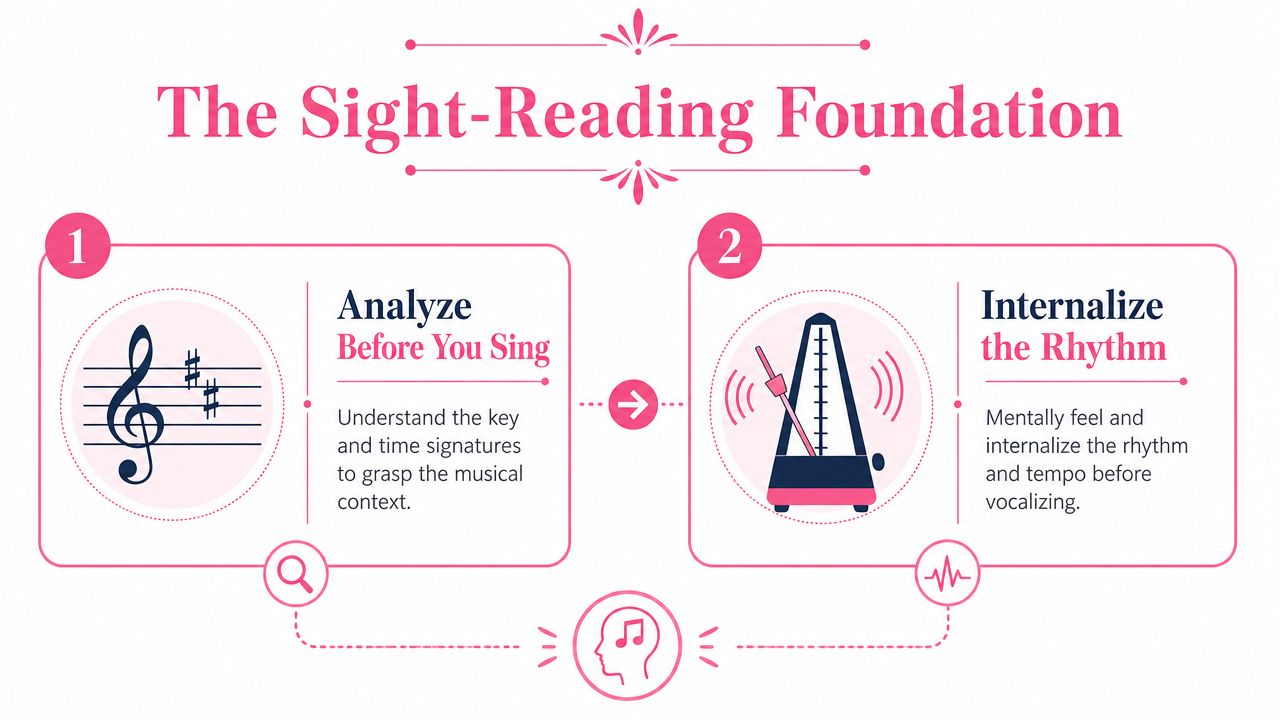
That feels efficient, but it usually creates a pileup of errors. Singers lose the tonal center, rhythms wobble, and once the group drifts, everyone starts copying the loudest person. A more reliable process is widely supported in choral pedagogy: establish tonality first, remove the piano, isolate rhythm by chanting, allow a silent preview, then sing. This sequence reduces overload by separating rhythm from pitch, and research on beginning choirs reported that this approach, along with individual assessment, increased scores by over 140% in 8 weeks in one treatment (Ashley Danyew’s summary of choir sight-reading strategies).
Start with sound, not symbols
Before anyone sings the excerpt, give them the home base of the key. That might be a tonic chord, or a short pattern such as I-IV-V7-I. The exact tool matters less than the result. Singers need to feel, ‘do resides here. The music wants to settle here.’
Then remove the piano.
That part makes directors nervous, but it matters. If the piano keeps feeding pitches, singers often follow the instrument instead of building internal hearing. Choir sight reading improves when the ensemble learns to carry the tonal center mentally.
Use a short routine like this:
- Name the tonal home: Ask what key or tonal center they hear.
- Sing the tonic chord or scale fragment: Keep it brief.
- Point out the first and last scale degree: Help singers hear where the phrase begins and resolves.
- Preview silently: Let them hear the line in their head before sound enters the room.
Silent preview isn’t wasted time. It’s the moment singers convert notation into internal sound.
Let rhythm carry less mental weight
Rhythm is often where singers panic first. When the pulse feels unstable, pitch usually suffers too. That’s why chanting or counting the rhythm before singing is so effective. It removes one layer of difficulty and lets the ensemble lock into flow.
A simple comparison helps:
| Approach | What singers experience |
|---|---|
| Sing immediately | Too many decisions at once |
| Chant rhythm first | Pulse becomes stable before pitch enters |
| Silent preview after chanting | The line feels more familiar on the first sung attempt |
Keep the first examples short. An 8-measure unison line is often enough to teach the process without overwhelming the group, as described in the same practical workflow above. Once singers can handle that calmly, then expand to multiple parts.
A few rehearsal reminders keep the method clean:
- Keep the tempo steady: Don’t let the group stop every time someone misses a note.
- Isolate trouble spots: If one measure causes the crash, fix that measure instead of rerunning everything.
- Use hand signs or simple tonal cues: These help singers connect pitch movement to sound, not just to notation.
The point isn’t to create a ritual for its own sake. The point is to help singers hear first. If they can hear the key and feel the rhythm before they open their mouths, the first sung attempt becomes much more honest. It stops being a guess.
Building Your Individual Ear Training Toolkit
Ensemble growth depends on what individual singers can do when no one is helping them. If the ear isn’t active between rehearsals, choir sight reading stays fragile. Singers may survive the group setting, but they won’t become independent readers.
That’s why short daily work beats occasional marathon practice. A focused 10 minutes a day gives the brain regular contact with pitch relationships, rhythm patterns, and tonal memory. It keeps hearing skills alive.

Why 10 minutes a day works better
Singers often wait for a free hour. That hour rarely appears.
But finding 10 minutes is achievable. That small window is enough to practice the exact hearing skills that support sight reading and playing by ear. You’re not trying to become perfect overnight. You’re teaching your ear to recognize patterns faster and with less guessing.
The biggest misconception about ear training is that it belongs only to advanced musicians, or to people chasing perfect pitch. It doesn’t. Relative hearing is what most singers need. They need to hear whether a note moved up or down, whether a phrase outlines a chord, and whether a leap feels stable or tense.
A simple daily routine
Use the same categories each day so your attention stays focused.
- Intervals first: Sing or identify small and large pitch distances. Don’t chase names only. Ask how each one feels and where it wants to resolve.
- Scale patterns next: Practice short fragments up and down. Hear the sound of stepwise motion until it feels predictable.
- Chord hearing: Listen for whether three notes sound like a stable home or a pull away from it.
- Rhythm pulse: Clap or tap one short pattern while keeping a steady beat underneath.
- One short sight-singing line: Apply all of it at once.
If you want more ideas for solo practice, these ear training exercises for musicians are useful models because they focus on hearing before naming.
Use guided listening when you practice alone
A lot of singers stall because they don’t know whether they’re hearing correctly. Guided audio practice helps. It gives immediate feedback and keeps the work from turning into vague repetition.
This quick demo shows what that kind of ear-based practice can look like in real use:

The best daily drills don’t just teach you to label sounds. They teach you to expect them.
That expectation is the bridge between theory and real music. Once a singer can hear intervals and chord motion more clearly, choir sight reading improves because the page no longer feels random. They begin to anticipate sound. That’s also why these same exercises help with improvisation, chord recognition, and the ability to play by ear.
If a student tells you, “I can’t do ear training,” treat that as a practice history issue, not a fixed trait. The ear is trainable. It gets sharper when you use it consistently.
A Smarter Way to Run Rehearsal Drills
Many rehearsal drills waste energy because they ask singers to perform before they’ve prepared. The choir sings, misses, stops, apologizes, and tries again. That loop doesn’t build confidence. It builds caution.
A smarter drill gives singers a clear order of operations and keeps each stage narrow. The room feels calmer because each task has one main job.

A rehearsal sequence that stays efficient
Try this when you introduce fresh material:
-
Silent scan
Give singers a brief look at key signature, meter, starting pitch area, repeated rhythms, and any obvious skips. -
Rhythmic chant
Speak or count the line in tempo. No pitches yet. If the rhythm falls apart, fix it here. -
Solfege or neutral syllable
Add pitch only after pulse is steady. Some choirs do better with solfege. Others need a neutral syllable first and scale-degree language after. -
Sing the excerpt twice
The first attempt reveals the core problem. The second attempt should target that exact problem, not everything at once. -
Reflect briefly
Ask one question: Was the main issue tonal hearing, rhythm control, or attention to pattern?
That reflection step matters more than it seems. Singers improve faster when they can name the cause of an error instead of saying, “We were bad at that one.”
For directors who want more structured material, these sight-singing exercises for choir practice can help vary the examples without changing the rehearsal logic.
Why timing matters more than cramming
One of the strongest historical signals in choir sight reading comes from a 2011 study of school choirs. It found that the earlier teachers introduced sight reading during the academic year, and the more class time they devoted to it, the higher their choirs tended to score. The model using start time and practice time explained about 83% of the variance in choir sight-reading ranking, with p < 0.0001 (Dollins study on choir sight-reading outcomes).
That doesn’t mean every choir needs long daily testing. It means systematic practice matters. Early beats late. Consistent beats crammed.
A short rehearsal table can help directors decide what to do:
| Rehearsal situation | Better choice |
|---|---|
| Choir is anxious with new music | Use a very short excerpt and keep the first win easy |
| Rhythm keeps collapsing | Stay in chant mode longer |
| Pitch is unstable after a good rhythm pass | Re-establish tonality before singing again |
| Students depend on accompaniment | Remove the piano sooner |
Start sight reading before the concert pressure rises. The skill grows better in ordinary rehearsal weeks than in emergency weeks.
Good drills don’t feel dramatic. They feel repeatable. That’s what makes them powerful.
Moving Beyond Notes to Hear Musical Patterns
Weak readers often move note by note. They treat each pitch as new information. That approach is slow, tense, and easy to derail.
Strong readers don’t process music that way. They see groups. They hear functions. They notice that a line is climbing by step, outlining a chord, or moving through a familiar harmonic path. Research synthesis in sight-singing shows that expert sight-readers use more analytic strategies, especially chunking music by harmonic patterns rather than reading every note in isolation. The same review reports that identifying chords and schemas was more beneficial for accuracy than a singular focus on reading ahead (review of sight-singing strategy research).
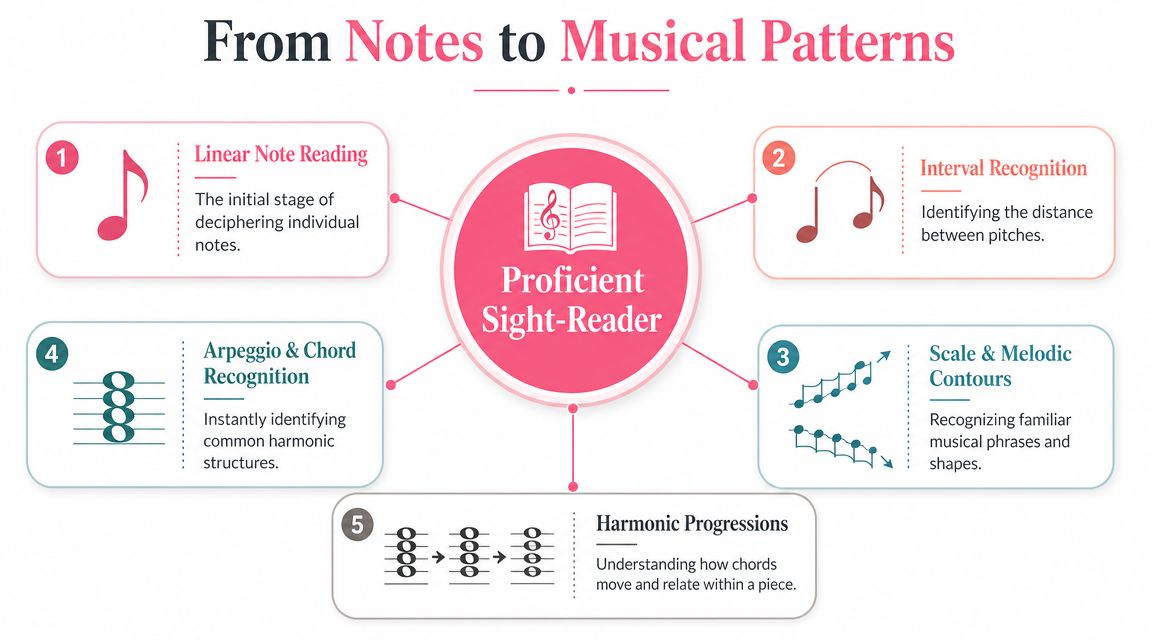
What strong readers notice first
They don’t ask only, “What is the next note?” They ask better questions.
- Is this stepwise or skipping?
- Does this measure outline part of a chord?
- Is this phrase moving away from home or back toward home?
- Have I seen this rhythm or contour before?
That shift changes everything. Instead of reading five separate notes, the singer may hear “ascending scale fragment” or “tonic arpeggio.” Once that happens, accuracy improves because the ear has a map.
A common confusion appears here. Some students think pattern recognition is just theory vocabulary. It isn’t. The point isn’t to say impressive words. The point is to hear familiar sound shapes quickly enough that the voice can follow them in real time.
How to teach chunking in plain language
Use language singers can feel right away.
If the notes are do-mi-sol, don’t start with abstraction. Say, “This is a home chord. Hear how stable it feels.” If a line goes sol-fa-mi-re-do, say, “This is falling back home by step.” If a phrase alternates two familiar chord tones, ask them to hear the chord underneath, even if no one is singing the full harmony.
A practical teaching sequence looks like this:
-
Spot the contour
Is the line mostly rising, falling, or circling around one pitch? -
Find the chord tones
Which notes feel strongest or most settled? -
Notice the filler notes Which notes connect the stronger ones by step?
-
Sing the skeleton first
Try just the anchor notes, then add passing notes.
Reading ahead can help, but it doesn’t replace harmonic hearing. Singers do better when they recognize the structure inside the line.
This is also where ear training and play by ear skills meet choir work in a very practical way. A musician who can hear chord movement in real music is less dependent on one-note-at-a-time decoding. They can predict. They can recover. They can stay oriented even after a mistake.
If you want choir sight reading to become fluid, teach singers to hear patterns, not just names. The page gets easier when the ear starts grouping information into larger musical ideas.
Tracking Your Progress and Building Consistency
Singers improve faster when progress is visible. Without some kind of tracking, rehearsal starts to feel repetitive, and students assume nothing is changing. That’s especially true with choir sight reading, because many gains are subtle at first. A singer may be hearing the key more clearly or recovering from errors faster before they see dramatic results on harder literature.
You don’t need complicated software to measure growth. You need a repeatable habit.
Measure what singers can hear
Use simple checkpoints after each attempt.
- Record one first read each week: Compare steadiness, pitch security, and recovery from mistakes.
- Rate the attempt on a small scale: Not for grades. For awareness. How secure did the rhythm feel? How stable was the tonal center?
- Write one sentence after singing: “I lost the key center after the leap.” “I stayed steady because I heard the pattern.”
- Track individual weak spots: For one singer it may be skips. For another, dotted rhythms. For another, holding pitch without piano support.
A practice log becomes more useful when it reflects hearing, not just correctness. “Missed note in measure 4” is less helpful than “Didn’t hear the chord change before measure 4.”
Build a system, not a motivational speech
Motivation comes and goes. Systems survive busy weeks.
For individuals, that system might be a daily 10-minute block. For directors, it might be the first few minutes of rehearsal on the same days every week. Either way, consistency matters more than intensity.
A simple structure works:
| Habit | Why it helps |
|---|---|
| Same practice time each day | Removes decision fatigue |
| Short first-read recordings | Makes growth audible |
| One focus per week | Keeps attention narrow |
| Practice log | Turns vague effort into visible patterns |
If you want a simple tool for daily consistency, a music practice tracker app for musicians can make it easier to keep records and maintain the habit.
The goal isn’t to become fearless overnight. The goal is to replace guessing with hearing, one session at a time. When singers can hear the key, feel the beat, and recognize the pattern in front of them, sight reading stops feeling like an ambush. It becomes another musical skill they know how to train.
If you want a daily system for building ear training, chord recognition, interval hearing, and stronger play-by-ear skills, take a look at Trill: Ear Training Daily. It’s designed for short, consistent practice so you can stop guessing and start hearing music more clearly.