Bass Staff Music: A Guide to Reading and Hearing the Low End
You hear a bassline in a song and know it matters. It’s the part that makes the chorus feel grounded, the groove feel alive, and the chords make sense. Then you look at bass staff music on the page and it can feel like a separate language.
That gap is where a lot of musicians get stuck.
They can tap the rhythm. They can hum the contour. But when the notes appear in bass clef, the sound in their head doesn’t connect to the symbols in front of them. They guess, hunt, and memorize. What they want is to play by ear with confidence, not decode one note at a time.
Bass staff music can help with that. It isn’t just a reading system for low notes. It’s a visual map of how the low end moves. When you learn to read it while training your ear, you start to recognize basslines, hear root motion, and feel intervals instead of treating every note as an isolated fact.
Table of Contents
- Your Guide to Hearing the Music Behind the Notes
- What Is the Bass Staff and Why Does It Matter
- Decoding the Notes on the Bass Staff
- Reading Beyond the Staff With Ledger Lines
- How Bass Staff Music Applies to Your Instrument
- Practical Exercises to Train Your Eyes and Ears
- From Reading Notes to Making Music
Your Guide to Hearing the Music Behind the Notes
A beginner bassist once told me, “I can hear when a line goes up or down, but once I see bass clef, I freeze.” That’s common. The ear notices shape first. The eyes often get trained to chase note names later.
The better path is to connect those two skills early.
When you hear a simple groove, you’re already noticing musical facts. You can tell whether the line stays put, steps upward, drops, or leaps. That’s not random guessing. That’s the start of ear training, and it’s trainable.
You don’t need perfect pitch to read bass staff music well. You need steady practice linking what you see to what you hear.
That’s why bass staff music matters so much for musicians who want freedom. If you only memorize note names, you may pass a worksheet but still hesitate when you need to pick out a bassline, sing a low harmony, or improvise over a progression. If you connect the notes to sound, the page starts helping your ear instead of slowing it down.
Three real skills grow from that connection:
- Recognizing bass movement: You start hearing when a line moves by step, skip, or repeat.
- Finding chord roots faster: Low notes often tell you where the harmony is going.
- Improvising with more control: You stop throwing notes at the beat and start hearing where the line wants to go.
A lot of beginner material treats bass clef as a memory game. That’s only the first inch of the journey. Musicians need to know how the low end functions in real music, especially when notes shift between staves, sit on ledger lines, or belong to a larger phrase rather than a single flashcard answer, as noted in Khan Academy’s bass clef and grand staff lesson.
What Is the Bass Staff and Why Does It Matter
The musical staff is a grid for pitch. It has 5 lines and 4 spaces, and each line or space can hold a note. On its own, though, that grid doesn’t tell you which notes you’re looking at.
The staff is the map
The clef gives the staff its meaning. It functions as a compass on a map. Without the compass, you have shapes but no direction.
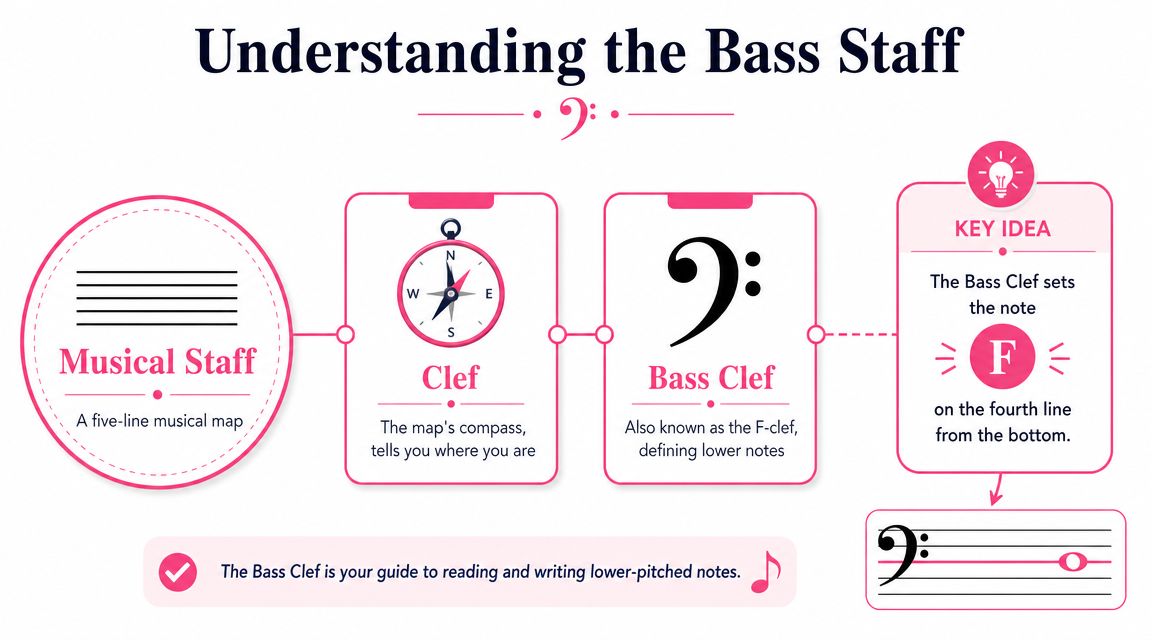
In bass staff music, that compass is the bass clef, also called the F clef. It tells you that the music lives in the lower register. That matters for instruments and parts that sit below middle C, like left-hand piano parts and many bass-range lines.
Why the bass clef exists
The bass clef didn’t appear out of nowhere. One reference source traces the staff back to the 11th century, when Guido of Arezzo introduced the musical staff around 1030 to show pitch more precisely, and by the 16th century the bass clef had become a standard part of notation. That shift helped composers separate lower voices and instruments from higher ones on the same five-line system, which shaped how Western music was written afterward, as described in this history of the bass clef and staff notation.
That history matters because the problem hasn’t changed. Musicians still need a clean way to read low notes without clutter.
Here’s the practical value of the bass staff:
- It reduces visual clutter: Low notes can sit close to the staff instead of floating under a stack of extra lines.
- It helps ensemble reading: Lower parts stay readable next to higher parts.
- It supports hearing the foundation: When you read low notes clearly, it’s easier to hear bass motion, harmonic direction, and groove.
Practical rule: Don’t think of the bass clef as “the hard clef.” Think of it as the clef that keeps low music readable.
If you play bass guitar, cello, tuba, bassoon, or keyboard left hand, this isn’t optional theory. It’s the notation system built for the range where your musical decisions happen. And if you’re a singer, guitarist, or producer, learning bass staff music helps you hear the part of the arrangement that often tells you what the chords are doing.
Decoding the Notes on the Bass Staff
Most players start with mnemonics, and that’s fine. They give you a foothold. But they’re only the doorway.
Start with the fixed note names
In bass clef, the symbol’s two dots bracket the line for F below middle C. That’s why it’s called the F clef. The line notes are G, B, D, F, A, and the space notes are A, C, E, G, as explained in this bass clef note guide from ToneGym.
Many students use these mnemonics:
- Lines: Good Boys Do Fine Always
- Spaces: All Cows Eat Grass
They work. Use them at first.
But don’t stop there, because music doesn’t arrive one isolated note at a time. It arrives as patterns.
Bass Clef Note Positions
| Location | Note Names (Bottom to Top) | Mnemonic |
|---|---|---|
| Lines | G, B, D, F, A | Good Boys Do Fine Always |
| Spaces | A, C, E, G | All Cows Eat Grass |
One more thing helps beginners fast. The note on a line stays on a line when it moves by skip. The note moves from line to space, or space to line, when it moves by step. Your eyes can use that before your brain finishes naming the note.
Read by distance, not only by labels
That’s where reading speed starts to change.
If you see one note and the next note is one step higher, you don’t need to pause and decode from scratch. You can feel the motion. The page is showing you musical distance.
This is also where ear training starts doing real work:
- Step: Sing or play the next closest note.
- Skip: Hear a wider move, often more open and less smooth.
- Repeat: Feel the line stay grounded.
- Leap: Notice a bigger jump that changes the energy.
Some teaching materials point out that interval recognition can make bass-clef reading easier because you’re reading relationships instead of memorizing isolated answers. That approach transfers better across keys and ranges, especially when ledger lines show up, as discussed in this video on interval-based reading in bass clef.
If you can see “up a step” and hear “up a step,” your reading starts turning into musicianship.
Try this on your instrument. Pick any note on the bass staff. Play it. Then choose the next written note and ask yourself two questions before you play: “Did it go up or down?” and “Was it a step or a skip?” That short pause trains the ear to lead the fingers.
If you also want to compare how another low-range clef works in advanced reading, this guide on how to read tenor clef can sharpen your understanding of how note relationships stay consistent even when the clef changes.
Reading Beyond the Staff With Ledger Lines
The five lines of the bass staff cover a useful range, but music doesn’t stay inside neat borders. Low parts dip lower. Melodies rise. That’s where ledger lines come in.
How ledger lines work
Ledger lines are short extra lines added above or below the staff. They continue the same pattern you already know. A line note is still a line note. A space note is still a space note.
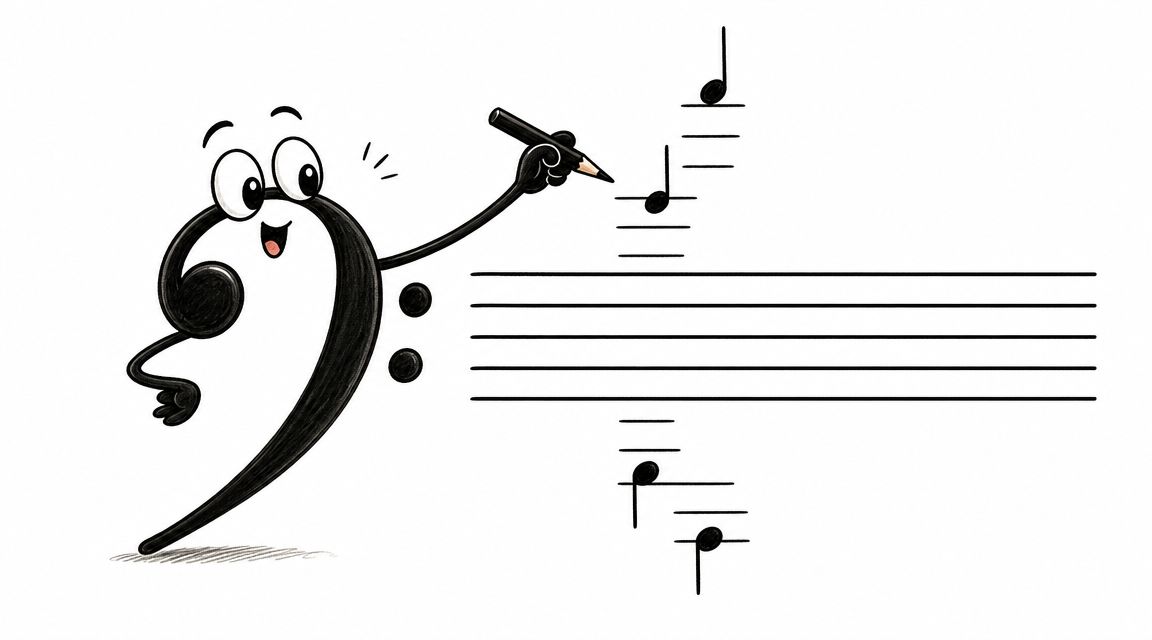
That’s the key idea. Ledger lines are not a separate system. They’re just the staff stretching a little farther.
A good way to practice them is to keep the pattern physical:
- Track line to line: If the previous note was on a line, the next skip lands on another line.
- Track space to space: If the melody rises by step, line becomes space or space becomes line.
- Stay anchored: Use one familiar note as your home base, then count outward.
Middle C is the bridge
In grand staff notation, the upper staff is usually treble clef and the lower staff is bass clef, with middle C placed between them. That layout keeps notes closer to the staff and reduces the need for excessive ledger lines, which improves readability for music that sits below middle C, as explained in Wikipedia’s overview of staff notation).
For keyboard players, that single note is a major landmark. It links the left hand and right hand. For everyone else, it helps you understand that bass and treble clef are not separate worlds. They meet.
Ledger lines look scary when you treat them as exceptions. They get easier when you treat them as normal continuation.
A useful ear exercise is to play a note inside the staff, then one note on a ledger line, then back. Listen for how the sound changes while the visual pattern stays consistent. That helps you stop reacting to ledger lines as visual noise and start hearing them as part of the same pitch map.
How Bass Staff Music Applies to Your Instrument
Bass staff music becomes useful the moment it leaves the page and lands under your fingers, voice, or ears. The value isn’t academic. It’s practical.
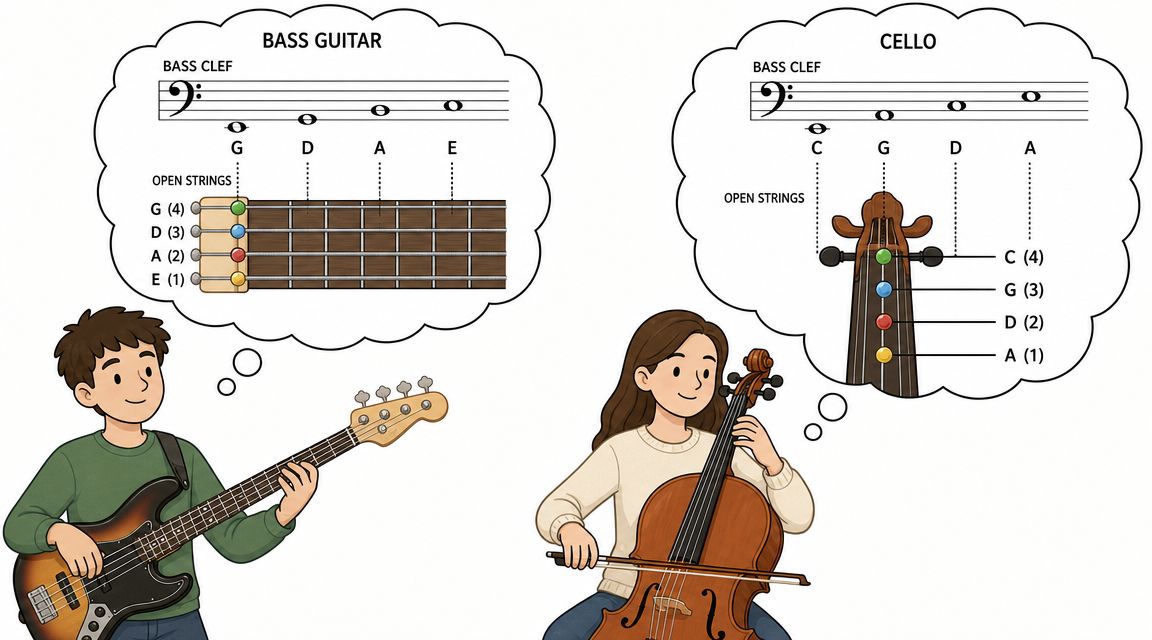
For bass players and cellists
If you play bass guitar, the connection is direct. The bass guitar was invented in the 1930s by Paul Tutmarc, and modern bass guitars are traditionally built with 4 strings. As electric music grew in jazz, rock, and pop, the bass became central to groove and root motion, which is one reason bass staff literacy matters so much for hearing how songs work, according to Musicians Institute’s bass guitar history.
When bass players read, they’re not just identifying pitches. They’re learning to hear function.
A note low on the staff might feel like home. Another might sound like motion away from home. Another might pull you back into the next chord. That’s why reading bass staff music helps with:
- Locking into root movement
- Recognizing repeating groove shapes
- Transcribing basslines by ear with less trial and error
If you want focused practice ideas for your instrument, these bass guitar exercises can help turn staff reading into actual groove work.
For pianists and keyboard players
For keyboard players, the left hand often carries harmony in bass clef while the right hand handles melody or texture in treble. That means the bass staff isn’t background information. It’s where your harmonic choices live.
A lot of confusion comes from seeing the same musical idea split across two staves. A note may appear in bass clef not because it is “a bass instrument note,” but because that placement makes the phrase easier to read as part of the left-hand line. That context matters more than memorizing one-note labels.
Watch how low-register notation works in real playing situations:

For singers, guitarists, and songwriters
You don’t need to perform bass parts to benefit from reading them.
Singers can use the bass line to hear where harmonies sit against the chord foundation. Guitarists can stop relying only on shapes and start hearing why a progression feels stable or tense. Songwriters can look at a low line and understand how it supports the melody from below.
Listening habit: When you hear a chorus, don’t only ask what chord is playing. Ask what the bass is doing underneath it.
That question changes your ears. It pushes you toward chord recognition, arrangement awareness, and more confident improvisation. It also moves you closer to the core goal of music theory: hearing structure clearly enough to make music on purpose.
Practical Exercises to Train Your Eyes and Ears
You glance at a bass clef line, find the note names, and still feel unsure what it will sound like. That gap is normal. Reading starts to feel useful when the page stops being a set of symbols and starts acting like a preview of the low end you are about to hear and play.
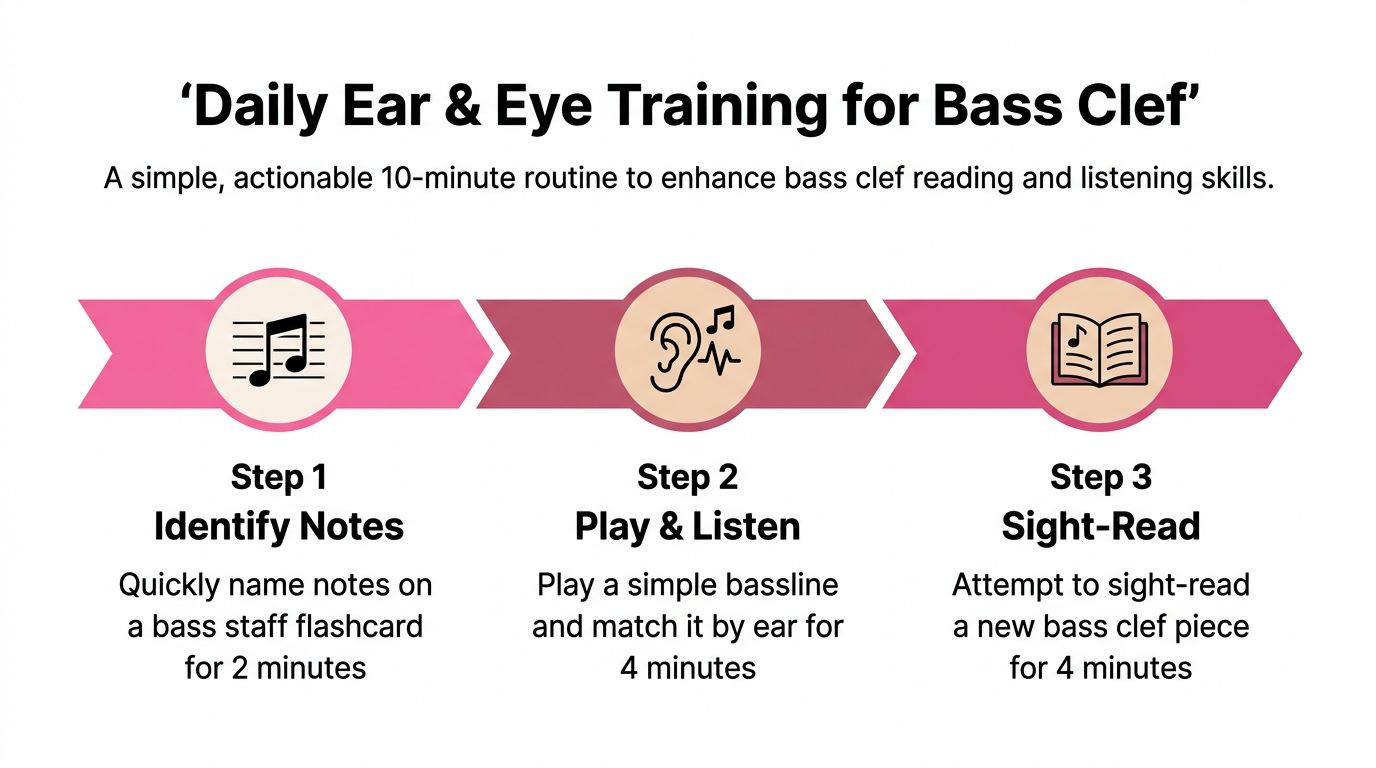
A simple daily routine
A short daily routine works better than a long session you rarely repeat. Ten focused minutes is plenty if each minute connects your eyes, ears, and hands.
Try this:
-
Two minutes of note finding
Look at random bass clef notes, say the note names out loud, then play them. Keep a steady pace. Your goal is to connect the staff position to a real pitch, not to rush. -
Four minutes of interval hearing
Read two notes in a row and name the motion before you play. Is the line going up or down? Does it move by step or leap farther? Sing the move first if possible. That habit helps you hear shape, which is what lets you recognize basslines in actual songs. -
Four minutes of short sight-reading
Read a simple bass clef phrase without stopping every time you miss something. Hold the pulse. Notice repeated notes, neighboring steps, and skips. Those patterns show up constantly in grooves, left-hand piano parts, and basic accompaniment lines.
The routine is simple on purpose. You see a note, predict its sound, and check that prediction on your instrument. That loop is how reading turns into ear training.
Exercises that connect reading and hearing
Use a few drills that make notation audible:
- Silent preview: Look at a short phrase and hear it internally before you touch the instrument.
- Sing then play: Read one note or a small pattern, sing it, then test it on your instrument.
- Bassline tracing: Listen to a simple song and mark whether the bass repeats, walks by step, or jumps by leaps before you hunt for exact notes.
- Root motion practice: Play the lowest note of each chord in a progression and listen to how the harmony changes from one chord to the next.
Each exercise trains a different layer of musicianship. Silent preview strengthens audiation, your ability to hear music in your head. Sing then play helps your voice become a bridge between the page and your fingers. Bassline tracing teaches you to notice movement patterns before note labels. Root motion practice helps you hear why a progression feels settled, tense, or ready to resolve.
For extra structure, Trill: Ear Training Daily includes practice for notes, intervals, chords, and scales, which fits this read, hear, sing, verify cycle well. If you want more ideas for short sessions, these ear training exercises for daily practice pair well with bass staff work.
A common question is whether to train your eyes first or your ears first. Train them together. If you read a written low G, you want more than the letter name. You want to hear its weight, feel where it sits on your instrument, and notice how it pulls against the next note.
Train until a note on the page feels like a sound waiting to happen.
Perfect pitch is not the goal here. Strong relative hearing does the essential work. It helps you hear how one bass note leads to the next, how the line outlines the chord, and how a written pattern becomes a groove you can recognize by ear and improvise around with more confidence.
From Reading Notes to Making Music
Reading bass staff music is not the finish line. It’s a tool that helps you hear low notes more clearly, feel interval movement faster, and understand what the harmony is doing underneath the surface.
That’s where musical freedom starts.
When your eyes and ears work together, you stop treating notation like a test. You start using it to recognize basslines, support your improvisation, and hear chord movement with less guessing. That’s true whether you’re a pianist reading the left hand, a bassist learning grooves, or a singer trying to lock into the harmony from the bottom up.
Keep the practice small and daily. Ten focused minutes can do more than an occasional long session that never becomes a habit. Read a little. Sing a little. Play a little. Listen closely every day.
The goal isn’t to become a human flashcard machine. The goal is to hear music better, trust what you hear, and play by ear with more confidence.
If you want a simple daily system for building those skills, Trill: Ear Training Daily is built for short practice sessions that train note recognition, intervals, chords, and pitch through real listening. It fits well if you’re trying to connect bass staff reading to stronger ear training, better chord recognition, and more freedom to play by ear.