Ear Training Guide: How Do I Know if Im Tone Deaf
The advice you hear most often is blunt. If you sing off key, you are tone deaf, and practice will not help. That advice mixes up three different jobs your ear and voice do, and it sends a lot of accurate listeners into the wrong conclusion.
A bad first note on a familiar song is not a verdict. Plenty of singers hear that a pitch is wrong and still land flat, sharp, or late. Others match well enough in a choir and still miss small changes when two notes sit close together. Asking how do I know if I’m tone deaf only helps if you test hearing, memory, and singing as separate skills, then train the one that failed.
What follows is a patient set of checks, not a label. You will run a short listening screen, a separate singing screen, and a way to read the two results together. From there, the useful path is ear training you can repeat, so you learn to hear music instead of guessing it, and so you can play by ear in real songs.
Table of Contents
- A Five-Minute Self-Check for Pitch Hearing
- Why Most Off-Key Singers Are Not Tone Deaf
- How to Test Pitch Hearing Separately From Singing
- What Your Singing and Hearing Results Mean
- A 10-Minute Daily Routine to Train Your Ear
- When to Train, When to Get Help and Your Next Step
A Five-Minute Self-Check for Pitch Hearing
People who worry they are tone deaf are often off key for a reason they can fix. Limited practice, a tight throat, poor monitoring of your own voice, or a melody you barely know can throw a note off while your ear stays fine. Five quiet minutes can show which of those is in play.
Sit in a quiet room. Use headphones so the room and your own voice do not cover the sound. Do not watch a tuner, a piano roll, or any screen that draws the pitch for you. You are testing what you hear, not what you see.
| Check | What it tests | Pass signal | Warning sign |
|---|---|---|---|
| Same or different | Pitch hearing, using two notes played one after another | You hear a difference when there is one, and none when there is none | You hear differences that are not there, or you miss clear gaps |
| Higher or lower | Pitch direction on the second note of a pair | Correct on most pairs a semitone apart | Consistently wrong on close pairs |
| Echo a three-note phrase | Hearing plus singing | Right direction and close pitch on most attempts | You hear the change but sing the wrong notes every time |
| Hum a familiar song | Pitch memory | A recognizable tune with roughly the right shape | You cannot follow the shape even of a song you know |
| Sing a slow scale against a tuner | Vocal control | Notes close to target on most tones | Errors run in the same direction every time |
How to read a pass and a warning
Same or different only asks whether two tones match. A pass means your yes and no line up with the recording. A warning means you invent differences, or you miss gaps that a friend hears at once.
Higher or lower asks for direction, not a note name. A pass on pairs about a semitone apart means you can follow a melody up and down. Consistent misses on close pairs point at direction, not at “no musical talent.”
Echo a three-note phrase mixes hearing with singing. If you can say which note moved and still sing the wrong ones, the ear got the message and the voice did not.
Hum a familiar song checks whether you can hold the shape in memory. A hum that still sounds like the song is a pass, even if it is not concert-perfect. Losing the shape of a tune you know well is a different problem from a wobbly high note.
Sing a slow scale against a tuner checks control. Notes that sit near the target on most tones are a pass. Errors that lean the same way every time, always flat or always sharp, usually mean a vocal habit, not a broken ear.
Practical rule: These five checks are screening snapshots, not a diagnosis. Fatigue, a bad headphone seal, or a misunderstood instruction can make one sitting look worse than your real ear.
If the rows disagree, that is useful information. Strong same-or-different answers with a messy scale point at singing. Weak pairs with a decent hum point at fine pitch hearing. The hearing test and the singing test later in this guide split those cases with a fuller two-stage method.
Run the same-or-different check first, out of twenty pairs if you can, and write the score down. That number is your baseline.
Why Most Off-Key Singers Are Not Tone Deaf
Tone deaf is the everyday name for congenital amusia, a lifelong difficulty hearing musical pitch. It is not the same thing as singing badly, skipping lessons, or failing to name a chord. A standard hearing test can still look normal, because the problem sits in musical-pitch processing, not in the ability to hear speech or pure loudness.
A large study of 16,625 people using three objective tests and a questionnaire estimated pitch-based amusia at 1.5%, against the often repeated 4% figure that came from one older single test. The same study found that 46% of affected participants had a similarly affected first-degree relative. The practical point is simple. Trouble matching a pitch, or trouble naming a chord, is a weak reason to decide you have a rare hearing difference.
Three skills, not one label
Hearing pitch means you notice that two notes differ and which way the second one moved. Remembering pitch means you can hold a short tune after the sound stops. Reproducing pitch means your voice or your instrument lands near the note you heard.
Say a student hears that the last note of a phrase is wrong, then sings it flat because breath support drops or because they cannot monitor their own voice. Their hearing worked. Their production did not. The reverse also shows up. A confident singer nails a chorus from muscle memory and still cannot tell two close piano notes apart when nobody is singing along.
A normal audiogram does not close the question. Amusia can sit beside ordinary peripheral hearing, so “my hearing test was fine” does not prove your musical pitch is fine, and a rough chorus does not prove it is not.
Ask which of the three skills is failing. That question replaces “Am I tone deaf?”
Perfect pitch means naming a note with no reference tone. It is uncommon, and you do not need it to play by ear. Relative pitch means hearing how notes relate to each other. That relationship is what you use for chord recognition, for hearing a melody rise, and for improvisation. Daily ear training can build relative pitch even if perfect pitch never arrives. If the gap is in the voice rather than the ear, a focused plan for pitch accuracy in singing is a better next step than a fixed label.
How to Test Pitch Hearing Separately From Singing
Singing muddies the result, because a tight jaw can miss a note you heard clearly. This stage removes the voice. You only listen, answer, and write the answer down.
The six steps
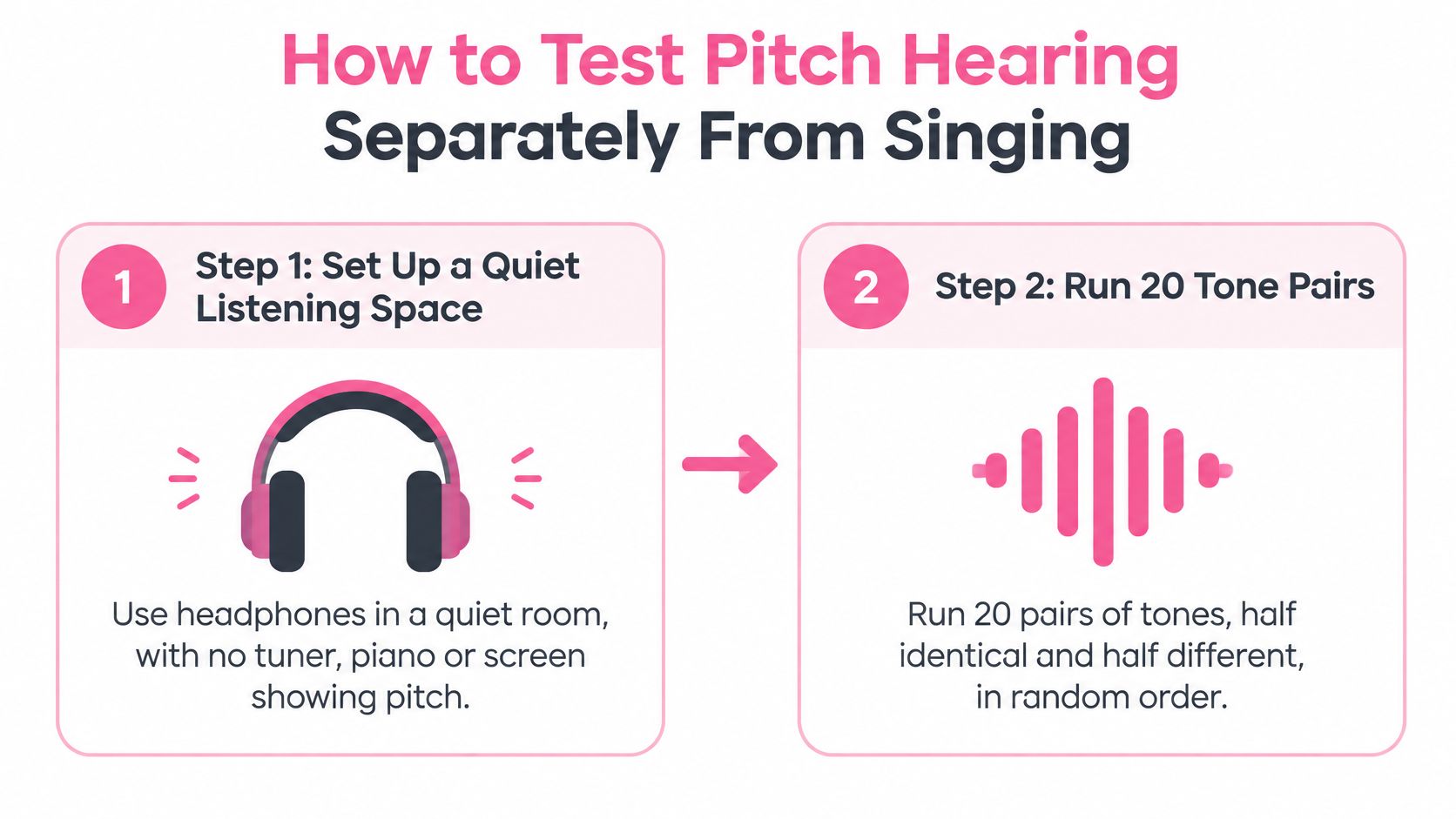
- Use headphones in a quiet room, with no tuner, piano, or screen showing pitch, so you cannot cheat with your eyes.
- Run 20 pairs of tones, half identical and half different, in random order, and record each answer before you hear the next pair.
- Start with a one-semitone difference and count how often you answer correctly, because that gap is the size of the smallest step in a typical Western scale.
- Make the difference smaller after correct answers and larger after errors, until you find the smallest gap you reliably hear, which stops one lucky run from looking like a skill.
- Repeat with short melody pairs, same or different, to check whether musical sounds behave like pure tones, since a beep and a sung phrase are not the same job.
- Repeat on another day, because fatigue, unfamiliar sounds, and inattention can make a first score look worse than it is.
What the score means
Reliably hearing differences of about one semitone is the benchmark this screen uses for ordinary pitch hearing. Difficulty detecting differences larger than one semitone has been used as a research criterion for pitch-based tone deafness. If you miss those wider gaps on a careful retest, take the notes to an audiologist or a music-cognition specialist. They can separate ordinary hearing loss from a specific musical-perception gap. One afternoon is still a screen, not a diagnosis.
A score you can trust sounds like this. You are right on most identical pairs and most different pairs, including pairs a semitone apart, and a second day looks similar. A shaky score sounds like this. You are near chance on close pairs, or your two days disagree by a wide margin. In that second case, fix the setup before you decide anything about yourself. A guided pitch-matching drill is a clean way to repeat the same-or-different task without turning it into a singing test.
One screening result is a clue. It is not a name for your musicianship.
What Your Singing and Hearing Results Mean
Now put the voice back in, on purpose. Record yourself echoing single notes, a four-note pattern, and a familiar song sung on a neutral syllable such as “la” or “doo.” Lyrics hide pitch. A neutral syllable does not. Compare each take with the target on a tuner or a pitch-tracking app, and watch two things: the direction of the errors and their size.
A steady tendency to sing flat is one kind of habit. Random wobble is another, and each points to a different fix.
Echoing a note also stacks three jobs together. Your ear hears the pitch, your memory holds it for a few seconds, and your vocal muscles reproduce it. A shaky take can come from any of the three, which is why the hearing check ran without your voice in it.
The trap in a bad take
Inaccurate singing is not proof of tone deafness. In a study on nonmusicians, participants matched their own recorded voices more accurately with an adjustable slider than by directly controlling their voices. The ear was ahead of the vocal muscles. Judge a take by the median pitch error across the whole phrase, measured in cents (tiny fractions of a semitone), and refuse to let one ugly note at the end carry the verdict. There is no single pass percentage for ordinary singing, because accuracy depends on the definition and the task.
Sort the two results
| Hearing test | Singing test | Likely meaning | Next step |
|---|---|---|---|
| Good | Off-key | Vocal control is the bottleneck | Sing on a neutral syllable, slow down, and check with a tuner |
| Poor | Good | Pitch hearing is the gap | Start with same-or-different and direction drills, then see a specialist if it persists |
| Poor | Poor | Both need work, and the pattern may be lifelong | Retest on several days, and see a specialist if it has always been this way |
| Good | Good | No sign of tone deafness | Move on to chords, intervals, and playing by ear |
Each row carries its own fix. Good hearing with off-key singing puts the bottleneck in the vocal muscles, so slow the phrase, stay in a comfortable register, and stop the backing track before it masks your voice. Poor hearing with decent singing usually means you are replaying a motor pattern your throat already knows. Work on direction drills before adding harder songs, and involve a specialist if careful retests stay weak.
When both results come back poor and the trouble reaches back to childhood, several calm retests on different days matter more than one embarrassed evening. When both come back good, stop hunting for a disorder and put the time into real playing.
After four to six weeks of daily practice, record the same echo test again on the same patterns. Compare the median error across the two recordings and let that number deliver the verdict.
A 10-Minute Daily Routine to Train Your Ear
Train one outcome per sitting, not a pile of theory. Keep the sitting near 10 minutes. That length is a consistency strategy, not a magic dose.
| Minutes | Exercise | Skill built | Payoff when playing |
|---|---|---|---|
| 0-2 | Same or different pairs, one-semitone steps | Pitch discrimination | Hear a wrong note in a song |
| 2-4 | Higher or lower on two-note intervals | Pitch direction | Follow a melody rising and falling |
| 4-6 | Echo three- and four-note phrases | Memory and vocal matching | Pick up a riff by ear |
| 6-8 | Major versus minor chords | Chord recognition | Catch the moment a chord changes |
| 8-10 | Sing scale degrees, then play them | Hearing-to-hands link | Improvise over a two-chord loop |
What each block changes in a real song
The first two minutes stop you guessing whether a note moved. In a song, that is the moment you notice a wrong note in a riff instead of playing past it.
Minutes two to four train direction. When a melody rises into the chorus, you hear the rise before your fingers hunt for it.
Minutes four to six hold a short phrase in memory and send it back out. That is how you lift a riff off a recording without pausing every beat.
Minutes six to eight are chord color. Major against minor is enough to catch the change under a vocal line. You are not naming a jazz extension yet. You are hearing that the harmony moved.
The last two minutes tie ear to hands. Sing a scale degree, then play it. That is the seed of improvising over a two-chord loop, using relative pitch rather than waiting for perfect pitch.
A 12-year study comparing musicians and nonmusicians found that musical training improved basic auditory perception and pattern recognition, including frequency, tone duration, rhythm, and subjective pitch, and that greater amounts of practice went with larger training-related changes in auditory brain responses. The study tracked years of playing, not a promise that exactly ten minutes produces a set result. It still backs the habit. Hearing more accurately is trainable.
Feedback you can use the same day
Immediate correction beats silent guessing. You hear a sound, you answer, and you find out at once whether you were right. That is how Trill: Ear Training Daily runs its short sessions. A list of ear training exercises can fill the ten minutes if you want the drills written out.
Train at the same time each day and log the score. A week of numbers tells you more than a feeling that you “tried.”
When to Train, When to Get Help and Your Next Step
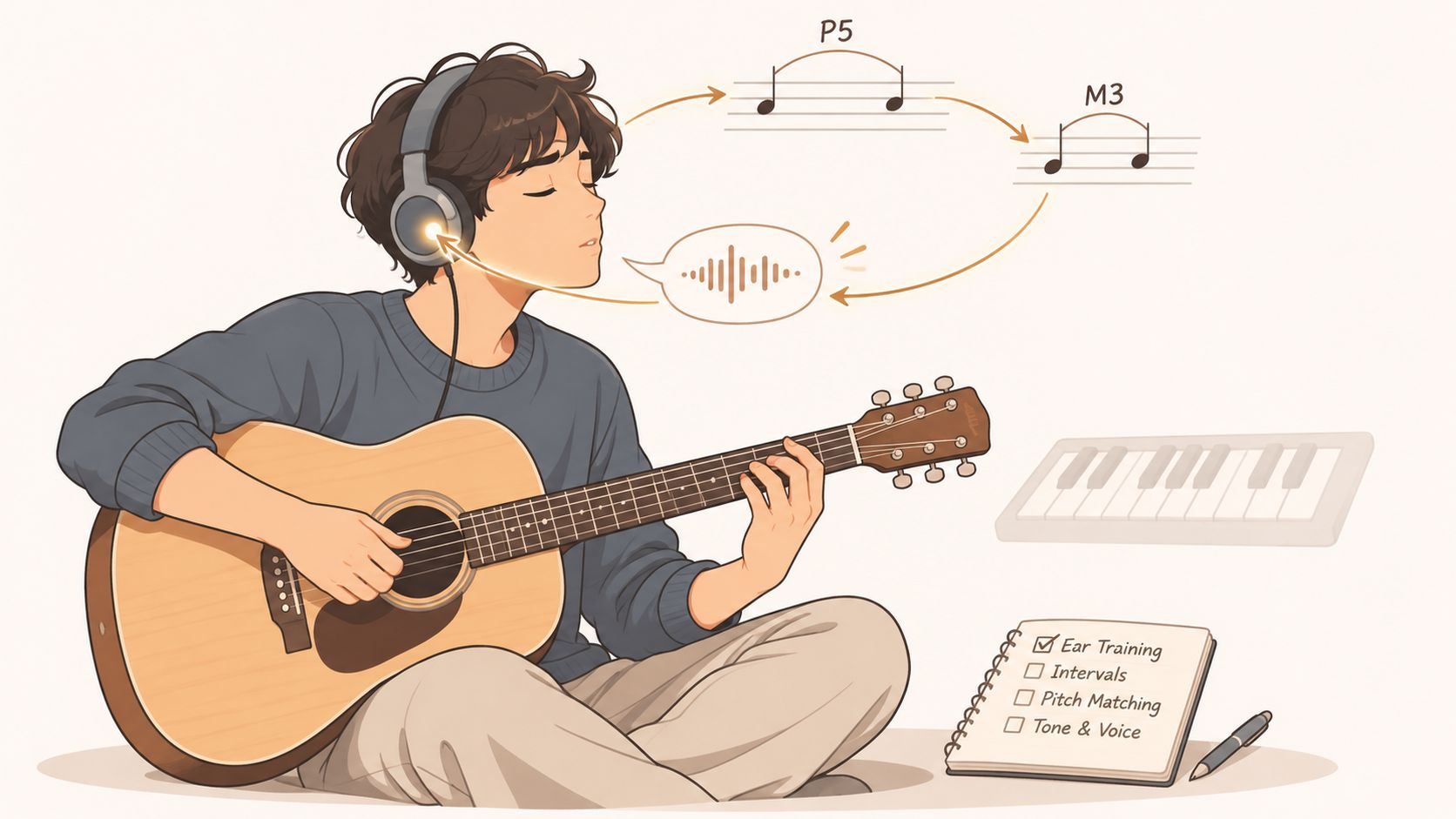
Pitch memory, familiarity with intervals, and the link from ear to voice often move after a few focused weeks. A guitarist who cannot name the key of a song can still hear the chord change once those chords have names. A singer can hear the target clearly and miss it on the first try, then land it once the phrase is slower and the breath is steady. That pattern is practice, not a life sentence.
Signs that need a specialist first
Some patterns should not wait on an app streak.
- Sudden change: Pitch problems that showed up after a stroke, a head injury, or a neurological illness are not lifelong congenital amusia. A clinical history of musical-pitch trouble treats that sudden change as a medical question, separate from ordinary singing.
- Broad, lifelong trouble: Difficulty since childhood that also affects speech-in-noise, loudness, or following conversation needs a hearing check before you blame music.
- Careful retests still fail: Persistent misses on same-or-different tasks, after a quiet setup and a second day, belong with an audiologist or a music-cognition clinic. They use structured melody and pitch tasks, not a single “sing this” prompt.
Attention, anxiety, and an unfamiliar melody can all drag a score down. One bad day is not a verdict.
In our 2026 onboarding survey of about 60,000 musicians, 78% said focus, consistency, structure, or time is what blocks their progress. The most common single reason was that they can’t focus (30%). So give the training its best conditions before you judge the result. A fixed time of day beats a long, irregular session. A visible streak beats a burst of motivation.
Pick the path that matches your two scores
The self-check gives you two numbers: what you hear and what you sing back. Read them side by side.
If hearing is fine and only the echo fails, the gap sits between your ear and your voice. That gap is trainable. Do 10 minutes a day for four to six weeks, then repeat the same-or-different test and the echo test on the same patterns. Slow the phrase down, steady the breath, and sing back single notes before full melodies.
If both scores were solid, move on to chords, intervals, and playing by ear. If the problem was sudden or very broad, see an audiologist or a music-cognition clinic before you pile on drills.
Trill: Ear Training Daily is built as that daily system. Its short sessions and instant feedback fit the ten-minute slot, so the bottleneck you found in the checks is the thing you practice.
Here is a general ear training example of the same idea: you hear a change, you answer, then you play it.

Today, run the five-minute check. Write down your same-or-different score, your direction score, and your echo score. Put a 10-minute slot on the calendar for tomorrow.
Trill: Ear Training Daily gives you short, focused sessions that train pitch, intervals, chords, and melodies with instant feedback, so you can tell a real hearing gap from a singing habit and then practice the skill that was weak. Ten minutes a day is enough to build the relative pitch you use to recognize chords, follow a melody, and play by ear without guessing. Start your first ten-minute session in Trill: Ear Training Daily and let the short drills and instant feedback show you which skill needs the work.