Moonlight Sonata Chords: Learn to Play with Feeling
You’ve probably had this experience. You learn the opening of Beethoven’s Moonlight Sonata, your fingers can find the notes, and yet the music still feels slightly out of reach.
It sounds correct, but it doesn’t feel understood.
That usually happens when you learn the piece as a hand pattern instead of a sound pattern. You’re memorizing shapes, not hearing harmony. And if someone asked you to play the same progression in another key, simplify it on guitar, or recognize it in a different song, you might freeze.
That’s not a talent problem. It’s an ear training problem, and ear training is trainable.
If you want real freedom with Moonlight Sonata chords, the goal isn’t to guess better. The goal is to hear what each chord is doing, so you can play by ear, recognize tension and release, and connect the sound under your fingers to the sound in your mind.
Table of Contents
- Why You Can’t Just Memorize the Moonlight Sonata Chords
- The 3 Core Chords That Define the Movement
- How to Train Your Ear to Hear the Progression
- Simplified Chords for Piano and Guitar
- Beyond Beethoven Reimagining the Chord Progression
- Build Your Ear in 10 Minutes a Day
Why You Can’t Just Memorize the Moonlight Sonata Chords
A lot of players learn Moonlight Sonata chords by watching a tutorial, reading sheet music, or copying hand positions. That can get you through the notes. It usually doesn’t teach you to hear what’s happening.
That’s why so many players can perform the opening at home but can’t recognize the same harmonic move anywhere else. As this Moonlight Sonata practice guide notes, existing content often explains the harmony in theoretical terms but rarely teaches learners how to hear and recognize these chords by ear. That gap matters.
Finger memory isn’t musical understanding
Finger memory is helpful. You need it.
But finger memory alone is like memorizing the route to one building without learning the neighborhood. You can arrive at the destination, yet still feel lost if anything changes.
Real playing by ear works differently. You start to notice:
- Home base: when the harmony feels settled
- Tension: when a chord sounds like it wants to move
- Color shift: when the mood changes even though the rhythm stays steady
- Return: when the music finally lands
Those are listening skills. And once you build them, the piece stops feeling like a sequence of commands.
Practical rule: If you can play the notes but can’t sing the bass movement or identify the tension chord by sound, you haven’t learned the harmony yet.
Why this matters beyond one piece
The first movement of Moonlight Sonata is famous partly because it teaches so much with so little. Beethoven keeps the texture steady, which makes the harmonic changes easier to isolate if you know what to listen for.
That’s great news for your ear training.
Instead of chasing every note at once, you can focus on hearing the chord underneath the pattern. That’s the shift. You stop asking, “Which key do I press next?” and start asking, “What sound is this chord creating?”
Here’s what changes when you train that way:
| Habit | Result |
|---|---|
| Memorizing shapes only | You depend on recall and hope |
| Listening for function | You recognize sound with confidence |
| Watching tutorials passively | You copy one version |
| Training your ear daily | You build transferable musical freedom |
You don’t need perfect pitch to do this. You need repetition, attention, and a simple way to practice every day for 10 minutes a day.
That’s enough to start turning Moonlight Sonata chords from a visual puzzle into something you can hear.
The 3 Core Chords That Define the Movement
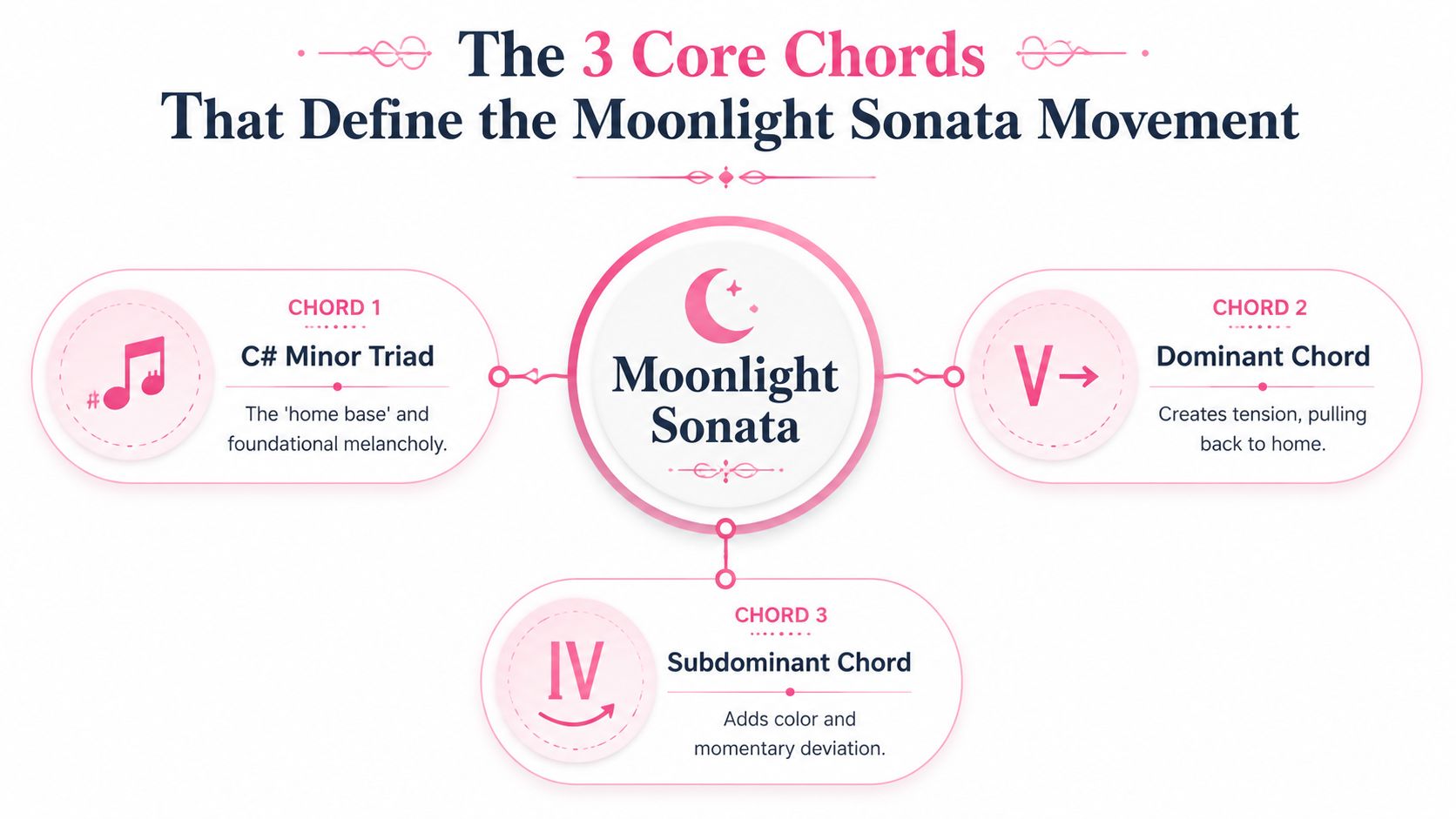
If you try to understand every chord in the first movement all at once, the piece can feel academic fast. A better approach is to hear the harmony as three core colors.
Think of them as the emotional DNA of the opening.
Hear the harmony as a story
The first movement pivots around i–♭II⁶–V–i in C♯ minor, with the famous Neapolitan chord arriving in measure 5, a progression described as a de facto standard in intermediate harmony and aural skills training in Tonara’s history and analysis of Moonlight Sonata.
If that label looks technical, strip it down to the feeling:
- C♯ minor feels like home.
- The Neapolitan chord feels like a sudden shadow of a different color.
- The dominant chord creates pull.
- Back to C♯ minor feels like exhale.
That’s the sound story your ear needs to learn.
If chord labels still feel abstract, a good primer on how chords work in real music can help you connect names to sound more quickly.
The three sounds to listen for
C♯ minor triad
This is the emotional ground floor. It’s the dark, still center of the movement.
You don’t need to hear it as “the i chord” first. Hear it as the place where the music belongs. When you return to it, the piece sounds settled again.
The Neapolitan chord
This is the famous surprise.
In formal analysis, it’s the D♭ major chord in first inversion. For your ear, it’s a color change that sounds both noble and unsettling. It doesn’t behave like home, and it doesn’t behave like pure tension either. It feels like the floor tilts for a moment.
When students finally hear this chord clearly, the opening stops sounding like one long blur of broken chords.
The dominant chord
This is the question mark.
It creates forward pull. It asks for resolution. If C♯ minor is “we are here,” the dominant is “we can’t stay here.”
A simple way to remember the three:
- C♯ minor = home
- Neapolitan = surprise color
- Dominant = pull back home
That’s much easier to hear than a page full of Roman numerals.
Why this matters for ear training
When you reduce Moonlight Sonata chords to these core sounds, you stop drowning in detail. Your ear starts sorting harmony by function.
That skill transfers everywhere. Classical pieces, film scores, pop ballads, and songwriter progressions all become easier to decode because you’re not just identifying notes. You’re identifying roles.
And that’s how people start to play by ear with confidence.
How to Train Your Ear to Hear the Progression
You sit at the piano, or with a guitar in your lap, and the opening of Moonlight Sonata still feels like a blur. The notes are easy to recognize on the page. The harmony is harder to hear in real time.
That gap is normal.
Hearing a progression is a trained listening skill. Your ear learns it the same way your hands learn a new shape. One small repeat at a time, until the pattern starts to feel familiar.

Start with the bass before the full chord
The bass is the floor under the harmony. If you can hear the floor, the rest of the room makes more sense.
In the opening, the bass moves down in a clear line: C♯, B, A, G♯. That descent gives your ear something solid to follow while the upper notes ripple above it. Instead of chasing every broken chord, track that one line first.
Try this in order:
- Play one bass note at a time and listen to the downward motion.
- Sing the notes back in a relaxed voice.
- Add simple block chords above the bass so you can hear harmony without the busy texture.
- Return to the original arpeggiated pattern after the progression feels familiar.
This approach helps because your ear grabs function before detail. You hear where the harmony is going, not just which notes are passing by.
If you want more practice with that skill, this guide on recognizing chords by ear through repeated listening patterns gives you a clear method.
Train the sound of tension and release
A lot of players get stuck because they try to memorize chord names before they can hear chord behavior. Start with behavior.
C♯ minor feels settled. G♯7 feels unfinished. The motion between them works like a question and answer. Once your ear hears that pull, the progression stops sounding random.
A close look at the harmony in this mode mixture analysis points out why the dominant sounds so sharp and directed. For ear training, the useful part is simple. One note presses hard toward home, and your ear can learn to expect that resolution.
Use this drill:
- Play C♯ minor and pause. Let the stable sound settle in.
- Play G♯7 and pause. Notice the tension.
- Resolve back to C♯ minor. Listen for the sense of release.
- Repeat the pair several times. Your ear begins to predict the return.
That prediction is the whole point. Playing by ear gets easier when you stop asking, “What chord was that?” and start hearing, “This sound wants to go home.”
Sing the note that feels pulled forward, then find it on your instrument. That turns theory into something you can actually hear.
Here’s a short demo to support that kind of focused listening:

A simple daily ear training loop
Keep the routine short so you do it.
| Minute range | Task |
|---|---|
| First minutes | Listen to the opening phrase and hum the bass |
| Next few minutes | Play the home chord and dominant, then compare how each one feels |
| After that | Isolate the surprise chord and listen for the color change |
| Final minutes | Play the phrase from memory without looking at music |
Ten focused minutes can teach your ear more than a long session of passive repetition.
The goal is understanding. You want to hear home, tension, and color as they happen, so the Moonlight Sonata progression becomes something you recognize and can play with confidence, not just something you remember with your fingers.
Simplified Chords for Piano and Guitar
You sit down at the piano or pick up the guitar, try the full opening as written, and your hands tense up before your ear learns anything. A simpler version solves that problem. It gives your ear a clear outline of the harmony, the same way a pencil sketch lets you see the shape before you paint in the details.
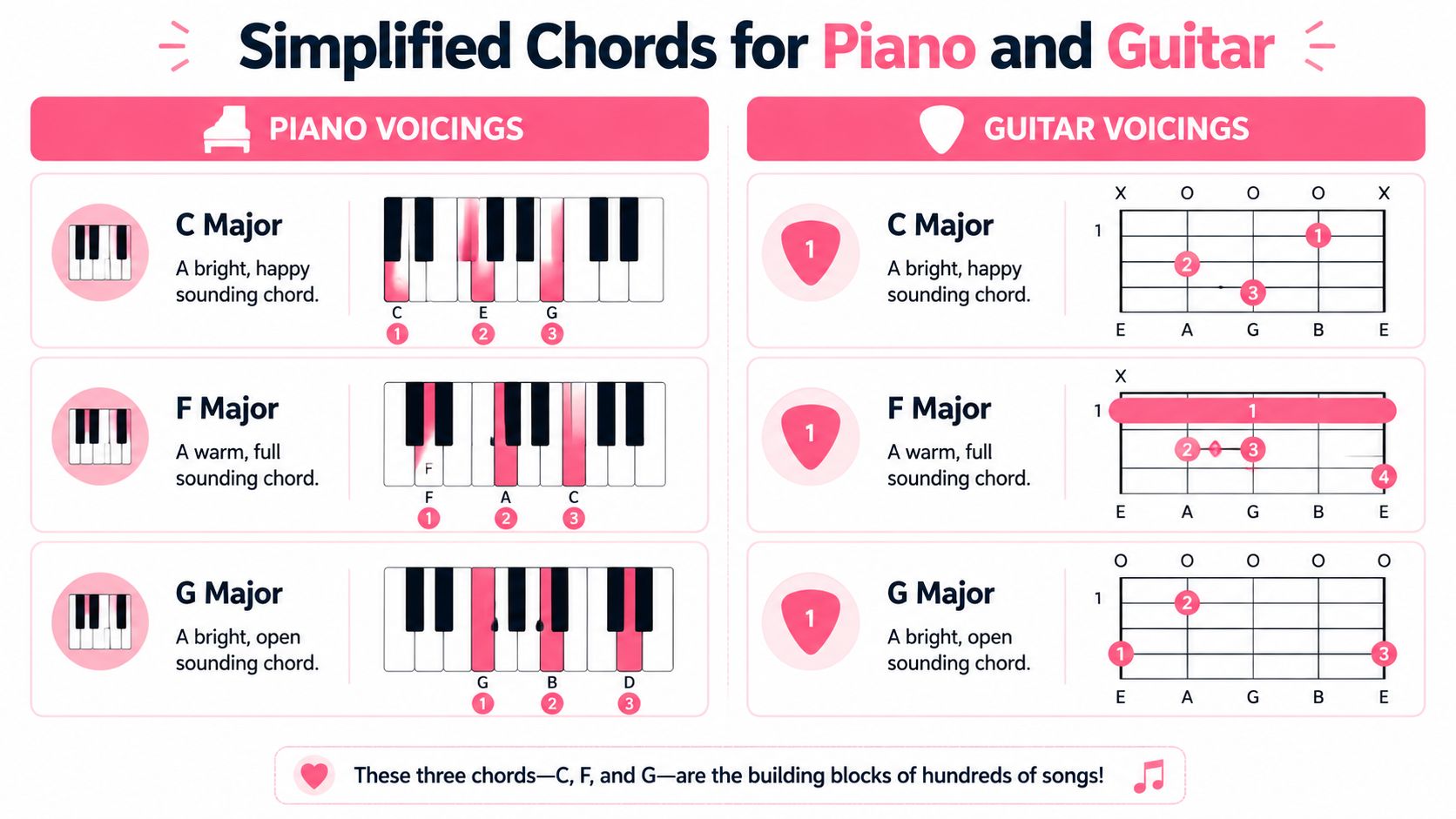
Keep one goal in mind. You are not reducing the music into something flat. You are keeping the emotional path clear enough to hear.
Easy piano shapes that still sound like Moonlight
Start at the piano with block chords. Broken patterns can come later. First your ear needs to recognize the harmony as a set of moods that move in order.
Use these simplified shapes:
- C♯m for home
- D major/F♯ for the sudden color change
- G♯ or G♯7 for tension and return
Play each chord slowly and let it ring. Then repeat them in order. After that, try a gentle rolling pattern with the same notes.
One small trick helps a lot. Keep any shared note between chords whenever your hand allows it. That creates smoother voice leading. Voice leading is just the path each note takes from one chord to the next. It works like watching one actor walk across a stage instead of having the whole cast disappear and re-enter in new costumes.
Listening check: If you can hear home, color, and pull, your simplified version is doing its job.
Simple guitar versions that keep the mood
Guitar players often see this piece on the page and assume it belongs only to pianists. A chord-based version makes the harmony easier to hear and much easier to remember.
Instead of chasing every written note, keep your attention on two things. Hear the chord quality. Notice the bass moving downward.
That falling motion gives the progression its heavy, searching feel. Even on guitar, you can suggest it without copying every classical detail. Hold a C#m shape for the home sound, then move to a brighter major color for contrast, and use G♯ or G♯7 to create the pull back.
Here is a simple hearing map:
| Chord function | Piano idea | Guitar idea |
|---|---|---|
| Home | C♯m block chord | C#m shape |
| Dark passing motion | lower the bass step by step | keep one upper note steady while the bass shifts |
| Color change | D/F♯ sound | major shape that suddenly brightens the minor mood |
| Pull home | G♯ or G♯7 | dominant shape that sounds unfinished on purpose |
If you are unsure whether a guitar voicing fits, ask a practical question. Does it still sound like the music is moving away, then asking to come back? If yes, the chord is serving the harmony well.
How to practice these without guessing
Use a short repeatable drill.
- Play one chord and sing the top note
- Move to the next chord and name the feeling change
- Decide whether the sound became steadier, brighter, or more tense
- Repeat until your ear expects the next chord before your fingers play it
That last step matters most. Prediction is the beginning of playing by ear.
For both piano and guitar, simplified chords give you a clearer doorway into the piece. Once you can hear the movement, the full version stops feeling like a pile of notes and starts feeling like a story your ear already knows.
Beyond Beethoven Reimagining the Chord Progression
Once you can hear Moonlight Sonata chords as functions instead of fixed shapes, the progression becomes portable. You can move it into other styles without losing its identity.
That’s where ear training starts turning into creativity.
Most chord resources for this piece reproduce the classical piano voicing exactly and don’t spend much time teaching learners how to re-voice, substitute, or extend the harmony for modern styles. That gap matters if you want to hear and reimagine the progression in pop or jazz settings, as highlighted in this discussion of modern arrangement possibilities.
Keep the contour, change the clothes
The contour is the important part. Not the costume.
If the progression still sounds like:
- dark home
- unexpected color
- strong pull
- return
then you can dress it differently.
A pianist might spread the notes into wider voicings and add gentle extensions. A guitarist might use open strings and let the upper notes ring. A producer might place the progression under a slow beat with soft pads and sparse melody.
What makes it still sound like Moonlight is not strict imitation. It’s the preserved emotional movement.
A practical way to experiment by ear
Try this at your instrument.
First, play the basic progression in plain chords. Then repeat it three different ways:
-
Softer version
Use fewer notes. Let silence do more work. -
Pop version
Keep a steady pulse and simplify the voicings so the progression feels song-like. -
Jazz-leaning version
Add color tones only if you can still hear the original function underneath.
The test is simple. If your ear can still recognize home, color shift, tension, and return, the adaptation works.
Don’t ask, “Is this the correct modern reharmonization?” Ask, “Can I still hear Beethoven’s emotional outline inside this version?”
Why this builds musical freedom
Players stop being dependent on tabs, charts, or one arrangement video. You start understanding harmony as a living language.
That has real outcomes:
- You can improvise around the progression.
- You can accompany a singer with confidence.
- You can borrow the sound for your own songwriting.
- You can hear similar moves in other pieces faster.
That’s the larger point of ear training. Not just to reproduce one masterpiece, but to build a musical ear that follows you into every style you play.
Build Your Ear in 10 Minutes a Day
You do not need marathon practice to improve your ear. You need consistency.
Moonlight Sonata is perfect for this because the first movement uses a clear cyclical pattern, and transcribing just four bars by ear gives you a concrete exercise that builds chord recognition and inner hearing in a real classical setting, as noted in this ear-focused Moonlight breakdown.

A short daily routine that works
Use the same tiny routine for a week. Keep it simple enough that you’ll do it.
A good plan looks like this:
-
Minute 1 to 2
Listen to the opening phrase once or twice without playing. -
Minute 3 to 4
Hum the bass notes and check them on your instrument. -
Minute 5 to 6
Find the home chord and the tension chord by ear. -
Minute 7 to 8
Try to catch the surprise color chord when it appears. -
Minute 9 to 10
Play or write the first four bars from memory.
That’s manageable. And because it repeats daily, your hearing sharpens instead of resetting between long practice sessions.
If you want a structured place to build that habit, daily ear training practice works best when it’s short, repeatable, and easy to return to.
What changes when you stay consistent
The first change is small. You stop feeling blind when you sit down to play.
Then bigger things start happening:
| Skill | Real-world result |
|---|---|
| Chord recognition | You identify progressions faster |
| Inner hearing | You can imagine sound before playing |
| Improvisation | You stop relying on random trial and error |
| Playing by ear | You trust your listening more than your memory |
You also become less dependent on visual crutches. That includes sheet music, tabs, and tutorial copying.
And no, this doesn’t require perfect pitch. Perfect pitch gets talked about a lot because it sounds impressive. But for most musicians, the useful skill is relative hearing. That means recognizing how sounds relate to each other. That’s exactly what Moonlight Sonata chords can train so well.
The best ear training habit is the one you’ll repeat tomorrow.
If you give this piece 10 minutes a day, your progress won’t just show up in Moonlight Sonata. It’ll show up when you sit at a piano and find chords faster, when you pick up a guitar and hear the bass movement, when you improvise, and when you play with other musicians without feeling lost.
If you want a simple system for building those skills every day, Trill: Ear Training Daily gives you short, focused practice designed to help you play by ear, recognize chords, strengthen pitch awareness, and move toward the kind of listening confidence many players associate with perfect pitch. It’s built for musicians who want real results from 10 minutes a day, so ear training becomes a daily habit instead of something you keep meaning to start.