What Is Sonata Form? Your Guide to Musical Structure
Sonata form is a three-part musical story that became most strongly associated with the Classical era, ca. 1750 to 1825. In plain English, it works like a movie plot: the exposition introduces the main characters, the development creates conflict, and the recapitulation resolves the story.
If you’ve ever listened to a long classical movement and thought, “This sounds beautiful, but where am I in the piece?”, you’re not alone. Many musicians can hear the notes but not the larger shape. That’s the gap sonata form helps close.
And this matters for more than music history. When you can hear form, you stop passively waiting for the next melody and start following the plot in real time. That skill helps with ear training, play by ear, improvisation, chord recognition, and feeling less lost inside bigger pieces.
Table of Contents
- Why Hearing Form Makes You a Better Musician
- The Three Act Story of Sonata Form
- Hearing the Harmonic Journey from Tension to Release
- Where This Musical Blueprint Came From
- How to Train Your Ear to Recognize Sonata Form
- Beyond the Textbook Rules and Common Variations
Why Hearing Form Makes You a Better Musician
A lot of players approach classical form backwards. They memorize terms first, then hope their ears catch up later. That usually leads to guessing.
A better approach is to hear shape before jargon. If you can tell when music is introducing material, wandering away from it, and finally coming back, you’re already hearing the heart of sonata form.
Why form matters to your ear
Think about what happens when you listen without a sense of form. A long movement can feel like a stream of events with no clear landmarks. You hear melody, dynamics, maybe a few chords, but the big picture slips past.
When you learn to hear form, the piece becomes navigable. You start noticing when a section sounds stable, when it starts drifting, and when a familiar idea returns with a feeling of arrival.
Practical rule: Don’t ask, “What section name am I supposed to memorize?” Ask, “Does this feel like setup, conflict, or resolution?”
That question is powerful because it trains listening, not labeling. It shifts theory from paper to sound.
What changes when you can hear the plot
Once your ear starts catching musical architecture, several practical skills get easier:
- Playing by ear gets less random. You stop chasing individual notes and start predicting where phrases and harmonies are likely to go.
- Improvisation gets stronger. You begin to feel tension and release over longer spans, not just one chord at a time.
- Chord recognition improves. Form helps you hear why a harmonic move matters, not just that it happened.
- Aural memory gets better. Big landmarks make music easier to remember.
This is one reason ear training isn’t some side skill for exam season. It’s central musicianship. If you want to play by ear, recognize progressions, or move toward perfect pitch goals with more musical context, hearing structure helps you organize what you hear.
Here’s the encouraging part. This is trainable. You don’t need a rare gift for classical listening. You need repetition, attention, and short consistent practice.
A musician with a trained ear doesn’t hear “more notes.” They hear stronger landmarks.
That’s why even 10 minutes a day matters. Small daily listening sessions build pattern recognition. Over time, you stop feeling lost and start hearing direction.
The Three Act Story of Sonata Form
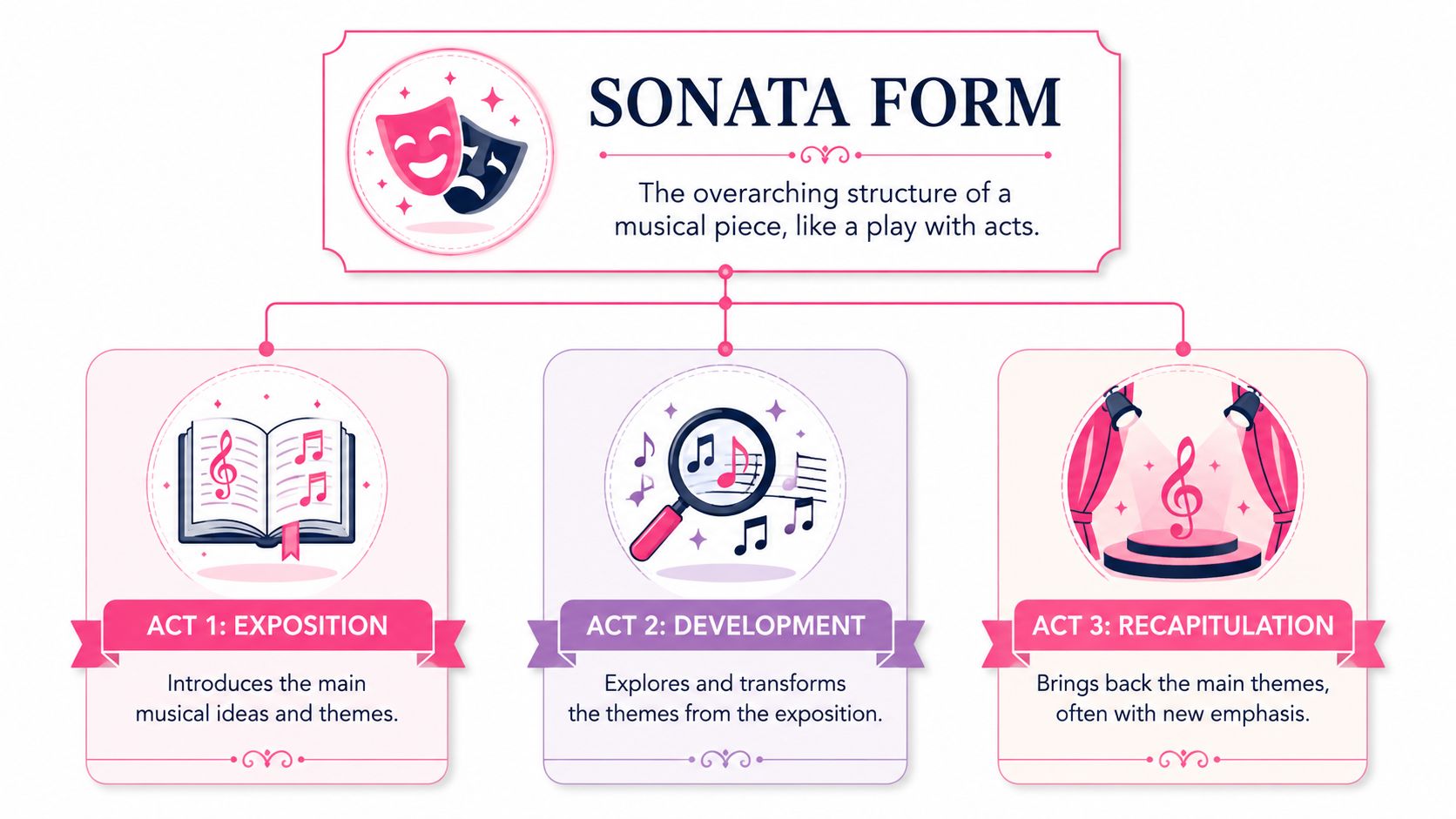
The standard textbook model of sonata form settles around three major sections: exposition, development, and recapitulation, with the exposition often presenting two contrasting themes and the recapitulation bringing the second one back in the home key for tonal resolution, as explained in this guide to sonata form.
That description is accurate, but it can still feel dry. The easier way to hear it is as a three-act drama.
Act one introduces the characters
The exposition is the opening act. The composer presents the main musical ideas. In many textbook examples, you’ll hear a first theme that feels grounded and a second theme that contrasts with it in mood, texture, or energy.
If this were a film, act one would introduce the main characters and show their world. You need to know who matters before the story can do anything interesting with them.
A beginner mistake is thinking the themes must sound like complete opposites. Sometimes the contrast is obvious. Sometimes it’s subtler. One may feel bold while the other feels smoother. One may sound rhythmically punchy while the other feels more lyrical.
A useful listening question is simple: what idea grabs your ear first, and when does the music seem to shift into a different personality?
Act two creates the trouble
The development is where the composer stops behaving politely. Material from earlier gets broken apart, sequenced, fragmented, pushed into new keys, and made less stable.
This is the conflict scene. The characters are still the same, but now they’re under pressure.
You might hear:
- Short fragments instead of full melodies
- Rapid changes in harmony or mood
- Restlessness instead of balance
- A sense of searching instead of arrival
For ear training, this is a huge moment. Your job isn’t to identify every key change. Your job is to notice that the ground no longer feels firm.
In the development, your ear should feel less settled than your brain wants to be.
That feeling is not confusion in a bad sense. It’s the point of the music.
Act three brings you home
The recapitulation gives the story its payoff. The opening material returns, and the earlier tension gets resolved by bringing the second theme back in the home key instead of the contrasting key from earlier.
That last detail matters. The return is not just thematic. It’s harmonic. The music comes back with a stronger sense of closure.
Here’s a quick way to think about the whole form:
| Section | Story job | What your ear can notice |
|---|---|---|
| Exposition | Setup | New themes, contrast, departure from stability |
| Development | Conflict | Instability, fragmentation, travel, suspense |
| Recapitulation | Resolution | Familiar return, stronger grounding, release |
So if you’ve been asking what is sonata form, the shortest useful answer is this: it’s a dramatic way of organizing musical ideas so your ear experiences setup, tension, and return as one coherent journey.
Hearing the Harmonic Journey from Tension to Release
Themes are only half the story. Harmony is what makes sonata form feel inevitable.
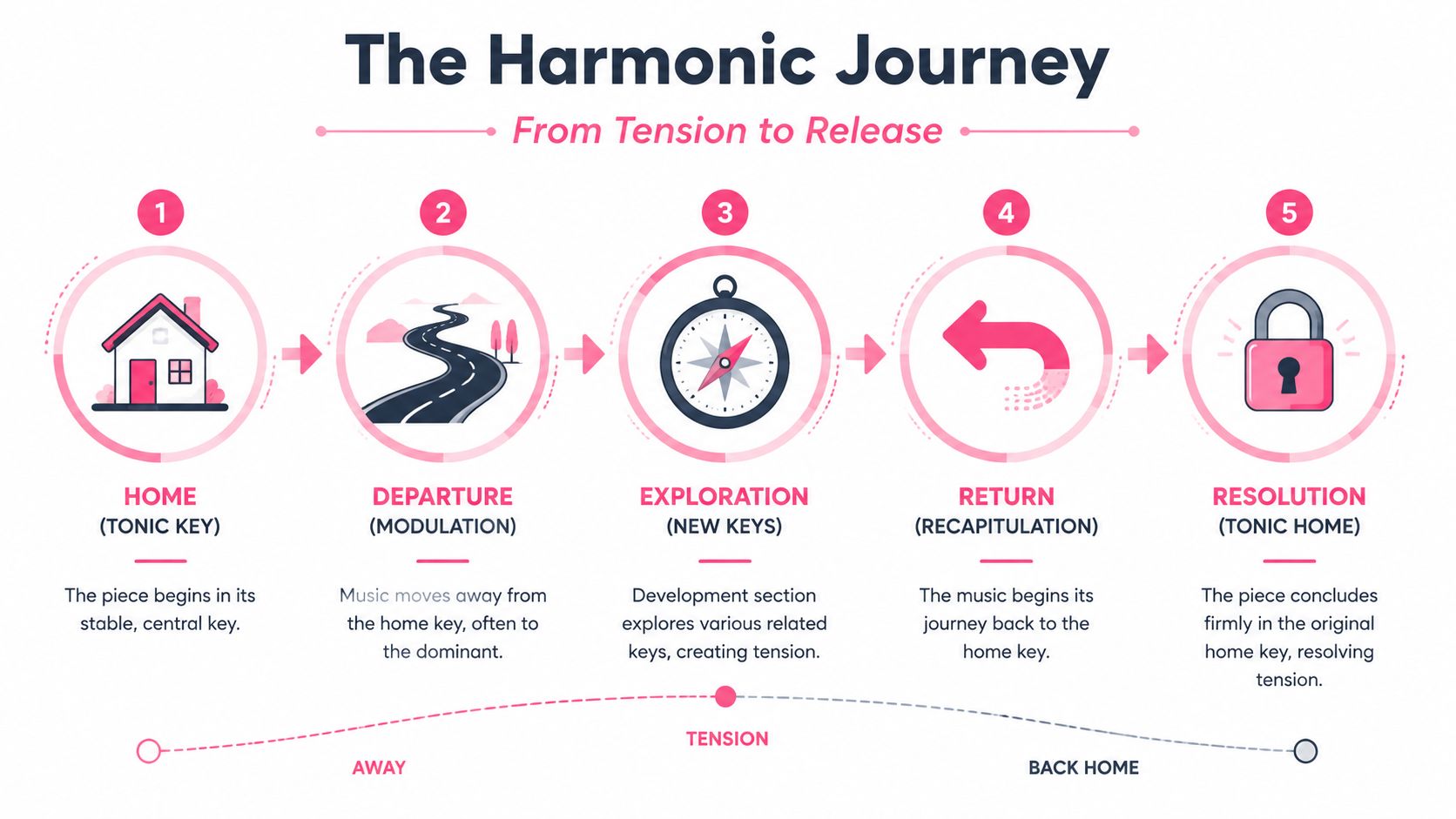
Many learners suddenly “get it” when they transition from tracking melodies alone to tracking home and away.
Home and away
In sonata form, the opening starts in the tonic, which you can think of as home. The exposition usually moves away from that home base. In major keys, that often means heading toward the dominant. In minor keys, it often heads toward the relative major.
That shift is the emotional engine. The music leaves its starting point, and your ear feels that change even if you can’t name the keys yet.
A more technical description says sonata form works through a cause-and-effect relationship between harmonic departure and return, functioning as a narrative arc of situation, conflict, and resolution, as noted in Grove Music Online.
If the dominant key is still fuzzy for you, this short guide to the dominant 7th chord helps connect the sound of tension to what your ear is hearing in tonal music.
The moment your ear should wait for
The development pushes the “away” feeling much further. It can pass through many keys and make familiar material feel unstable. This is the wandering section.
Then comes one of the best ear-training moments in the whole form: the build-up before the recap. Theory often calls this the retransition. You don’t have to memorize the word first. You only need to recognize the sensation.
It often feels like suspense. The music starts preparing for return. Your ear begins to expect home before home arrives.
Try listening for these signals:
- A growing sense of pull toward one destination
- Held or repeated tension that won’t quite resolve yet
- The opening theme returning with a stronger grounding than before
Don’t chase every modulation. Wait for the emotional gravity of the return.
That single habit improves listening fast. It keeps you from getting distracted by surface detail.
Here’s the harmonic journey in plain language:
| Stage | Harmonic feeling | Ear-training translation |
|---|---|---|
| Opening | Stable tonic | “I know where home is” |
| Shift outward | Move to a related key | “We’ve left home” |
| Development | Instability across new areas | “I can’t settle yet” |
| Preparation | Build toward tonic return | “Something is about to land” |
| Recap | Home restored | “There it is” |
When you train this way, theory supports hearing. It doesn’t replace it.
Where This Musical Blueprint Came From
Sonata form didn’t appear because one composer wrote a rulebook and everyone obeyed it. It grew out of practice.
Historically, it’s most strongly tied to the Classical era, ca. 1750 to 1825, and it developed from earlier Baroque binary and ternary habits before reaching its peak there. Historians also note that the term itself wasn’t used by Haydn and Mozart in their own time, but was applied later by 19th-century theorists, which you can read in this history of sonata form overview.
A practice before it was a label
That little history lesson clears up a lot of confusion. Students often imagine sonata form as a fixed invention, like someone announced the rules and composers followed them exactly.
What happened is more musical than that. Composers working in symphonies, quartets, concertos, and sonatas kept using a dramatic large-scale pattern that audiences and musicians recognized. Later theorists gave that pattern a name.
So the label came after the practice.
That’s helpful because it keeps you from treating the form like a strict checklist. Haydn, Mozart, and Beethoven were writing expressive music, not filing paperwork. If you enjoy Beethoven, this article on interesting things about Beethoven gives more context for the world surrounding that style of listening.
Why that history helps beginners
Once you know the term was retrospective, sonata form becomes less intimidating. You don’t need to force every measure into a diagram. You need to hear the broad dramatic logic that made the pattern so useful in the first place.
The form was a shared language for musical argument, not a cage.
That mindset changes how you listen. Instead of asking, “Am I identifying every textbook feature correctly?”, ask, “How is this composer creating contrast, tension, and return?”
That’s the more musical question, and it’s the one your ear can train on.
How to Train Your Ear to Recognize Sonata Form
You don’t learn sonata form best by staring at a chart. You learn it by listening to one movement repeatedly until the landmarks become obvious.
Start with a piece that many teachers use for first listening. The first movement of Mozart’s Symphony No. 40 works well because the contrasts are audible and the return feels memorable.

A first listening checklist
For your first pass, don’t analyze every chord. Just orient yourself.
Listen once and ask:
- What is the opening idea? Hum it if you can.
- Does the opening section repeat? In many Classical movements, the exposition is repeated.
- When does the character change? That often points toward the second theme area.
- Where does the music become unstable? That’s often your development.
- When does the opening come back with a strong feeling of arrival? That’s the recap landmark.
Those five questions already move you from vague listening to guided listening.
A simple 10 minute a day routine
A short daily habit works better than one giant theory session. If your goal is ear training that leads to real playing, consistency wins.
Try this routine:
- Day one. Find and sing the opening theme.
- Day two. Find the contrast point where the music changes character.
- Day three. Locate the unstable middle.
- Day four. Catch the return of the opening.
- Day five. Listen for home versus away in the harmony.
- Day six. Tap the form in real time: setup, conflict, resolution.
- Day seven. Replay the movement and describe its plot out loud without looking at notes.
If you want a broader routine for daily listening skill building, this guide to ear training for musicians fits naturally with form practice.
Listening habit: Stay with one movement long enough that you stop being surprised by the notes and start hearing the shape.
That’s when the ear starts organizing sound instead of just reacting to it.
What to listen for in real time
Many players get thrown off in the development because it sounds messy compared with the opening. That’s normal. Don’t try to “solve” it instantly.
Instead, track these practical cues:
- Melodic clue. Has the original theme come back whole, or are you only hearing pieces of it?
- Harmonic clue. Does the music feel settled, or does it keep slipping away?
- Memory clue. Can you still recognize the opening when it returns, even if the texture is bigger or louder?
After a few listens, add one more exercise. Pause the track right before a major return and sing what you expect next. That trains prediction, which is at the core of playing by ear.
A short performance-based example can help too:

You do not need perfect pitch to do this. Relative hearing is enough. In fact, sonata form is a great training ground for relative hearing because the big story depends on relationships, especially the movement away from tonic and the return to it.
When that clicks, your ear becomes less dependent on notation and more capable in real musical situations.
Beyond the Textbook Rules and Common Variations
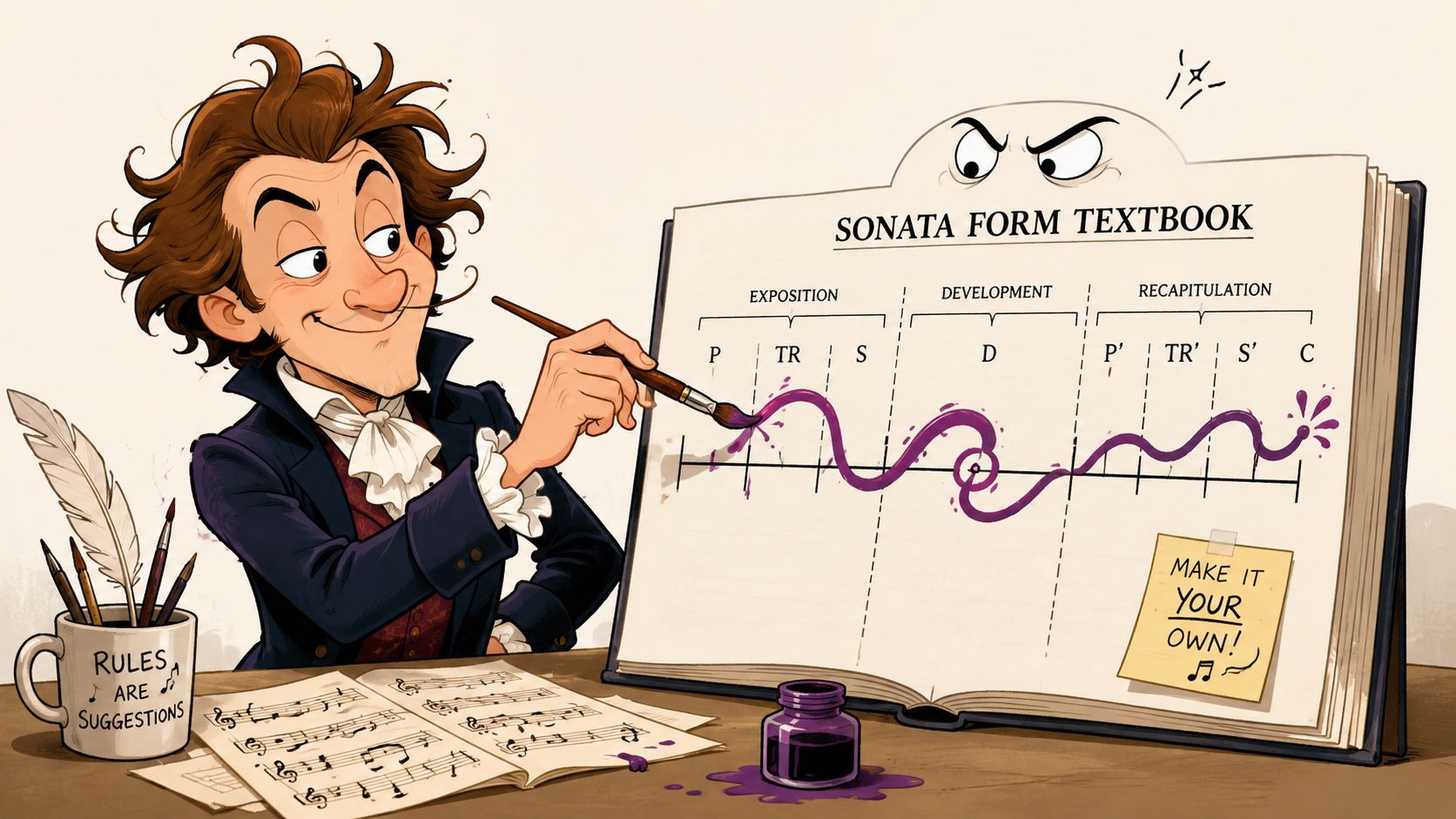
One reason beginners get frustrated is that real music doesn’t always behave like the clean classroom diagram.
That’s not a failure of the music. It’s part of the form.
Why real pieces don’t always match the diagram
Authoritative references describe sonata form as “difficult to pin down to a single model”, and they note that introductions and codas are optional, while sonata form is not limited to first movements, as summarized in this overview of sonata form.
That means the tidy three-part model is best treated as a listening guide, not a prison.
A composer might add:
- A slow introduction before the main action begins
- A long coda that feels like an extra closing chapter
- Compressed transitions that make sections blur together
- Unexpected thematic handling where one idea seems to do multiple jobs
How to stay oriented when the form bends
When a real piece stretches the pattern, come back to function.
Ask yourself:
| If you’re confused by… | Ask this instead |
|---|---|
| An unusual opening | “Has the main story started yet?” |
| A messy middle | “Does this feel unstable and exploratory?” |
| A delayed return | “Is the music still withholding home?” |
| A big ending | “Is this a coda after the resolution?” |
This approach saves you from rigid listening. It lets you hear what the composer is doing rather than what a worksheet said should happen.
Some of the best sonata-form listening happens when the composer bends your expectations but still gives your ear a satisfying return.
That’s also why this topic belongs inside practical musicianship. Hearing form trains patience, memory, and harmonic awareness. Those are the same ingredients behind better improvisation, stronger chord recognition, and the freedom to play without depending on sheet music.
If you want a simple daily system for building those skills, Trill: Ear Training Daily is designed for exactly that. It helps musicians train chord recognition, intervals, notes, and harmonic hearing through short practice sessions you can actually stick to. If your goal is to stop guessing, improve ear training, and play by ear with more confidence in just 10 minutes a day, it’s a practical place to start.