Practice Key Signatures to Play by Ear & Improvise
You look at the staff, spot the sharps or flats instantly, and still miss the notes once you start playing.
That’s the experience most musicians have with key signatures. On paper, you know the answer. In real time, your hands hesitate, your ear goes blank, and every accidental feels like a trap. You might even be able to pass a theory quiz and still struggle to play by ear, improvise, or read fluently.
That gap matters because key signatures aren’t supposed to be trivia. They’re supposed to help you hear the tonal world you’re in before the music unfolds. If you practice key signatures only as labels, you’ll recognize symbols. You won’t build the instinct that lets you hear chord movement, anticipate scale tones, and stay grounded while reading.
The useful approach is simpler and more musical. Learn the map. Then connect that map to sound, touch, and expectation until the key starts to feel like home.
Table of Contents
- Why Knowing Key Signatures Doesn’t Mean You Can Use Them
- Moving Beyond Flashcards to Real Musical Skill
- The Fastest Way to Memorize the Key Signature Map
- Ear Training Drills That Connect Signatures to Sound
- Your 10-Minute Daily Key Signature Workout Plan
- How to Handle Tricky Keys and Common Mistakes
Why Knowing Key Signatures Doesn’t Mean You Can Use Them
A common scene in lessons goes like this. A player sees four sharps, says “E major,” and then stumbles through the first phrase because every G and D needs a second thought. The problem isn’t lack of knowledge. The problem is that the knowledge hasn’t turned into musical expectation yet.
That’s why practice key signatures has to mean more than naming them. If the signature doesn’t change what you expect to hear, it won’t help much when you’re reading, improvising, or trying to play by ear. You’ll still treat each note as a separate decision.
Educational material treats key signatures as a foundational reading skill because you can identify them from the first measure, and beginner guides often connect major keys such as C major and G♭ major with related minor keys to link notation to aural expectation, as described in this beginner guide to key signatures. That’s the right idea. The issue is that many players stop at recognition.
Recognition is not fluency
Fluency starts when the signature changes what your ear predicts.
If you’re in D major, you shouldn’t merely remember that F♯ and C♯ belong to the key. You should start to feel how that key pulls toward its tonic, how the dominant wants to resolve, and how melodies tend to lean on certain notes more naturally than others.
Key signatures work best when they stop being symbols and start becoming a sound world.
That shift is what helps with improvisation. It also helps with reading under pressure. You’re no longer asking, “Is this note sharp?” You’re asking, “Does this note belong to the key I’m already hearing?”
What musicians usually miss
Traditional learning often creates a mismatch:
| What you practice | What real music demands |
|---|---|
| Naming the key | Hearing the tonal center |
| Counting sharps or flats | Anticipating likely notes and chords |
| Memorizing signatures in isolation | Applying them while reading and listening |
| Passing theory drills | Playing without hesitation |
If your goal is ear training, perfect pitch development, or learning to play by ear, this difference matters a lot. Real musicianship starts when the visual cue at the start of the staff changes what you hear in your mind before you play the first note.
Moving Beyond Flashcards to Real Musical Skill
Flashcards help. They’re just not enough.
If you drill “three flats equals E-flat major” often enough, you’ll get faster at recall. But speed of recall isn’t the same as musical control. At a jam session, rehearsal, or sight-reading session, nobody cares whether you can answer the flashcard. They care whether you can stay inside the key.
A big gap in music teaching is that key signature practice often stops at naming the key and doesn’t address the player’s more practical question: how to stop missing the accidentals when reading actual melodies. That gap is discussed in this lesson on practicing key signatures for real music reading. The core idea is simple. Memorization alone is insufficient unless it connects to note spelling, transposition, and harmonic context.
Why isolated drills stall out
A flashcard asks one narrow question. Real music asks several at once.
You must notice the signature, read the clef, track rhythm, identify the note, hear its function, and keep going without breaking time. That’s why players who seem strong in theory still freeze on the page. They practiced recognition without context.
Three habits usually cause the problem:
- Separate theory from sound. You name the key, but you never sing the scale or hear the tonic.
- Practice too slowly and too cleanly. You become accurate in isolation, then fall apart when the reading gets busy.
- Ignore harmony. You think of the key signature as a note rule, not a chord environment.
What transfers better
Use recall drills as a warm-up, not as the whole workout.
Then move straight into tasks that force the signature to do real musical work:
- Read simple melodies in one key for several minutes. Stay in the key long enough to feel its note pattern.
- Transpose a short phrase. This forces you to think in scale degrees, not note names alone.
- Play basic chords in the key. The signature becomes easier to remember when your ear connects it to tonic, subdominant, and dominant movement.
- Sing before you play. If you can’t audiate the line, your fingers will keep guessing.
Practical rule: If your key signature practice never reaches melody, chords, or transposition, it probably won’t show up when you need it.
For ear training, this is the dividing line. The players who learn to play by ear don’t just memorize which notes are altered. They start hearing how those altered notes shape the whole key.
The Fastest Way to Memorize the Key Signature Map
You sit down to sight-read, see four sharps, and lose a beat figuring out whether you are in E major or C-sharp minor. That hesitation is the primary problem. The goal is not to recite a label. The goal is to recognize the pattern fast enough that your hands, eyes, and ear stay in time.
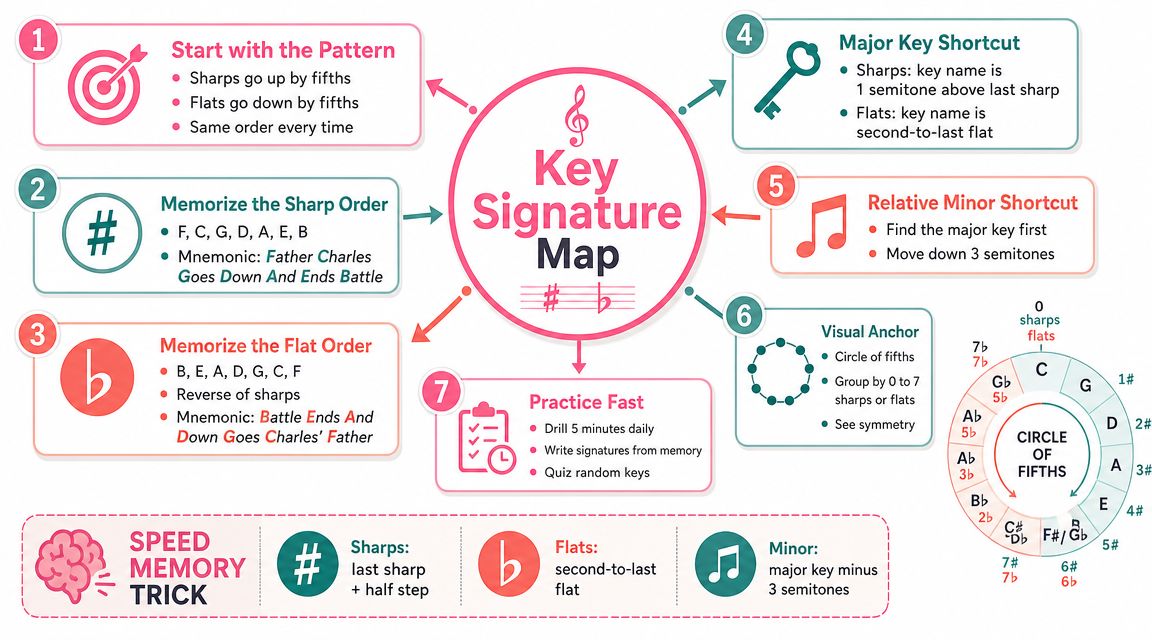
A usable key signature map starts with one fact: the accidentals always appear in the same order. Standard notation uses a fixed sequence of sharps and flats, and those repeating patterns cover the full set of common key signatures, as outlined in Wikipedia’s key signature overview.
Start with the fixed order
Get these orders automatic first.
Sharps appear as:
- F♯
- C♯
- G♯
- D♯
- A♯
- E♯
- B♯
Flats appear as:
- B♭
- E♭
- A♭
- D♭
- G♭
- C♭
- F♭
I do not recommend stopping at verbal recall. Players who only recite the order often still freeze on the page because the pattern never became physical. Write the sequence from memory. Point to those notes on your instrument. Say them in reverse. Pianists can play a simple scale and notice which notes change. Guitarists can locate each altered note across one string set, then inside a scale shape. Singers can sing the altered degrees against a tonic drone until they stop sounding like interruptions.
Use the naming shortcuts, then verify them on the instrument
Once the order is secure, naming keys gets much faster.
Use these recognition rules:
| Signature type | Shortcut |
|---|---|
| Sharp keys | Take the last sharp and move up a half-step |
| Flat keys | Read the second-to-last flat |
| Exception to remember | One flat is F major |
Those shortcuts save time, but they are only half the job. After you name the key, play one scale, one tonic chord, and one dominant chord in that key. That extra step is what turns a visual shortcut into working musicianship. If the signature says three flats and your hands still feel lost in E-flat major, the map is not learned yet.
Turn the map into a sound you can recognize under your fingers
Memorization gets stronger when each signature has a physical and aural identity.
On piano, notice how each key signature creates a different black-key layout and a different hand feel. On guitar, connect the signature to a scale pattern and the I, IV, and V chords you are likely to meet first. On voice, sing the major scale slowly enough to feel where the altered notes pull, then return to the tonic. That is where the page starts to connect with real hearing.
A visual practice tool can help if you need to check the layout in different keys. This scale visualizer for mapping keys on your instrument is useful for comparing the written signature with the note pattern you play.
Memorize key signatures as playable environments, not trivia.
That approach takes a little longer at the start than flashcard-only work. It pays off faster once you are reading, comping, transposing, or trying to catch a progression by ear.
Ear Training Drills That Connect Signatures to Sound
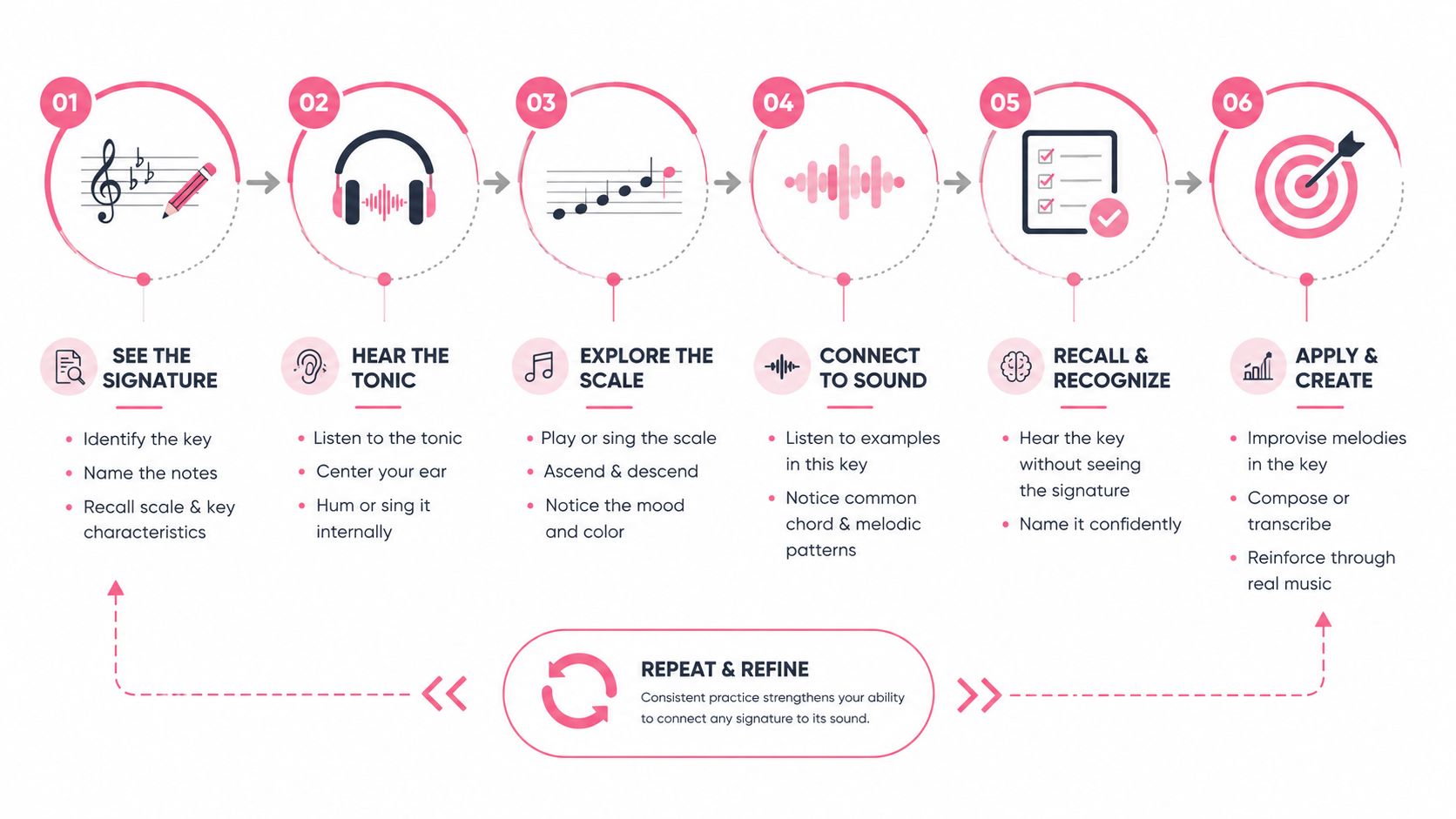
Once the visual map is in your head, the next step is ear training. With ear training, key signatures stop being reading symbols and start becoming living musical environments.
The mistake is trying to hear a key only after the notes happen. Better players usually hear the key first. Then they read, sing, improvise, or accompany inside that sound.
Drill one, find home fast
Play or listen to a short phrase in a single key. Stop. Then sing the note that feels like home.
If you’re not sure, test it on your instrument. The right tonic usually feels settled. The wrong one feels unfinished or unstable. This drill trains your ear to hear the center of gravity in the music.
Use it like this:
- Choose a key you know visually
- Play a short melody or progression
- Pause and sing the tonic
- Check it on your instrument
- Repeat in a new key
This is one of the fastest ways to connect notation, listening, and improvisation. Once you hear “home,” the rest of the key starts organizing itself around that center.
Drill two, hear the color before the label
A lot of players chase the key name too early. Hear the quality first.
Take a short melody and ask two questions before naming anything:
- Does this sound major or minor?
- Where does it want to resolve?
Then check the key signature and see whether your ear agrees with the notation; relative major and minor can share the same signature while sounding completely different in use.
If you can hear the mood and pull of a key, the label becomes easier and more accurate.
For singers, this drill is powerful. Sing scale degrees against a tonic note. Notice how the third changes the character. Notice how the leading tone sharpens the pull back home. Those are the sounds you want to connect to the written signature.
A practical next step is working through short listening routines focused on tonal center and chord recognition, like the exercises discussed in this guide to learning how to play by ear.
Drill three, hear chord function inside the key
Improvisation opens up at this point.
Choose a key. Play the tonic chord, then move to the subdominant and dominant. Listen to what each one does. Don’t analyze too much at first. Just notice the feeling.
Try this format:
| Chord function | What to listen for |
|---|---|
| Tonic | Rest, arrival, stability |
| Subdominant | Motion away from home |
| Dominant | Tension that wants to resolve |
Then improvise a tiny melody using only notes from the key. Land on the tonic after each phrase. After a few rounds, your ear starts expecting the notes that fit and rejecting the ones that don’t.
This is the bridge between theory and playing by ear. If you want better chord recognition, more confident improvisation, or a real path toward perfect pitch work, this kind of tonal listening matters more than speed drills ever will.
Your 10-Minute Daily Key Signature Workout Plan
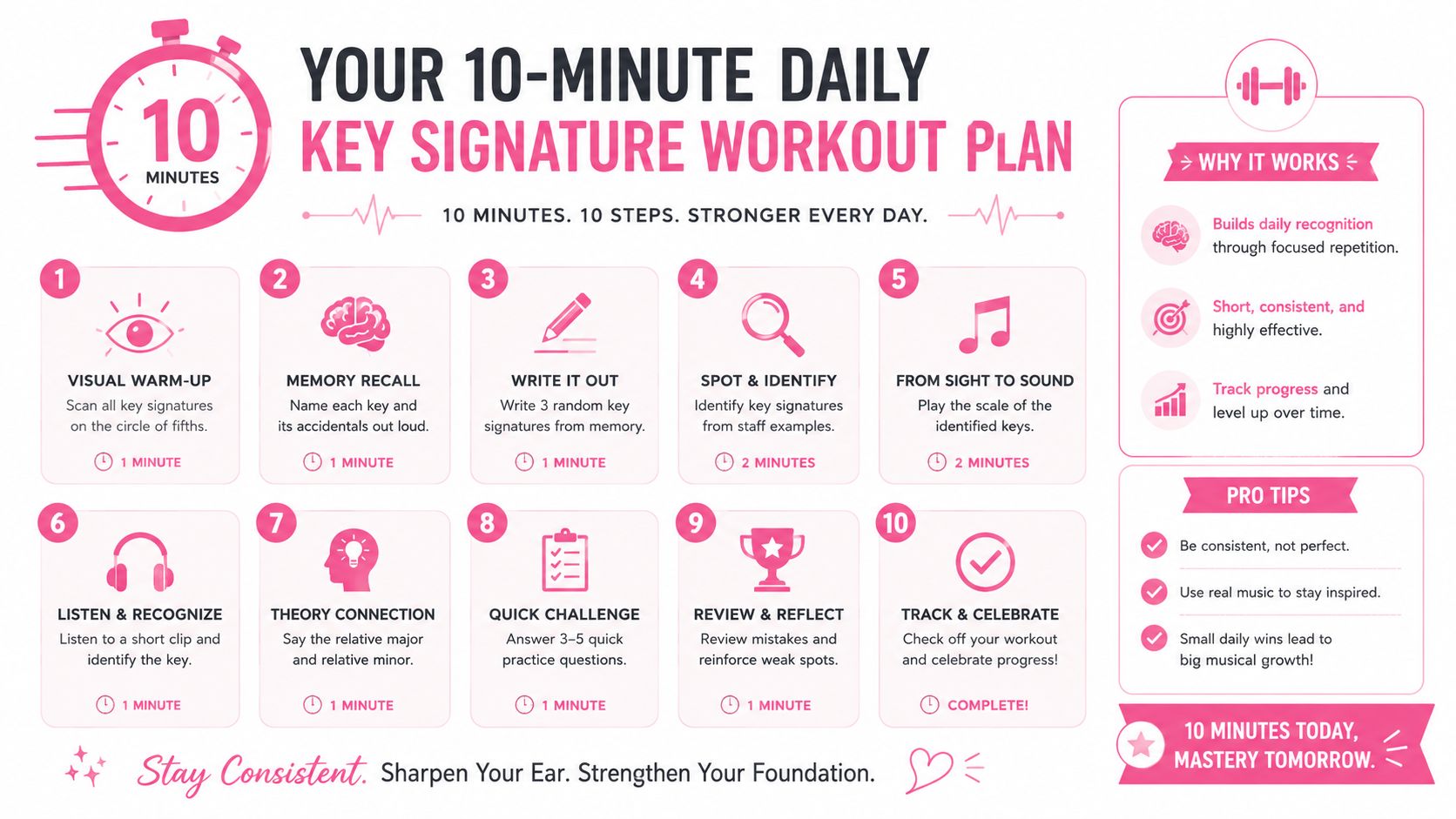
You sit down to practice, see four sharps, identify E major, and still hesitate on the first phrase. That gap is the fundamental problem. A useful key signature routine has to train recognition, hearing, and touch at the same time, or the knowledge stays stuck on the page.
Ten minutes is enough if each minute has a clear job and you stay in one key long enough to feel how it behaves under your hands and in your ear.
Minutes one to two, identify the key fast
Start away from the instrument if that helps you focus.
Look at one signature and answer four things immediately:
- What key is this?
- Which notes are altered?
- What is the tonic?
- Are you treating it as major or minor today?
Keep the pace brisk. Slow recall usually means you are re-deriving the answer each time instead of recognizing the pattern. That is fine early on, but daily work should push toward instant recognition.
Say the altered notes out loud. Musicians who only read the symbol often miss the actual note names while playing.
Minutes three to six, hear the key before you play it
Now give the signature a sound.
Choose the same key and do one short ear task. Sing the tonic, sing the scale, or listen for whether a short phrase settles on major or minor. On another day, hear I, IV, and V in that key and identify which chord feels like home, which one opens the phrase, and which one creates pull.
Short listening work done every day builds faster than occasional long sessions. If you want structure for this part, use daily ear training exercises that focus on tonic, intervals, and chord function.
The goal is simple. When you see three flats, you should not only think “E-flat major or C minor.” You should already have a sound in mind.
Minutes seven to ten, put the key on the instrument
Here, key signatures stop being trivia.
Pick one practical task:
- Play the scale, then the tonic triad and dominant triad
- Read a short line and watch for the altered notes in real time
- Improvise a two-bar phrase that clearly lands on the tonic
- Transpose a familiar pattern into the day’s key
Use only one task per session. Switching between too many mini-exercises burns time and weakens focus. A pianist might comp I to IV to V and improvise with the right hand. A singer might arpeggiate the tonic and dominant, then sight-sing a simple phrase. A guitarist might play the scale in one position, then harmonize scale degree 1, 4, and 5 as chords.
Daily target: End by making the key sound settled and recognizable, not just correctly named.
Here is the full routine in one view:
| Time | Task | Outcome |
|---|---|---|
| 2 minutes | Identify the signature and altered notes | Faster visual recognition |
| 4 minutes | Sing or hear the key center and function | Stronger connection between symbol and sound |
| 4 minutes | Play, read, improvise, or transpose in that key | Better transfer to real music |
This routine works because each part checks the others. If you can name a signature but cannot hear the tonic, the weakness shows up quickly. If you can hear the key but freeze while reading, that also becomes obvious. Ten focused minutes a day is enough to turn key signatures into something you can use while playing, listening, and responding in real time.
How to Handle Tricky Keys and Common Mistakes
The hardest part of key signatures isn’t the easy examples. It’s the moments where the pattern seems clear but the music still trips you up.
That’s especially true with minor keys, enharmonic spellings, and notes that look obvious until the context changes. An important missing angle in many tutorials is error prevention. Fast identification can create false confidence, and a player still has to interpret the signature in the context of the specific note being read, as discussed in this lesson on key signature edge cases and common confusion.
When relative minor confusion trips you up
You see the signature and identify the major key correctly, but the piece sounds minor. That’s a listening problem, not a memorization problem.
Fix it by asking where the melody and harmony come to rest. If the music keeps pointing to A as home, the shared signature with C major won’t help unless your ear notices the tonic shift. Always test the center, not just the label.
When lots of sharps or flats freeze your reading
Dense signatures can make players panic before they play a note.
Use a smaller decision process:
- Read the signature once
- Name the altered notes
- Scan the first phrase for those letter names
- Hear the tonic before starting
That keeps your attention on the notes that changed. You don’t need to re-solve the whole theory problem every measure.
When fast recognition creates sloppy note choices
This one catches advanced students too. They identify the key fast, then misread the actual staff note because they’re thinking in shortcuts instead of in context.
Slow the first read enough that the key signature informs the note name. Don’t let speed outrun accuracy.
That matters for every musician who wants to play by ear well. Your ear has to learn the key, but your eye still has to identify the specific pitch on the page. Good reading comes from combining both.
If you want a daily system for ear training instead of scattered theory practice, Trill: Ear Training Daily gives musicians short listening sessions focused on notes, chords, intervals, and scales. That kind of routine helps turn key signatures from something you recognize into something you hear, which is what lets you play by ear with more confidence.