How to Sing Three Part Harmonies by Ear
You’re probably here because you’ve had this moment before. A lead singer starts a phrase, two more voices join in, and suddenly the whole line opens up. It sounds full, emotional, and effortless. Then you try to copy it, and your harmony either collides with the melody or feels like a random note that happens to fit for a second.
That gap is normal.
Difficulty with three part harmonies doesn’t arise from a “lack of talent,” but rather from thinking about harmony as a written puzzle instead of a listening skill. If your ear doesn’t recognize what the melody is pulling toward, theory alone won’t help much in the moment.
The good news is that ear training changes this. You can learn to hear where the upper part wants to go, where the lower part should settle, and which notes create stability instead of tension. That’s the difference between guessing and learning to play by ear. It’s also why singers who don’t have perfect pitch can still become excellent harmonizers. They’ve trained their ears to hear relationships.
Table of Contents
- Why Some Harmonies Sound Amazing and Others Do Not
- Hearing the Building Blocks of Harmony
- A Practical Method for Arranging Harmonies
- Essential Ear Training Drills for Harmony
- Common Harmony Mistakes and How to Fix Them
- Making Harmony an Instinct Not a Calculation
Why Some Harmonies Sound Amazing and Others Do Not
You are in a rehearsal. The lead singer starts the chorus, two more voices come in, and one version feels warm and settled while another feels tense and wobbly. The difference is often simple. Good harmony sounds like three people hearing the same musical gravity.
That is why strong three part harmonies usually sound natural instead of crowded. The singers are not just picking notes that fit on paper. They are listening for which note makes the melody feel clearer, steadier, and more complete.
A chord works like a home with a few strong support beams. If a harmony part lands on one of those supports, the whole sound feels secure. If it lands in an awkward spot or jumps around without a clear pull, the listener feels that instability right away, even if they cannot explain it with theory terms.
For many singers, the gap is not knowledge. It is speed of hearing. You may know that a third or fifth often works, but in live music you do not have time to solve a puzzle note by note. You need your ear to recognize the sound of a note that belongs. If interval hearing still feels blurry, a short guide to hearing intervals and how they function can help you connect the sound to the choice.
Three part harmony also has a special kind of clarity. With one lead and two added voices, you can hear whether each part is helping the chord speak or making it harder to hear. There is less room to hide than in a thicker arrangement. That is useful. It trains your ear faster because every note has a job.
The main job is support.
A good harmony does not compete with the melody for attention. It frames the melody, the way good lighting helps you see a face more clearly. The best parts often move smoothly, stay close to the melody when possible, and change only when the chord or melodic shape asks for it.
A few listening habits make a big difference:
- Listen for fit, not just correctness: More than one note can be technically possible. Choose the one that makes the melody feel stronger.
- Favor small motion: Stepwise movement usually sounds more connected than wide leaps.
- Check the blend: A note can be right by itself and still sound wrong if it sticks out against the other two voices.
- Practice hearing under pressure: Short daily singing reps help your ear respond in real time instead of after the moment has passed.
If you have ever thought, “I know what harmony is, but I cannot find my note fast enough,” that usually points to a listening skill that needs practice. The encouraging part is that listening improves. With steady repetition, your ear starts to notice stable notes the same way your eye learns to spot familiar shapes.
Hearing the Building Blocks of Harmony
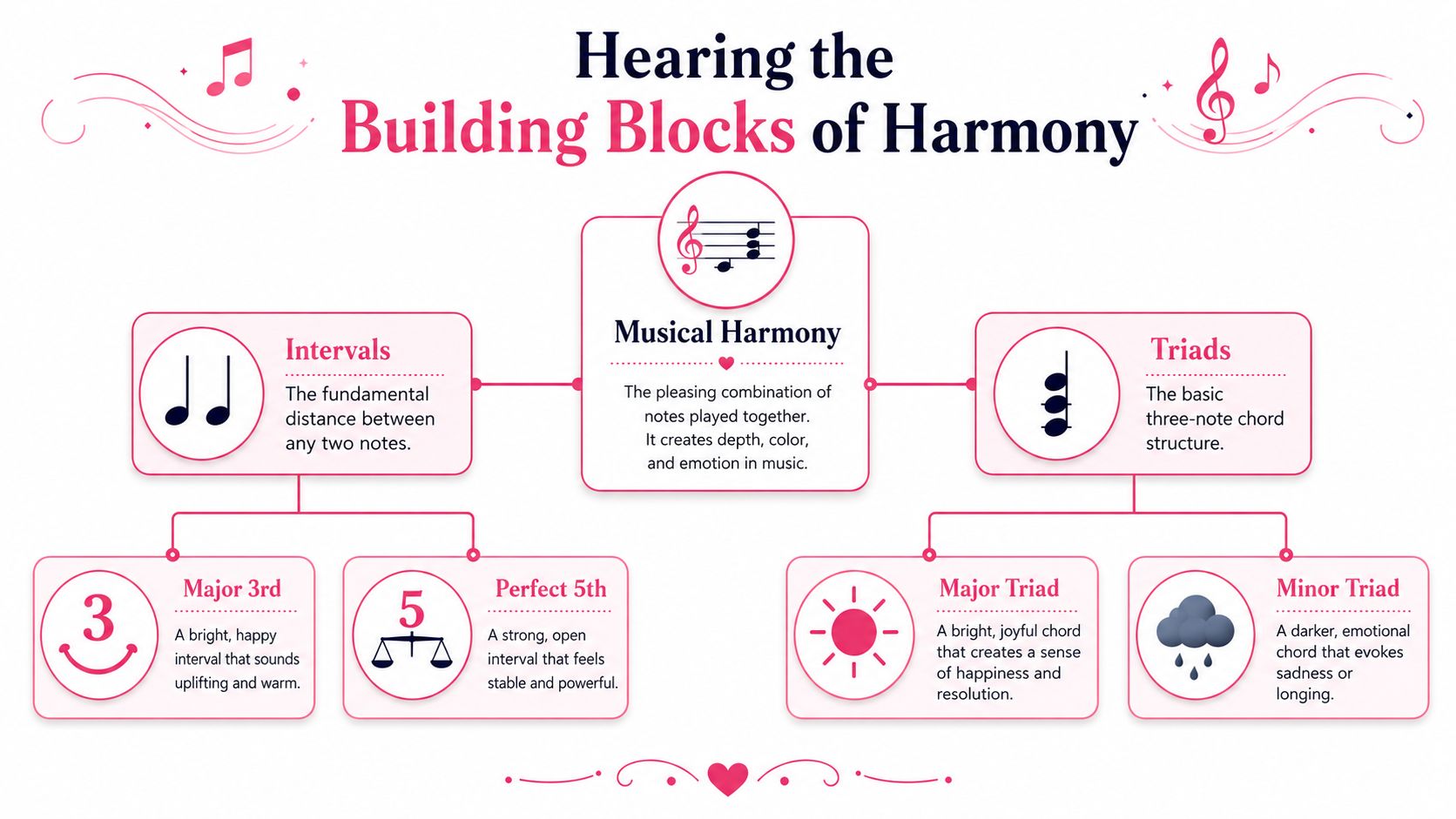
Harmony gets easier when you stop seeing notes as names on paper and start hearing them as roles. A note can sound settled, bright, tense, dark, open, or unfinished. Once you hear those qualities, three part harmonies stop feeling mysterious.
Why thirds and fifths feel stable
The first sound to recognize is the interval, which is the distance between two notes. For harmony singing, you don’t need a giant list. Start with the sounds you meet constantly.
A major third often feels bright. A minor third often feels sadder or more inward. A perfect fifth feels open and steady. Those descriptions aren’t scientific formulas. They’re listening handles. They give your ear something to notice.
If interval hearing feels fuzzy, spend a little time with this guide to intervals in music. Then sing each interval against a single reference note until you can feel its character instead of calculating it.
Practical rule: If you can hear the color of an interval, you won’t need to guess its function as often.
A simple way to hear a triad
Most three part harmonies are built around a triad, which is a three-note chord. In common-practice harmony, a triad can be voiced as a three-part system with the root in the bass and the upper voices carrying the 3rd and 5th, and smooth voice-leading aims for the minimum amount of motion between chords, as explained in Berklee’s piece on voice-leading paradigms for harmony.
That sounds technical, but the ear version is simple. When the chord changes, each singer usually sounds better moving to the nearest useful note than leaping somewhere dramatic.
Try this at a keyboard or with a drone app:
- Play a major triad: Sing the lowest note, then the middle, then the top.
- Hold one note at a time: Ask yourself which one feels like “home,” which one adds color, and which one adds openness.
- Switch to a minor triad: Notice how the middle note changes the mood more than the outer shape.
- Sing notes out of order: Root, fifth, third. Third, root, fifth. Train your ear to recognize each chord tone no matter where it appears.
A lot of confusion comes from hearing the chord as one block. You want to hear it as three jobs happening at once.
Here’s a quick listening map:
| Sound you hear | What it often means |
|---|---|
| Most settled note | Likely the root |
| Note that changes major to minor feeling | The third |
| Open, supporting tone | The fifth |
If you can hear those three roles, you’re already much closer to singing three part harmonies by ear.
A Practical Method for Arranging Harmonies
When people first try to arrange harmony, they often make it too complicated. They start hunting for clever notes before they’ve locked in the melody.
Start simpler.
Start with the melody, not with theory
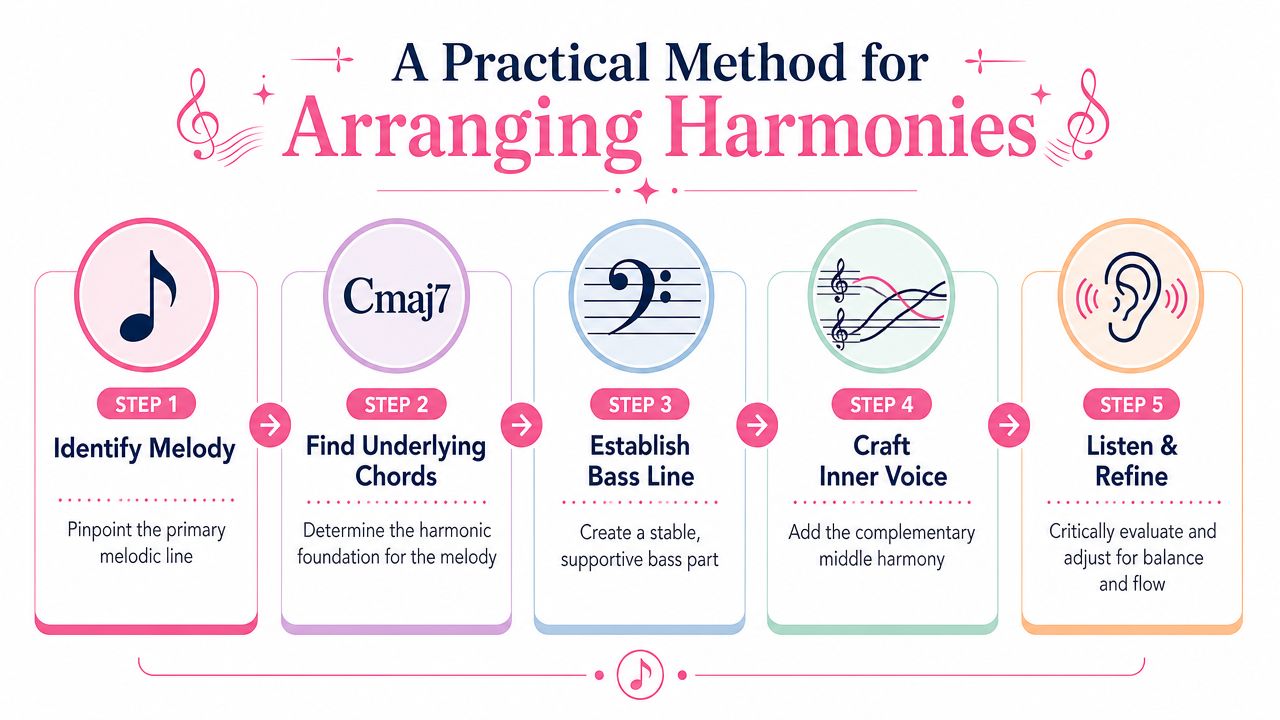
A practical method for building three-part vocal harmonies is to treat the melody as the anchor, place one harmony on the nearest chord tone above the melody, and the other on the nearest chord tone below it. For the most stable sound, arrangements often favor thirds and fourths as core intervals between the melody and harmony lines, as described in this lesson on how to create a three-part harmony.
That gives you a simple workflow:
- Sing the melody alone. Don’t touch harmony yet.
- Find the chord under that melody note. If you play guitar or piano, strum or block the chord and listen.
- Choose the nearest chord tone above the melody. That becomes one harmony line.
- Choose the nearest chord tone below the melody. That becomes the other line.
- Check the motion from chord to chord. If one part makes a big awkward jump, try a closer chord tone.
This section of video gives a helpful demonstration of hearing parts in context.

A simple example you can sing today
Use a very easy tune. Take a short phrase from “Twinkle, Twinkle, Little Star” or any melody you know cold.
If the melody note sits inside a C major chord, your available chord tones are C, E, and G. Suppose the melody is on E. The nearest chord tone above might be G. The nearest below might be C. Now you have three notes that form the chord without guessing.
Sing them one at a time, then together if you have friends or can overdub yourself:
- Melody: E
- Upper harmony: G
- Lower harmony: C
Then move to the next melody note and repeat the process. Don’t worry if the stack changes shape. Real arrangements often need flexibility. Some arrangers also move voices above, below, or around the melody depending on range and what sounds natural for actual singers, not just textbook spacing, as discussed in this practical article on arranging three-part harmony from an existing song.
If a harmony is theoretically correct but awkward to sing, most listeners will still hear it as wrong.
That’s an important ear-training lesson. The goal isn’t to spell the chord like a worksheet. The goal is to make each line singable, connected, and easy to hear.
Essential Ear Training Drills for Harmony
If you want to sing three part harmonies without freezing, train the ear before the gig, rehearsal, or recording session. Short daily work matters more than occasional long sessions because you’re teaching your brain to recognize sound patterns quickly.

Four drills that build real hearing
Try these in rotation. They connect directly to real harmony singing.
-
Drone singing: Hold one note on a keyboard, app, or instrument. Sing a third above it, then a fifth, then return to the original note. This trains stability. You stop wandering because your ear learns what “locked in” feels like.
-
Chord deconstruction: Play a simple triad and sing back one note at a time. Don’t just arpeggiate from bottom to top. Pick out the third first, then the fifth, then the root. This helps with chord recognition and makes harmony notes easier to hear inside a fuller sound.
-
Melody plus one harmony: Sing a melody line, record it, then add only the note above or below. Don’t build all three voices right away. Learning to hear one supporting line clearly is often the fastest route to being able to play by ear and sing by ear in groups.
-
Passing tone check: Between chord tones, test a moving note and ask whether it sounds calm or tense. Advanced vocal coaching advice for mixed-ability groups recommends sticking to pentatonic passing notes where possible and avoiding scale degrees 4 and 7 unless they land strongly within the target chord, as explained in this advanced harmony tutorial on YouTube.
How to practice for 10 minutes a day
You don’t need a huge routine. A simple 10 minutes a day is enough to build momentum.
Try this:
| Time | Task |
|---|---|
| 2 minutes | Match a single note cleanly |
| 3 minutes | Sing thirds and fifths against a drone |
| 3 minutes | Hear and sing chord tones from a triad |
| 2 minutes | Record one melody and add one harmony |
If you want more structure, ear training exercises for daily practice can help organize the sequence. Tools like Trill: Ear Training Daily also focus on recognizing chords, intervals, and notes through short sessions with feedback, which fits well if your goal is consistent ear training rather than occasional theory study.
Common Harmony Mistakes and How to Fix Them
A lot of singers assume bad harmony comes from choosing the “wrong note.” Sometimes that’s true. More often, the note is fine on paper and awkward in motion, tone, or blend.
What usually goes wrong
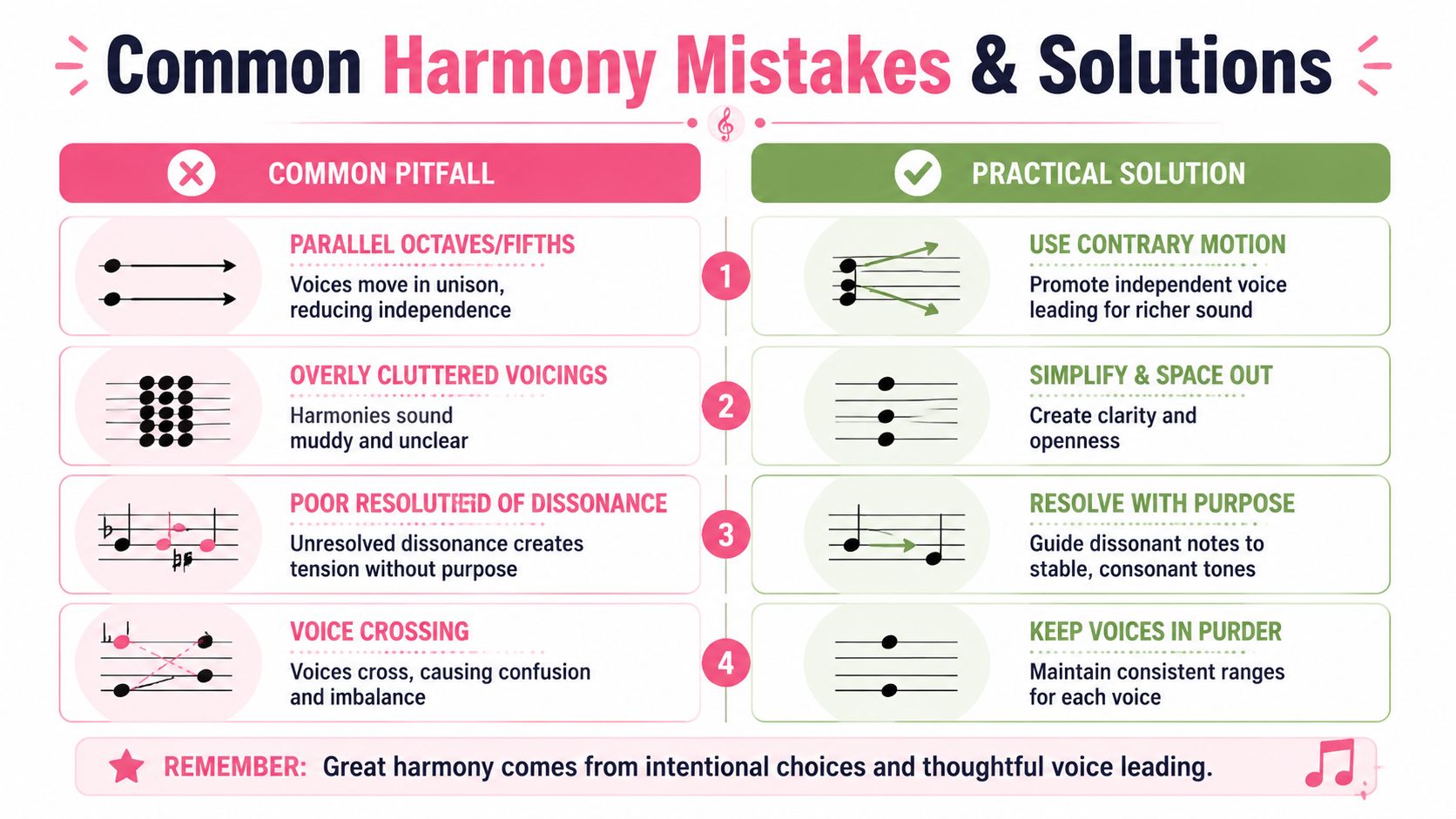
One common problem is big leaps. A singer hears a chord change and jumps to a distant chord tone instead of the nearest one. The harmony may still be technically legal, but it sounds clunky and harder to tune.
Another issue is every voice copying the same motion. In three-part writing, theorists warn against consecutive perfect fifths and octaves between voices, and the leading note usually rises by step while the 7th of a chord tends to resolve downward by step, according to this guide to three-part voice leading. You don’t have to memorize every rule to hear the effect. When all the parts move like one block, the harmony loses independence.
Singers often improve faster by smoothing out motion than by adding more notes.
Quick fixes that work in real groups
Real groups also run into performance issues that theory books often underplay.
- Mismatch in vowels: If one singer shapes “ah” and another shapes “uh,” the chord won’t blend well even when pitch is correct.
- Passing notes that create unwanted tension: In mixed-ability groups, it helps to favor simpler passing tones and be careful with notes that rub against the chord.
- Range problems: If a line sits too high or too low, people strain, and strain ruins tuning.
For pitch consistency, singers who drift sharp or flat can benefit from focused work on improving pitch accuracy while singing.
A quick troubleshooting table can help:
| If you hear this | Try this |
|---|---|
| Muddy, crowded sound | Spread the voices farther apart |
| Harsh clash on a weak beat | Recheck the passing note |
| One voice disappears | Match vowel shape and volume |
| Line feels hard to sing | Rewrite for smaller motion |
The best fix is often less dramatic than people expect. Fewer leaps. Clearer vowels. Better listening.
Making Harmony an Instinct Not a Calculation
You are in a rehearsal. The lead starts the chorus, someone above takes a clear high part, and then it is your turn. The singers who seem effortless in that moment are usually doing one thing well. They are hearing relationships fast enough to sing them in time.
That skill grows from repeated listening and singing, the same way a good driver stops thinking about every mirror check and pedal movement. At first, harmony can feel like mental math. With steady ear work, it starts to feel like recognition.
Three part harmonies stay popular because they give your ear enough information to lock into a chord without becoming overcrowded. You can hear the top, the bottom, and the note that fills in the middle. As noted earlier, that third voice is often what makes the sound feel complete. In practice, this means you are training yourself to hear where the missing color sits, not just hunting for a random extra note.
That shift matters. A good harmony singer is not reciting rules during the song. They are listening for tension and release, hearing which note sounds settled, and adjusting in real time to the lead and the other parts.
A simple daily routine works better than occasional theory binges.
Listen to a melody and pause after each phrase. Hum the chord you think is underneath it. Then sing one stable note that fits. Check it on an instrument, or by recording yourself against the melody. If it clashes, do not treat that as failure. It is ear training doing its job. Your ear learns by making a guess, hearing the result, and correcting it.
Keep the sessions short enough that you can repeat them tomorrow. A few focused minutes of intervals, chord hearing, and matching recorded harmony parts will build more usable skill than reading pages of rules you never sing. Over time, your ear begins to spot familiar shapes, like hearing an old friend’s voice in a crowded room.
If you want a simple daily system for building this skill, Trill: Ear Training Daily offers short practice focused on intervals, chords, notes, and listening speed. It is a practical way to train your ear for three part harmonies, chord recognition, improvisation, and the wider goal of learning to play by ear with more confidence.