Why Do I Sing Flat? Causes and How to Fix It

You’ve typed why do I sing flat into a search bar, which means the obvious advice has already failed you. You listened harder. You turned the backing track down. You sang the note you could hear clearly in your head, and it still came out low.
The uncomfortable part is that the note in your head was probably right. Flat singing isn’t one condition with one cure. It’s several different problems that feel identical from the inside, and until you know which one you’re dealing with, “listen harder” is a guess.
Table of Contents
- Four Patterns That Explain Why You Sing Flat
- Why High Notes Drift Toward Your Comfort Zone
- How Monitoring Hides Drift While You Sing
- Pitch Is Trainable, So Practice Ten Minutes a Day
- What Accurate Pitch Unlocks in Real Playing
- Start Tomorrow’s Ear Training Session
Four Patterns That Explain Why You Sing Flat
Most beginner advice lumps every pitch miss into weak hearing or being “tone deaf.” That framing sends people down the wrong path for months, because most flat singing starts somewhere other than the ear.
A study in Royal Society Open Science drew the distinction that matters here: pitch perception can be perfectly adequate while the brain-to-larynx mapping is inaccurate. Singers can hear a target correctly and still undershoot it, because turning an auditory image into the right vocal-fold tension and breath pressure is a separate skill from hearing the note. The same study found that some singers carry a consistent flat bias while others swing between flat and sharp across attempts, and those two groups need different fixes.
Sort yourself into one of four patterns first.
- Flat only on high or upward notes. Your comfortable range ends and the target sits just past it, so the voice lands at the highest pitch it can produce without extra effort.
- Flat on fast, staccato or descending lines. Sustained notes sound fine, then a run of quick notes sags. The ear isn’t getting a clean read while you’re busy producing.
- Flat on some attempts, sharp on others. The target wanders from take to take. That’s inconsistency rather than a fixed direction of error.
- You can’t hear a flat note when it’s played. Someone plays a note, then plays it lower, and both sound the same to you. This is the rarest pattern and the only one rooted in perception.
The five-attempt self-test
Before you practice anything, spend two minutes finding out which row you belong in. Sing one comfortable note and hold it. Play a reference note on a piano or a tuner, then match it.
Repeat that match five times and write down what happened after each attempt: flat, sharp, or centered.
Reading the result: five misses in the same direction point to control. A scatter of flat, sharp, flat points to consistency and focus.
| When you sing flat | Likely cause | First fix |
|---|---|---|
| Flat only on high or upward notes | Range and vocal-fold coordination | Transpose down, then climb by semitones |
| Flat on fast, staccato or descending lines | Weak auditory feedback | Slow the tempo and use dry, quiet monitoring |
| Flat on some attempts, sharp on others | Inconsistent matching or focus | Short daily repetition against a stable reference |
| Cannot hear a flat note when it is played | Perception gap | Interval and pitch-discrimination drills |
Start with the row that fits you most often. If two fit, take the one that shows up in songs you sing, not the one that shows up in warm-ups.
Why High Notes Drift Toward Your Comfort Zone
The pull toward the middle of your voice is physical, not laziness. This is what happens mechanically when a melody climbs.
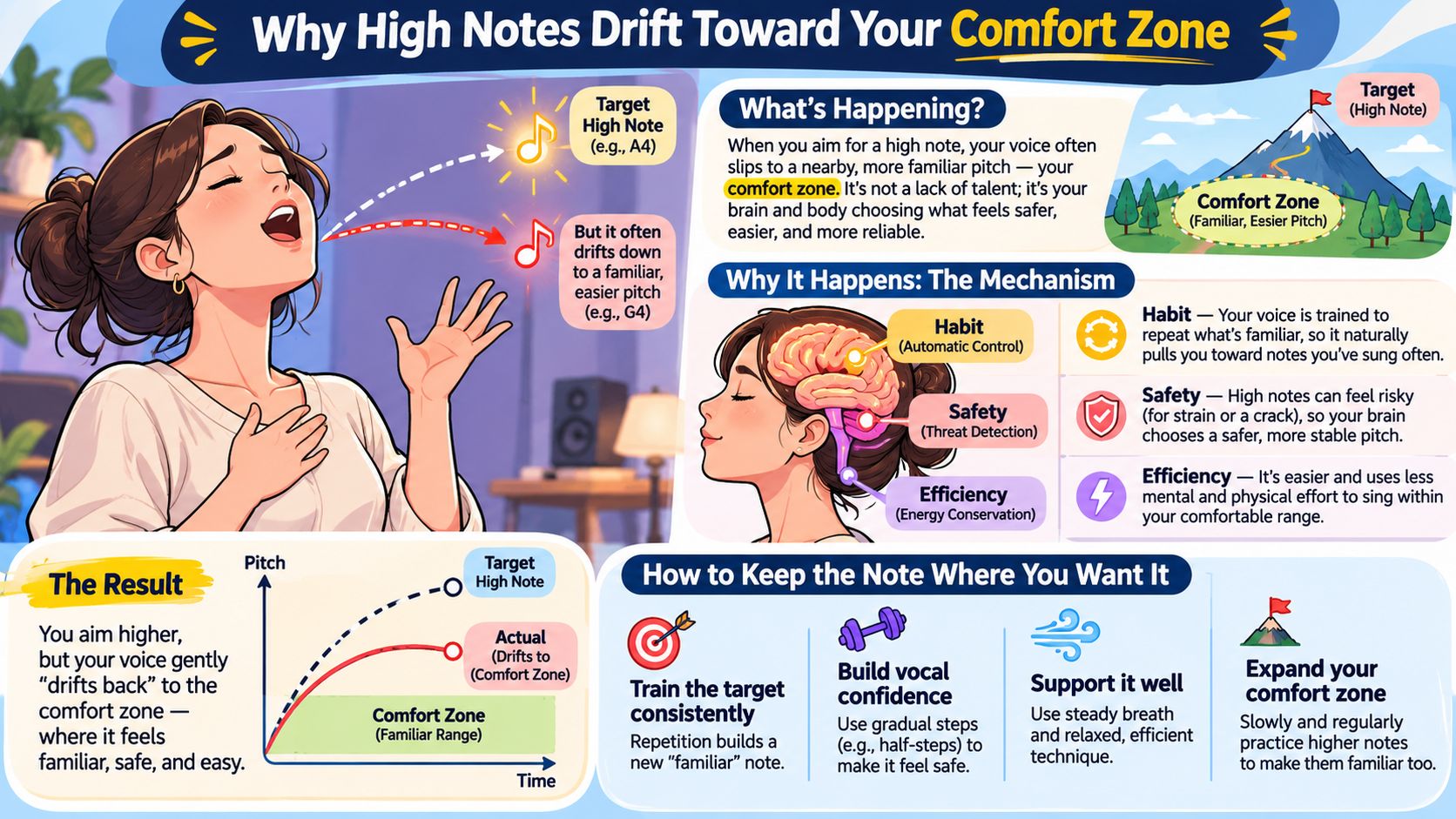
Think about reaching for a shelf that’s slightly too high. Your arm doesn’t stop where the shelf is. It stops at the height your shoulder and elbow can reach without strain, and your hand closes on air. Your voice does the same thing. Ask it for a pitch above your usual speaking range and it delivers the nearest note it can produce with the muscular effort it already knows.
That isn’t just how it feels. In a controlled study reported in Attention, Perception, & Psychophysics, singers tended to produce notes below higher-pitched targets and above lower-pitched targets, a systematic bias toward a comfortable midrange rather than random error. Related work in the same paper found sung notes were pulled toward each singer’s habitual pitch, likely because that pitch needs less muscular effort from the larynx, and accuracy was best for notes inside the singer’s spontaneous range.
Three moments raise the risk: a melody that moves upward, a target sitting near the top of your current comfortable range, and a phrase that starts before you’ve established the starting pitch.
Why the tuner alone won’t fix it: you can stare at a needle showing you 30 cents flat and still not know which muscle to change. Range work comes first.
Work the problem in this order.
- Transpose the passage into a key you can already sing in tune. The shape of the melody stays the same while the demand on your range drops, so you can practice phrasing without fighting pitch.
- Sing it there until the sound is stable. Stable means three clean passes in a row without watching a display.
- Climb one semitone at a time. Move the passage up a half step and repeat the three-clean-passes test. A semitone is small enough for the larynx to adjust without bracing.
- Warm up with sirens, lip trills and slow five-note ascending patterns. These train smooth adjustment without volume. Pushing louder to reach the top practices tension instead of coordination.
- Record the first attempt, then compare the sustained pitch with the target in cents. A steady negative deviation across several days confirms a production-range issue rather than a hearing one.
Match the sound first, then look at the tuner. If you’re unsure where your comfortable range sits, working out your voice type gives you a starting point before you transpose anything.
How Monitoring Hides Drift While You Sing
Small downward drift is easy to miss while you’re singing, and your setup decides how easy. If you can’t hear the moment your pitch sags, you can’t correct it in the moment.
The clip below shows the basic loop: a reference tone, then your voice against it.

Four things routinely hide drift from your own ears. Loud accompaniment masks the upper harmonics your brain uses to judge pitch. Heavy reverb smears the note’s ending, which is exactly where sag shows up. Closed headphones that seal out your natural voice remove the bone-conducted feedback you rely on. Delayed monitoring makes you sing the previous note instead of the current one.
The amount of feedback matters as much as the quality. Research on pitch-matching and feedback found accuracy depends on training, tempo, articulation, melodic direction, tessitura and how much external auditory feedback the singer receives, with descending passages sung quickly and staccato especially inaccurate among non-professional singers. A second experiment in the same body of work found hearing a synthesized voice alongside your own could hurt poor-pitch singers while helping stronger ones. More feedback isn’t automatically better. Matched feedback is.
The order to practice in
- Use a dry, quiet monitoring setup. No reverb, backing track off or very low, one earbud out if you’re wearing headphones.
- Sustain one vowel at moderate volume against a reference tone. A single vowel takes lyrics and consonant timing out of the equation.
- Alternate hear, pause, sing, check. Play the reference, stop it, sing from memory, then check. The pause is what forces an internal target instead of a copy.
- Move to two- and three-note intervals. Small intervals make a small error audible immediately.
- Add lyrics, faster tempos and descending phrases last. Those are the conditions where untrained singers drift most, so they belong after the basic loop holds.
Ear first, screen second: sing the note from memory, then look. A moving pitch line tempts you to chase the display instead of forming the target in your head.
If you can’t produce a reference note without an instrument in front of you, finding a note by ear is the companion skill worth building in parallel.
Short daily repetitions beat long sessions after vocal fatigue sets in. Ten minutes when your voice is fresh does more than forty minutes of increasingly flat singing.
Pitch Is Trainable, So Practice Ten Minutes a Day
Here’s the part that should settle the “maybe I’m just not musical” question. Pitch discrimination responds to training fast, in adults, without any special gift.
What training actually changes
A study summarized by Science.gov compared pitch-discrimination thresholds in 30 classical musicians and 30 non-musicians. At the start, the non-musicians’ average thresholds were more than six times larger than the musicians’ thresholds. After only two hours of adaptive pitch-discrimination training the gap was still about fourfold, but a separate group of eight non-musicians practiced for a total of 14 hours and reached levels comparable to those measured in the musicians.
Fourteen hours. Not a lifetime, not perfect pitch, not a childhood of lessons. That result also answers the fourth pattern from the table, the one where a flat note sounds identical to a centered one. Pitch-discrimination drills go straight at it.
There’s a second effect worth knowing about. A controlled study on learning melodies by ear trained musically naive participants to play a short piano melody by ear, and found that notes which had started as ordinary sounds became physically meaningful after training. The study also found preliminary evidence that listening to a newly learned passage could improve motor performance without extra physical practice.
That’s the ear-to-hand link, and it’s why the routine below mixes singing with finding notes.
Consistency is where many lose the gains. In our onboarding survey, the most common reason musicians gave for not improving was that they can’t focus (30%).
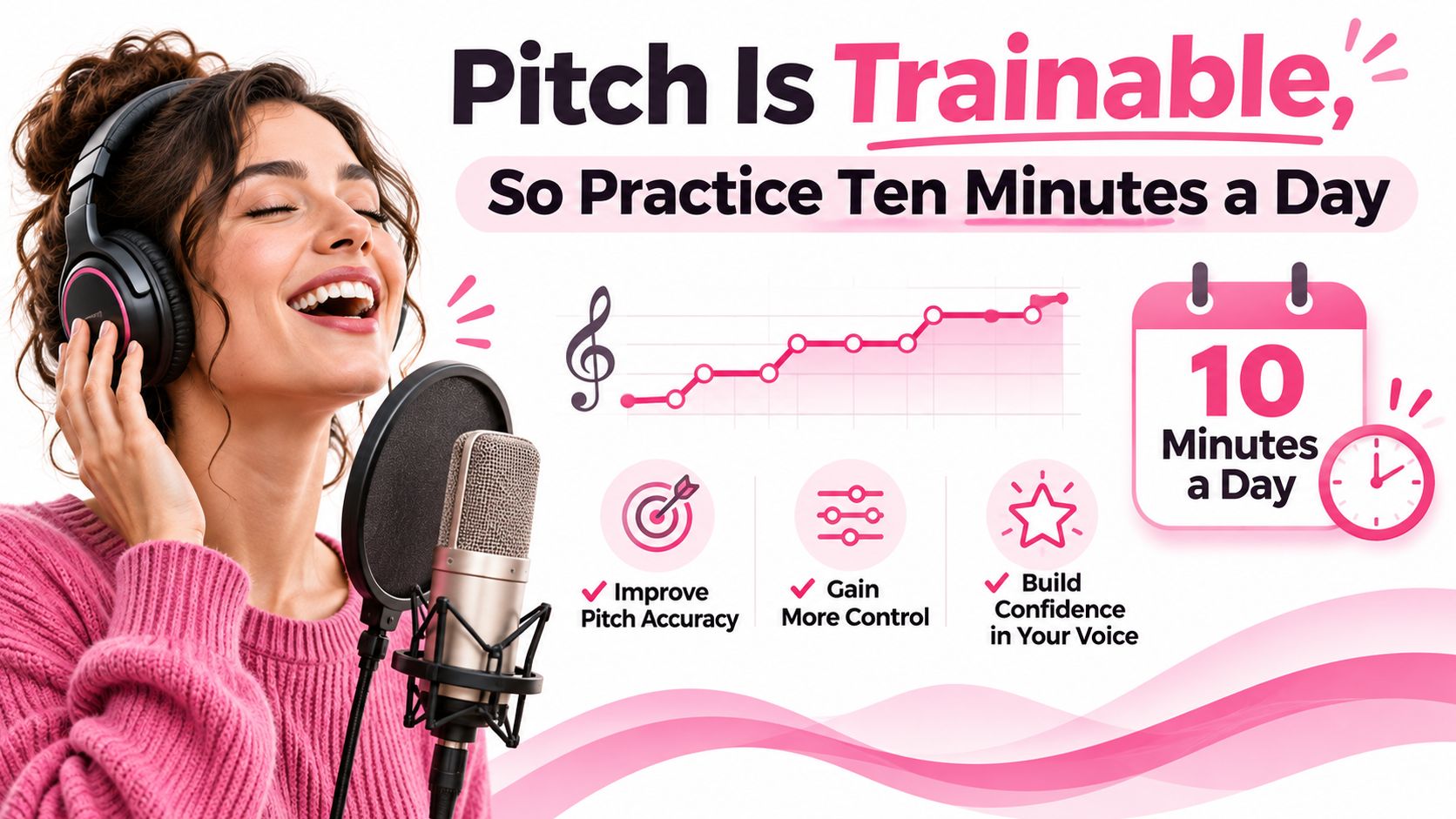
The ten-minute daily routine
- Warm up, two minutes. Sirens and lip trills. They loosen the larynx without asking for volume you’ll need later.
- Sustain one note, two minutes. Match a comfortable reference tone, hold it, listen for the two pitches fusing, release, repeat. This builds the habit of landing rather than sliding.
- Two-note intervals, three minutes. Play a pair, say higher or lower out loud, sing the second note, then check it. Naming the direction first separates hearing from producing.
- Listen, pause, hum, play, two minutes. Hear a short phrase, hum its first note, find that note on an instrument, then reproduce the phrase. This is playing by ear in miniature.
- Log, one minute. Write the day’s best attempt and the direction of each miss. The log turns vague frustration into data you can act on.
Fix the time. Same ten minutes, same slot every day, before your voice tires and before your attention drifts.
What each block buys you: the warm-up buys coordination, the sustained note buys accuracy, the intervals buy discrimination, and the listen-hum-play cycle buys melodic recall.
What Accurate Pitch Unlocks in Real Playing
When a melody is clear in your head, can you find its notes with your voice or hands? Accurate pitch helps connect what you hear to what you can play, whether or not you have sheet music.
Adults with musical training distinguished tones differing by an average of 5.46 Hz, compared with 10.92 Hz for adults without musical education, according to a 2024 study in the European Archives of Oto-Rhino-Laryngology. That is twice the resolution, though this comparison of trained and untrained adults cannot show how much of the gap comes from training itself.
That finer pitch distinction helps in several practical ways. To find a melody, hum its first note, then look for it on a keyboard. You can check each note against the sound in your head instead of searching at random.
For chord recognition, listen to how a chord changes the feel of a song. Notice whether the next chord sounds higher, lower, or settled in place. This helps when learning a song without written chords.
The shift that matters: ear training helps you move from copying written notes to playing by ear, giving you more options when there is no chart on the stand.
Improvising becomes easier when you can hear a musical idea, sing it, and keep track of its pitch against a backing track. During rehearsal, noticing your own pitch as you sing can help you correct a drift before it affects the group.
Perfect pitch is not required. Relative pitch, hearing how one note relates to another, supports melody, harmony, and chord movement. It is like using landmarks to find your way: you do not need to know every location by name if you can hear how each note connects to the next.
Start Tomorrow’s Ear Training Session
Take the row from the table that matched you most often and start there tomorrow. Day one is one action long: sing a comfortable note, match a reference tone, and write down which way you missed.
Put ten minutes in the same slot every day. Among the roughly 60,000 musicians in our onboarding survey, 78% said focus, consistency, structure or time is what blocks their progress, which is exactly why a fixed short session beats a long one you keep postponing.
Trill: Ear Training Daily is built as that daily system, an ear training app covering chords, intervals, perfect pitch and melodies, designed as a 10-minute daily practice. Its vocal training has you sing a note while seeing your pitch live, and the microphone is used only to analyze pitch in real time. Your voice is never recorded or stored.
Keep the order ear first. Sing from memory, then check the screen, so the display supports the target you built rather than replacing it. Log three things each session:
- The target note and register: so you can spot a pattern across the week.
- The direction of each miss: flat or sharp.
- The size in cents: from a tuner reading, taken after you’ve already judged it by ear.
Misses that shrink while staying in one direction mean control is improving. Misses that scatter mean you’re still hunting the target, so slow everything down. If you want a set of exercises to plug into that slot, these vocal ear training exercises follow the same ear-first order.
Tomorrow, before anything else, sing one note and check which way it went. That single data point decides what you practice next.
Trill: Ear Training Daily gives you a place to run that ten-minute routine every day, with short sessions covering chords, intervals, perfect pitch and melodies, and a vocal mode that shows your pitch live while you sing so you can see the direction of each miss instead of guessing at it. Daily challenges, streaks and feedback after every attempt make the habit stick even when motivation dips, which is the part most singers struggle with. Start your first session at Trill: Ear Training Daily.